And It Goes Slow
A restless year.
One of the questions asked of you on the PHQ-9 is, in the last two weeks, have you had trouble concentrating on things, such as reading the newspaper, or watching television.
In the last two weeks, it asks, have you moved or spoken so slowly that other people could have noticed—or, the opposite. Have you been so fidgety or restless that you have been moving around a lot more than usual.
The GAD-7 asks, in the last two weeks, have you had trouble relaxing.
Have you been so restless that it’s hard to sit still.
Several days? More than half the days? Nearly every day?
A restless year.
I often think about propulsion. There is an entropy to our existence, but within that, we find ourselves within this forward momentum. Relationships and our dynamics with others. Work. Interests, or passions. Extracurriculars. The day begins. The day ends. We continue moving forward. We ease into this rhythm that becomes our lives.
There is this restlessness, though.
Because in that propulsion, and in the entropy, we can be and often are, asked to grow. To change. The Work on the self never ends. Self-discovery. Improvement. And there is a kind of restlessness. A fidgeting within ourselves. A writhing or thrashing, perhaps. We no longer have the heart, or can barely feign enthusiasm for the duties asked of us at work. The job itself becomes a source of resentment. We lose interest in our interests or passions—burned out or frustrated. Uncertain what point there is, if any, to keep trying to enrich ourselves this way. We, despite our past efforts to remain connected, lose touch. Relationships suffer. Dynamics shift. In the entropy you are asked to grow or to change but what happens when you do not grow or change in not even the same way but not even at the same pace and what if you are then confronted by and are asked to reconcile with the fact that you can outgrow a person.
A restless year. And I had at one time convinced myself that there was a space that existed between grief and joy. Between sorrow and jubilance. And I spent a long time trying to find it, or, I spent a long time waiting for it to find me. It never found me, or, I eventually gave up looking for it. And you do eventually give up on people. A person. You realize that when the sky opens up and it begins raining even though in the distance the sun is still shining in the late afternoon sky, and you’re stuck in traffic on a bridge as you try to exit a city in which you do not live, and you, in that moment, must acknowledge that sometimes, the last time you see a person is actually the last time you are ever going to see them.
We fidget and thrash within ourselves. Writhing. This propulsion towards something perhaps larger. A want. Something unknown. But there is this feeling. Several days? More than half the days? Nearly everyday?
The last question on the PHQ-9 asks if you checked off any problems, how difficult have the problems made it for you to do your work, take care of things at home, or get along with other people?
Not difficult at all? Somewhat? Very difficult?
Extremely difficult.
A restless year. And what I find is that we are often both running away from something while, at the same time, running towards it and that something is almost always the exact same thing and that something is more often than not a part of ourselves.
*
And I am always talking about The Kingdom of Desire.
About want giving way to more want. About how, in contemporary popular music, when a song hinges on this conceit, we are brought to an edge. A moment just before.
How gracefully can you sustain a feeling. That feeling. How can we, as listeners, or an audience, be suspended in this space that exists outside of, or adjacent to, something of great consequence.
It cannot be easy to construct a world within the confines of a pop song—to build something vivid and compelling, and perhaps personal, or revealing, within the boundaries of length, and of rhyme. Melody. It is not only a matter of finding the right words to describe something, but can you take those words and shape them, or work with them, and articulate what you wish to within the right number of syllables. It’s impressive, really, the more I give it consideration.
Certainly not easy, but often made to look effortless.
And there is a world built—one that is complicated, vibrant, and alive, spanning across the entirety of Hana Bryanne’s second full-length album, This is Not A Place of Honor. Narratives that are personal, yes, certainly, but only revealing just enough, with many moments, within these songs, existing in this kind of poetic ambiguity. Single lines are often rich enough in imagery to craft evocative portraits of people and places. Events. Experiences. But there is this intentionality to Bryanne’s writing here—the stories she tells and how she wishes to tell them—where some elements remain murky. Like something we are on the cusp of understanding. A secret, whispered, that we keep leaning ourselves further and further forward in an effort to better hear.
And there is an edge we are brought to. The moment just before. Sometimes the moments long after. Our desire leads us towards something that is just out of reach. Someone we can see but we cannot stretch ourselves out far enough to grasp them. There is a world built around these fragments. These instances. Reflections on choices, or decisions made—never asking of us to determine, as listeners, if those were the right or wrong. This is Not A Place of Honor is not an album that is preoccupied with answers. There aren’t answers, easy or otherwise, which is why it is an album that, throughout its ten songs, with great care and accuracy, offers a reflection of the human condition.
It’s an album that, in confronting the choices and decisions made, cannot be bothered with the notion of regret. Rather, it depicts life. A life. Hers. Yours. Mine. We are living. We live.
I had convinced myself, at one time, that there was a space that existed between grief and joy. Between sorrow and jubilance. And I tell you all of that to tell you this—This is Not A Place of Honor finds that space and not only exists within it, but thrives within it. Because there is a difference, I think, between sadness and sorrow. A thin line. Bryanne, throughout Place of Honor, in depicting this sorrow chooses to acknowledge it, but in doing so, it is accompanied by a buoyancy in the arranging and instrumentation, which results in the creation of a fascinating, beautiful, and stark juxtaposition.
*
Something that I marvel at is how, in time, you can hear the growth, or the development, of an artist. For there to be so much promise, or potential—something arresting and captivating resonating through a debut record, or within early material. And for that potential to be fulfilled, and that promise to be kept, on a subsequent release.
For things to be even more captivating to hear, and arresting to consider. To feel a sort of surge, and a reminder of why, originally, you were so moved or interested in the artist.
I marvel at how, in time, you can hear an artist becoming more confident. Bold. Thoughtful, or sharper in their writing. And this is not to say that on her 2023 debut full-length, Dollface, Hana Bryanne was not a thoughtful or sharp writer. Or that it is not a bold collection of songs. Or that it, or she, lacked confidence. That is simply not the case. It is a remarkable album—haunting and vivid in the narratives depicted. In everything it chooses to confront, rarely is there an album so unafraid.
And in that, direct. Dollface is such a direct album. Startling, at times, in just how frank it can be.
And I tell you all of that to tell you this. This is Not A Place of Honor is an enormous achievement—it’s poignant and reflective. It’s clever. There are moments where it is surprisingly funny. That is life, though. How it’s depicted. Hers and yours and mine. We live, and we do try as we are able to find humor in places unexpected.
It’s an album that in all of the places it is willing to go, and what it wishes to explore, it recognizes a sorrow that is deep within but in the same breath, is not willing to surrender entirely to it, and it is a kind of rare album that exists where jubilance and sorrow do not coexist but rather converge.
It’s a collection of songs that, from the moment it opens, until the final notes, you can hear Bryanne’s growth as a songwriter. Bold and thoughtful, yes. Her observations are razor sharp. Intently focused and well crafted. Entire worlds are built within these songs and she places us deep within them. An edge we are brought to. The want that gives way to more want.
That something or someone who is just out of reach, even though we can see them but we are unable to stretch ourselves out far enough to grasp them.
This is Not A Place of Honor, in myriad ways, is an expansion, and a further development, of the narratives and worlds that Bryanne worked on shaping in the songs on Dollface.
Because there are these ideas, and this imagery, that recur between the two. There are the more apparent threads that are used to connect the songs within each album, yes. Of course. An intentional, and imperative cohesion. But there are these echoes between the two. Often small. Phrases that are revisited or eerily familiar portraits that have found their way into her writing. I am thinking of the way Bryanne resigns and confesses, “Somewhere high over Lake Michigan I am contemplating suicide, thinking of you calling me her name while the baby cried,” on Dollface’s “Lake Michigan.”
And here, she returns to imagery that is similar. The implication. It is woven in, and in doing so, Bryanne develops it further into a portrait still evocative but one that is also much more robust, during the bright, folksy chorus to “Benchwarmer.”
“It was hard enough when Rachel had the baby—getting real good at tugging the leash,” Bryanne exclaims. “You know the greatest loves have already gone. The greatest line’s already in a song. And it was going fine,” she continues. “At least until you met me—getting real good at keeping the peace. I’m waiting, baby, for you to come home to me.”
Something that I marvel at is how, in time, you can hear the growth of an artist. The places they wish to take us. What they wish to reveal, or tell us. And how they want to do so. How they may have done so previously, and what has brought them to how they would tell us today.
What challenges does the growth, or maturation, present them with, as the songwriter. What challenges might present themselves to us, then, as the listener.
In an exchange about This is Not A Place of Honor, Hana Bryanne tells me that she has always loved country music. And the reason this is important is because her growth as a songwriter over the last few years, is apparent, yes. You can hear it in her lyricism. It is also apparent in how the album sounds—the instrumentation, and arranging, favored. It’s an inherently twangy record—tinged with a folksy drawl, and steeped in country and western inspiration.
And there are a few big, pop-leaning moments on Dollface—the rollicking “Suzannah at The Wedding,” and the gossamer textures of “Clementine.” But overall, it is a chilling album. Chilling of course in what Bryanne details within her songwriting, but it has this icy sound, and feeling to it—the cavernous feeling of the opening track, “Doing The Play,” and the mournful, eerie crests of feedback of “Visions.” It’s never inaccessible. No. Not chilling enough to keep you at an arm’s length. But there is this underlying spectral nature to it that creates a sense of unease.
Bryanne explains that the twang of her songwriting was more present in the demo recordings of the material that would end up on Dollface, but that element was “put to bed on the studio versions.”
And you can hear it, if you think about it. The enormity and urgency, and the melody, within the chorus of “Suzannah at The Wedding” has a kind of twang, or country flair to it, even though it is accompanied by something more bombastic and crunchy in sound. The narratives themselves on Dollface also give it away, I suppose. Bryanne’s deep interest in country music. The kind stories told within country and western songs. The narratives, at times tumultuous, that unfold against the mournful sound of a pedal steel and the strum of an acoustic guitar.
“I wanted these songs to live closer to the original demos this time,” she told me. “I think I’ve grown as a songwriter and wanted to give my lyrics a chance to appear just as they are, without anything getting in the way.”
*
I’m where you left me last September. You might not—but I remember
The past beats inside like a second heart. And there are these moments that a part of us remains within.
The tone, or at least the aesthetic, of This is Not A Place of Honor is set within the first few seconds of its opening track, “Ain’t It Just.” There is an enormity to it—the song, as it unfurls over roughly five minutes, does ascend to truly towering, emotionally stirring heights. But even as the muted count-off on the acoustic guitar gives way to these huge strums—the strings resonating, with something unspoken and pensive hanging in the space that forms as one chord shifts into another- there is a rippling tension. The hint of restlessness. The need to go somewhere. The need to say something.
“Ain’t It Just,” with ease, finds a groove, and latches onto that, riding it until the final moments—the taut sound of Bryanne’s acoustic guitar punctuated with a clean-toned electric guitar playing a country-tinged lead melody over the top of it, before the other elements find their way in. There’s something warm about it, yes. An invitation. But what is striking is this immediate, somber feeling. The sorrow. We’re brought to an edge—in the fragments that Bryanne unrelentingly depicts, and in the remorse the song just hoovers on the cusp of.
The additional instruments come in at the moment you expect them to, serving as a means of emphasis—the rumbling bass notes, the rustic plinking of the banjo, crisp, steady percussion, and the sweeping grander of a string accompaniment, all swaying in a way that feels organic, or loose, but there is this precision to it all, working towards the boldness of the chorus where everything starts to build and the tension is briefly released, or when the song does truly soar, as all the elements are layered, then swell dramatically in the dizzying, gasping climax.
And there is a literacy, and a poignancy to Bryanne’s writing. I mean, there always has been. She found her way, thoughtfully and with grace, through the darkness detailed on Dollface. Throughout This is Not A Place of Honor, she has the preternatural knack for keen, articulate observations and reflections, both of herself, and others—pulling together specific fragments, or instances, or encounters, and in doing so, starts building the world of the album. One that is vivid, and perhaps difficult at times. But is incredibly real.
Bryanne describes a man with just two words in the opening lines to “Ain’t That Just,” and in doing so, effortlessly conjures something. Or someone. A portrait fully realized. “Ain’t that just my type of guy,” she asks with a sigh, and a smirk in her voice. “All lithium and turpentine,” she continues before referencing familiar imagery for the first time on this record. “Hold the baby, start to cry—where have you been all of my life.”
And there is, across the album, and specifically here, on “Ain’t That Just,” Bryanne is not looking for resolve—that is the thing that makes this such a human, honest record. One that does offer this accurate, at times unflinchingly so, reflection on the human condition. Because there sometimes isn’t a resolution. Questions asked, with no answers, easy or otherwise. That is life. Hers, and mine, and yours. Living. Thrashing around in these moments presented, oscillating just along the edge of sorrow and remorse. Understanding there is a difference between bitter and bittersweet.
I often think about the way a lyric can be delivered. The inflection used. The way the syllables might fall, or tumble, into the music below. And what ultimately might be left unsaid, but in that, conveyed. Or understood. And there is an impassioned way that Bryanne can, and regularly does, emphasize something specific within a line—in “Ain’t That Just,” she does it when the song arrives at its chorus, singing the album’s titular expression in a way that I can only describe as a warning to heed. “Secrets kept are cannon fodder,” she proclaims. “This is not a place of honor.”
And there is a kind of ownership implied within that warning. A reclamation of one’s missteps. The sorrow, and the remorse that we teeter on the edge of. An acceptance of sorts. That this is where life has brought us. To this moment. We have to live in it.
Throughout This is Not A Place of Honor, Bryanne uses humor as a means of breaking the tension in her narratives. Often surprising, it often happens quickly, with lines often coming as asides. A little wink to the listener. Or there’s a kind of sardonic nature to them. A bit of a scoff. Or a little self-effacing. “Secrets kept are cannon fodder,” she repeats near the end of the song before resigning through gritted teeth. “At least I’m always someone’s daughter.”
The past beats inside like a second heart. And the idea of the past, how we carry it, is something that Bryanne explores, often indirectly, across the album. What we are haunted by. And how we are haunted by it. There are these moments, throughout our lives, that a part of us remains within.
And there is this idea of longing, or yearning. Want giving way to more want. A chase. Desire seemingly just slightly out of our grasp. The edge of something that we are brought up to, uncertain what, if anything, will happen next.
The way that the concept of The Kingdom of Desire works within these songs is through adjacency. On the outside of the aftermath, looking back in. Events continue to replay though we keep stumbling forward as best as we are able. And there are plenty of places on This is Not A Place of Honor, where there is a desperation that comes through. An urgency. That isn’t the case here. Not really. There is an immediacy, sure. You can hear that rippling in the tension. But more than anything, there’s an exhaustion and a frustration. A restlessness. A warning to heed. You can hear it in the way Bryanne sings one of the lines that is amongst the most overtly resonant.
“I’m where you left me last September. You might not—but I remember.”
*
I was 12 years old when my parents divorced—and in roughly the year leading up to it, my mother started listening to country music. The radio in her old gray Pontiac hatchback tuned to the country station that was based out of the next largest city to the east of where I grew up. The CDs and cassettes she started buying were from artists popular at the time. Garth Brooks. Alan Jackson. George Strait. Trisha Yearwood. Faith Hill. Reba McEntire. Names that are still popular or at least known, today. Legacy acts I suppose. Many of them relatively young, and fresh-faced then, in 1994.
I was unwilling to appreciate it at the time. Scoffing at the notion of it. These artists and their songs. When I was a teenager, I responded similarly to pop music. Britney Spears. Backstreet Boys. The faces I saw regularly on Total Request Live. The songs, and the voices, that were ultimately inescapable. So ubiquitous for so many years.
You come around in time, is the thing. Or at least I did. Because these songs and these artists were the soundtrack to my adolescence. There’s a comfort, I think. Familiarity certainly. You find a way to understand what it was that others heard, and accept the emotional resonance and the connection.
You come around in time. At least I did. You listen differently. With more thought.
And in listening differently, and with more thought, an element you can perhaps have a greater appreciation for, and if not an appreciation then at least an acknowledgment, is the narratives. The storytelling. Country songs often have a story to tell. An antagonist. Someone who is just out of their reach. Want giving way to more want. A moment and an edge we are brought to.
Bryanne, in her songwriting, is a storyteller. She had stories to tell—incredibly personal on Dollface, and here the stories or narratives are no less personal, but one of the most wondrous things about This is Not A Place of Honor is how expansive these narratives are. There is an undeniable enormity to the characters and settings. Their circumstances. Just incredible in how well-developed everything feels. The stakes are high.
And there is, of course, a twang, or a tinge of country, that you can hear throughout the record but there are places where Bryanne does lean further into that aesthetic—in arranging and structure, and also in the writing and story that is crafted and unfolds within the boundaries the song has set. “Benchwarmer,” the album’s third track, is one of those moments.
Opening with huge, pensive acoustic guitar strums, “Benchwarmer” is quickly underscored by the presence of a mournful pedal steel, the shimmering flourishes of a very crisp, clean toned electric guitar, and the slightly dissonant, rootsy bowing of a fiddle—with the piano, and the snap of the snare drum coming in right on cue, guiding the song into a bouncing rhythm that you do easily find yourself nodding your head along to.
And there is this sense of restraint that you can feel in “Benchwarmer,” even after all of the elements arrive, and the song heads into the immediacy, and pleading, within its chorus—there’s just the hint of an ascension. A lift. Though within this moment, and with the grip that is held elsewhere, even when Bryanne becomes more impassioned in the narrative, and the delivery of, there’s never a risk of the song getting away from her.
There is a kind of dramatic flare to the imagery as this song unfolds—opening with a car broken down on the highway, Bryanne conjures something vivid in a single line. “I called you from a payphone, ‘cause your number’s engraved my headstone,” she sings.
And there is a kind of desperation to what is to come in “Benchwarmer.” A yearning, and the melancholy that comes with that. An urgent plea. And what is most surprising is that there is this small sliver of hope that’s present, that Bryanne, as narrator or protagonist, continues clinging to.
“I hate interrupting your dinner production but I’m begging you to throw me a rope,” she confesses in the moment before the chorus. “And it was hard enough with Rachel had the baby—getting real good at tugging the leash. You know the greatest loves have already gone. You know the greatest line’s already in a song. And it was going fine—at least until you met me. I’m getting real good at keeping the peace,” she continues, before we hear the convergence of that hope, and that pleading. “I’m waiting, I’m waiting, I’m waiting, baby, for you to come home to me.”
The song ends both in a moment of cruelty, and of frank self-deprecation, and on that sense of hope, even if it is a story she is telling herself in order to survive. “He was nice enough but just a little boring,” Bryanne sings, dismissive of another romantic prospect. “Making my mind up there on the street.” Then, later, “I was so on fire, the bench that I’ve been warming—nothing but strikes from there on my knees,” before emphasizing the desperation, and this undying desire, by singing, “I’m waiting,” nine times. “I’m waiting, baby, for you to come home to me.”
At the end of the first half of the record, there is a surprising boldness to the way Bryanne explores a different facet of country music—the depiction of scorn. The result, “Miss Wisconsin,” is the album’s most rollicking, freewheeling moment—playful, smirking, and flirtatious in the way it slinks, and then it careens into a moment of shout-along bombast. Pulsating and lively, moving with a relentlessness in the literal and figurative give-and-take it is painstakingly structured around.
From the instance it begins, it is apparent that “Miss Wisconsin” is on its way toward something larger—the jangly percussion shuffles underneath while everything is propelled forward through the voluminous, crunchy, distended strums of the guitar, as Bryanne bellows over the cacophony, which is punctuated, and becomes a little more orderly, the further into the first verse we’re taken, by a lead guitar melody, and wonky flourishes from the pedal steel.
Across “Miss Wisconsin”’s near five-minute running time, this kind of raucousness is sustained for nearly all of it—the enthusiasm receding only slightly, for a moment or two, in the latter half. And it is, of course, a song that is crafted around a compellingly told narrative, but it is a narrative that is guiding us towards the chorus. Bryanne is sassy, bratty, and confrontational in her writing here—cleverly turning it into a dialogue of sorts, barreling towards this place that is extraordinarily fun. The kind of shift from verse, to chorus, that knows exactly what it is doing—with the instrumentation dropping out, save for the muted chugs of the acoustic guitar and a stomping percussive rhythm with Bryanne allowing her words to tumble rapidly. “Are you the Queen of California with your armchair takes,” she asks. “Sing along to records that you said that you hate.”
The rest of the instruments, then, kick back in, and push the rest of the chorus into this moment of unhinged jubilance. “Nothing’s gonna happen til you lower the stakes,” Bryanne warns. “Me and Miss Wisconsin, going 95—flying.”
The way humor is used in the narrative of “Miss Wisconsin” is fascinating. It’s scathing at times, and there is this boisterousness to how Bryanne depicts herself, and how she describes her unlikely counterpart, before arriving , in the end, at a seething frankness.
“I’ve been a scene maker. I’ve been a ball breaker. I’ve been a bitch in every life,” in an opening line that commands attention. “I’ve been a shadowboxer—out of my ass talker. I was raised being right.”
There is a kind of humbling, of sorts, that occurs, within the story as it unfolds, in the exchanges had between the two characters, or these personas that Bryanne adopts. “‘I think I’m gonna kill myself,’I tell her,” she sings in the lines leading up to the chorus, then answering herself, with, “‘Yeah right,’ is her reply,” with the vocal melody returning with a different observation in the second verse. “I think I’m gonna call him when we get there—she says I’d like to see you try.”
And there is a shared antagonist at the center of the conflict and scorn in “Miss Wisconsin.” “His name still sends me running,” Bryanne concedes in the second verse. “Grasping at straws to recall just what I liked about him.” And she returns to this scorn with even more vitriol, in the song’s final exhalations, but before this, her eye, and the narrative, turns to the titular persona. “I wish that I knew the places she’s been,” Bryanne muses. “A mean, damn drunk,” she continues, before uttering a lyric that walks the line between cutting and good-natured. “And a Midwest ten. But life is long and strange, so I can only hope she’ll tell it all again.”
The finale of “Miss Wisconsin” careens towards this highly charged moment of catharsis for Bryanne—a letting go, as much as one is able, of the memory of this individual. “I hope you become the smartest man in the room,” she sneers. “I hope you find someone to make into a version of you,” she continues. “I hope you finally finish that worthless degree—that you can’t turn a corner without seeing pictures of me.”
And there is a surprising frankness, throughout Bryanne’s writing, but especially on This is Not A Place of Honor, to how sex, or sexuality, is depicted. Here, it’s weaponized—an arresting line that does make you do a double-take. “I hope you call her by my name every time that you cum,” she smirks. “I hope you get all that you wanted, and it’s never enough.”
*
And I have said as much before. So you will have to forgive me, for the way that it is my nature to default to this. It is my experience though. Perhaps it is yours, as well. There is so much media to consume. Books to read. Films or television shows to watch. Albums to listen to, or sit down with. There’s only so much of your day that you can dedicate to it all. Hearing about something. Always looking out for something new or genuinely interesting. Something exciting.
The internet moves quickly. It is, despite our best efforts, always onto the next thing. And there are times that I can recall how I am introduced to something—an artist, an album, whatever—with great accuracy. There are other times where I am not confident. Where I’m uncertain. I tell you all of that to tell you this. I am introduced to Hana Bryanne a year after Dollface is released. There is something that is both haunting and alluring about the photograph on the cover. And I am transfixed. Compelled. By the evocative nature of how it sounds. By Bryanne’s voice. By her writing. Immediately I am taken by the starkness of her phrase turns. The opening line, in the shimmering, cavernous opening track, is startling. “CVS man wouldn’t sell me the razors. Newly shed skin calls you up for a favor.”
“Visions,” the second song, is strung together along this hypnotic plunking guitar progression. There’s a provocative nature to the line it begins with and an eeriness, or an unnerving tension, in the words that follow. “I wear lace underwear to go nowhere, and no one walks me home.”
And there is this frankness to Bryanne’s writing. A hideousness about the human condition that she is not afraid to confront. On Dollface, there are unflinching depictions of the predatory nature of men—the title track, specifically. The arranging is sparse, and gentle. Her voice fragile. Beautiful. But she sings a warning, in “Dollface.” “He’s gonna want you, and you’re gonna let him,” she explains, slowly. Pensively. “Stand on the corner, and wait for the cops to come get him.”
“He’s not gonna know you,” she says near the end of the song. “So he’ll call you dollface. Porcelain—gathering dust when you give up the chase.”
There are these ideas, and imagery, that recur between Dollface and here on This is Not A Place of Honor. The apparent threads that are used to connect songs within each album, respectively. Yes. Of course. This intentional and imperative cohesion. But, there are these echoes between the two. At times, small. Phrases that are revisited, or eerily familiar portraits that find their way into the narrative a second, or third time.
Bryanne returns to this starkness—the hideousness of the human condition, and her confrontation of it. And the uneasy portrait of the predatory nature of men on the dazzling, folksy, swaying “Parker Posey.”
Musically, and in the affect that Bryanne takes throughout as she sings, there is this intentional sense of reserve to the song—it’s never at risk of getting away from her, and I am remiss to say that there is a “flatness” to it all, since it remains in this specific place, because it is not flat. But it, as a means of conveying something larger, operates from a space where it can neither recede or ascend. It’s stuck. Or trapped. And there’s a closeness to it—a closeness required to hear Bryanne’s vocals which are delivered in a range just slightly above a sullen whisper. A closeness in how, in listening, you do immerse yourself in the textures. The rolling strum of the guitar. The wonky, subtle synthesizer line that meanders through at the beginning. The punctuative fluttering of the mandolin cutting through the other layers. Then, before the second verse arrives, the surging bass notes, reverberating through, and the pinging of the snare drum.
And it is impressive. This kind of focus on restraint. On sustaining this feeling. A mirroring of the discomfort, or the unease, in the narrative.
“Parker Posey” begins with a beckoning. “He says, ‘Hey, Parker Posey,’” Bryanne sings, quietly. There is a solemnness and spite in her voice as she crafts the narrative—vivid and horrific in what is depicted as the music swirls around her. But in that, there is this poetic kind of ambiguity. It doesn’t exist in the shadows, but she reveals just enough. Or what she’s willing to. Enough to convey the severity but leaving the rest up to us to fill in, or simply wonder about.
“‘I saw you from across the bar, and now I want you only,’” she continues—with the lyricism, at least in this first half, remaining in this space where she is recalling the conversation fragments with this person—a predatory figure from her past. “He says, ‘Oh just you wait, kid. It’s a shame to hear about your mom, but at least they caught it early,’” Bryanne confesses, before the song turns further into stark, and frank imagery. “He says, ‘Are you still playing that guitar? Are you still crying when they get hard? Are you still sorry?’”
“He says, ‘I had you chained up in the yard. I had you playing that guitar—and I’m not sorry.’”
“Parker Posey,” as it unfurls, depicts manipulation—bleak, certainly, but what is bleaker is the implication that there are others who have met with a similar fate at the hands of this individual.
“He says, ‘Hey, Parker Posey—when you go back to California, are you gonna leave me lonely,’” Bryanne continues after the difficult imagery of the chorus. “He says he’s getting sober. He calls her in the parking lot—says my name over and over,” she continues, losing herself in uttering the word “over,” an additional seven times.
“Mary plays guitar just how I taught, with her thumb,” Bryanne sings, adopting the tone, again, of the song’s antagonist in the chorus, detailing the controlling behavior of this man. “I’m sure you remember,” she adds, with melancholic grit.
And there are these ideas, and imagery, that recur between both of Hana Bryanne’s full-length albums. Of course there are the threads within each, respectively, connecting the songs together. Yes. This intentional and imperative cohesion. However, there are these echoes between both Dollface, and This is Not A Place of Honor. Phrases, or portraits that are visited.
In the song “Dollface,” as she carefully plays the guitar, Bryanne’s voice delicately allows the words to tumble out—“Goin’ blonde for the summer, but already hungry for fall.”
And the idea of changing one’s hair color appears twice here. Once, early on, in the incredible and evocative single, “May December”—“Maybe I’ll paint my nails,” Bryanne muses near the end of the song. “Maybe I’ll go blonde.” And then again, on “Parker Posey,” in the chilling chorus.
“Mary’s going blonde for the summer.”
I asked Bryanne about how intentional the reference was, between the albums, and even just within the songs here on Place of Honor. She laughed and told me the repetition of the line is more of a crutch than anything intentional. “I love a thru-line on a record,” she further explained. “I think that’s the thing that separates a collection of songs from an album. I’m not prescriptive about where those thru-lines appear, but I facilitate them where I can.”
And there is, of course, no resolve, as “Parker Posey” shuffles towards an ending, concluding with the same beckoning for attention it began with. There’s the sense of unease and discomfort that keeps rippling, even after the music stops.
A restless year. I think about why someone would change their appearance. Or would want to. A dissatisfaction with yourself. A reflection perhaps more tired than you wish for it to be, gazing back at you. The entropy of our existence and the rhythm of our lives. The way we writhe and thrash around wildly within it. An act of refusal. What I find is that we are often running away from something and, at the same time, we are running towards it, and that something is almost always the very same thing and that something is more often a part of ourselves.
*
A Friday evening. Mid-August. Around a year ago. I huddle into the darkness, watching Hana Bryanne perform at the 7th Street Entry, in Minneapolis. She’s on the road, 15 dates opening for Jake Minch. I do not know Jake. And I won’t know him, either. I leave The Entry before he takes the stage that night, having bought a ticket, and driven into the city, specifically to see Bryanne.
It’s a half hour before the show begins when I arrive and the venue is already filling up. It’s dark and cramped. In the past, I have referred to The Entry as a hole in the wall. Or that it feels like you are inside of a speaker. It uncomfortably holds around 250 people. A large crowd, arriving presumably when the doors opened, has formed on the floor near the stage. I clutch my plastic cup of Diet Coke with care. And from what I can tell, Jake Minch attracts a relatively young, and primarily female-presenting, audience. The stage at The Entry is low to the ground, and there is very little, then, that separates the artist, during the performance, from those in attendance. It can, and often is, an intimate space. A trust, and an understanding, that forms within this kind of proximity.
On stage, chatting in between songs, Hana Bryanne is warm and incredibly charismatic. And, I mean, you have to be, I think. The supporting act is not an easy role to fill. You are given such a limited amount of time to captivate. To be memorable. To offer something of yourself, and in return, hope something, from the audience, is offered back. That the crowd is receptive.
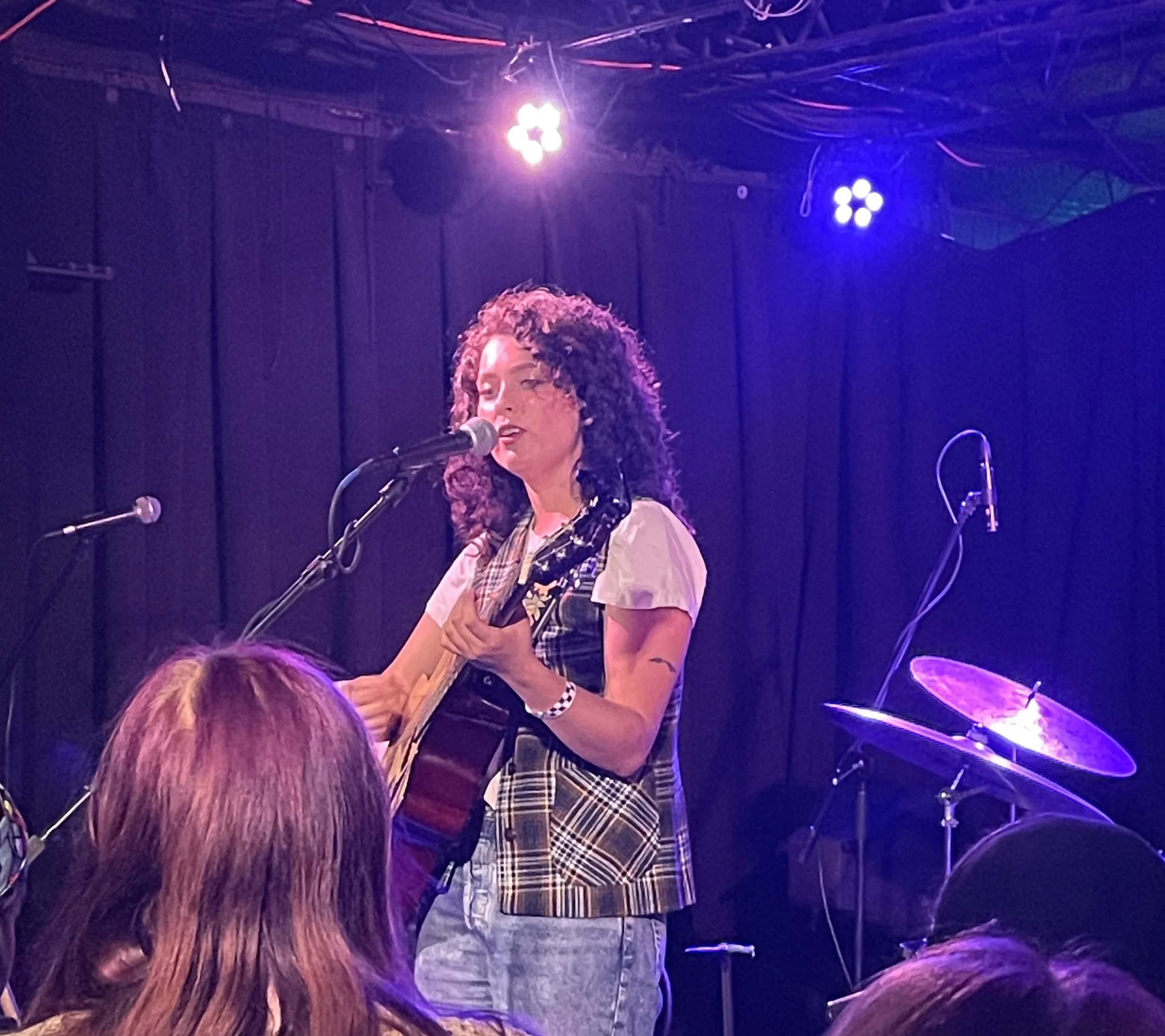
Because I think, and I am generalizing here, that there is an impatience that can ripple throughout the darkness, and the bodies that are standing within it, as they wait for the moment when the headliner—the artist that they, more than likely, are there to see, takes to the stage. Bryanne is up there alone—just her, and an acoustic guitar, and as she plays, truly belting out her songs with an effervescence, I am uncertain how many others in attendance are familiar, even in passing, with her work. How many have sat down, and immersed themselves in the complexities and vivid portraits found on Dollface.
How many have just passively listened to Bryanne’s most-streamed song, on Spotify, on their way over to the venue.
I
t’s not the first time I have bought a ticket for a concert with no intention of staying for the headliner. Only there to see the supporting act. It’s not the last time. I wonder how much of a minority I’m in. If others will spill out of the narrow doorway of the 7th Street Entry, into the commotion of downtown Minneapolis. Across the street, at the Target Center, The Offspring are performing. The sound of street performers, pounding rhythms out on overturned plastic buckets, ricochets off of the buildings, blurring itself into the whooshing of traffic, the occasional shouting from a pedestrian.
Given around a half-hour of time, Bryanne opens her set with what is then a new song—the single, “Jesus or Harrison Ford.” It’s sly, and frank, like so much of her writing, in how she depicts sex, and romance. There’s a longing to it. Again, longing for someone just out of reach is something she writes about often. But there’s this acknowledgment here that is fascinating. A melancholy, and within that, a resignation. An extremely evocative portrait of a life had, and then a life chosen. From Dollface, she plunks out the slow, deliberate notes to “Visions,” and strips away the pop-leaning gloss of “Clementine,” bringing it to a much more insular, solemn place.
On a Friday evening, in mid-August, Bryanne plays two songs that will, a year later, have found their way onto This is Not A Place of Honor. Because, in hearing it again, within the context of the album, I immediately recall how startling it was the first time I heard the line, “And it was hard enough when Rachel had the baby,” as she enthusiastically belted out the chorus of “Benchwarmer.”
On a Friday evening, in mid-August, at the 7th Street Entry in Minneapolis, Bryanne also plays the album’s smoldering, and slinking closing track, “Nowhere, CA.”
The song, far less twangy than others on the album, moves with the slightest drawl—a kind of dramatically stirring ballad, sharp enough to know exactly when to soar, or push itself out just a little further, and when to recede into a hush or restraint. It’s bold—certainly one of the most ascendant songs on Place of Honor, and it walks this impressive line in maintaining pop songwriting sensibilities while favoring a rootsy, folksier aesthetic.
There’s a tenderness to how the instrumentation of “Nowhere” is approached. A brightness or a kind of triumph, or excitement, that it’s just on the cusp of, if it were not for how pensive the strums of Bryanne’s guitar sound as the song begins. A fascinating juxtaposition that occurs with ease, and does reveal the give and take that her writing is firmly planted from here. There isn’t a conflict, really. Rather, a study in how one approaches regret. Or how one reconciles and justifies things to themselves.
There is this sensational rush—warm, inviting. Like autumn, really. That arrives when the elements gently tumble together, spilling out underneath Bryanne’s voice. The rumbling bass notes, the plinking banjo and the emotionally charged string accompaniment. The steady crunch of the drum kit. Rolling itself forward with this very tangible momentum, like it is really working towards something more expansive. An enormous moment that climbs to a towering height before it drifts back down. That never happens though. It’s a fascinating exercise in real restraint. A kind of patience in just allowing almost the entire song to simmer, swelling only where it needs to—the unwillingness to let it boil over completely, save for a single instance, as Bryanne bellows the final, emotionally charged line, all before the song retreats into itself, slowly swaying to an end.
There’s a bittersweetness to “Nowhere, CA.” This experience, or notion, is perhaps unavoidable. A forward momentum. Propulsion. A restlessness and a writhing and trashing. A looking forward while unable to stop yourself from glancing at what is behind you, and in this case, it is both literal and figurative, as Bryanne works through this narrative and assembles these wildly vivid fragments into something larger, using the same tenderness and care that the instrumentation underneath her has.
It’s haunting. And, I mean, if not haunting, there is this real sense of loss and longing that hangs over the song like a specter. It’s impressive how Bryanne can take a single image, or idea, like the opening line—“Billboard outside Sausolito says ‘Jesus Loves You,’” she begins, before crafting something larger around it. “The things we did out there,” she continues with remorse, or embarrassment in her voice. “I guess he doesn’t know or doesn’t care.”
“Every time I do that drive I feel like laying down,” she sings, a line later. “In my bed, or on the highway divider—it doesn’t matter.”
And I have said as much already. Bryanne writes with a frankness. For as poetic and intentionally vague as some of her lyrics can be, there is also this very matter-of-factness within specific instances. I presume, in songwriting, challenges present themselves in writing, with tact and thought, about sex, and sexuality. A sensitivity perhaps to this facet of the human condition. And what is impressive, when Bryanne takes us to this place on This is Not A Place of Honor, is that she is honest in her depictions. In that honesty, sometimes there is humor. It’s never a punchline. An absurdity, maybe. Sometimes there’s something sensual, or seductive. Regardless, the way it arrives within the world of a song, and how it is allowed to breathe, and how just the right amount of time and attention is drawn to it, is remarkable. Not quite an aside to the listener. Just honest. Matter of fact.
“There’s a steeper competition on the road to perdition,” she declares at the beginning of the second verse in “Nowhere,” before confessing, “My shotgun rider cumming in my hand.”
Then later, when the song folds inward, briefly, with a tenderness, she sings, “I’m in the bedroom, nothing on but your necklace. I’m painting the walls blue, and keeping my promise.”
The reason “Nowhere, CA” works, and works as well as it does, is because of the way it finds the perfect balance. Because there’s the balance in the intentional swelling, and theatricality to the arranging. Emotionally stirring but it never pushes itself too far to a place it cannot return from. And there is this give and take that occurs within the writing. The restlessness. A thrashing and writing. Imagery that is fully realized, and places you within a moment, but there is still this haze of ambiguity over certain phrases that requires you to use your imagination if you so wish to.
“In my dreams, you take a shape that you never do awake,” Bryanne conjures, with ease, in the third verse. “I find you in the kitchen, pitting cherries, making keepsakes. Back home, it’s all small plates. Small talk. Small waists,” she continues, then adding a line, sung with emphasis but there’s haze to its meaning. “The money ran dry, and I waited outside while they try to make a man out of you yet.”
This bittersweetness is what resonates, though, over everything else Bryanne writes of in the narrative to “Nowhere, CA.” The unavoidability of it all. This part of the human condition. This momentum that propels us forward. Restless and writhing and thrashing and within all of that, we’re unable to stop ourselves from glancing back at what is behind us, and perhaps, longing for it in a way. Acknowledging a loss of something. Or someone. “I recall it all in the not-so-distant past. When it all goes bad, we can always go back to Nowhere, California,” she howls passionately in the chorus, then changing the line, just slightly, when she sings it the final time.
“After all, isn’t that where you saw me last."
*
I am often thinking about the space that exists between two things, and when those things do inevitably converge, what forms within that convergence. Within that center. Because what I understand is that the distance between when you describe something as haunting and when you describe something as beautiful is not as far as you think. And the distance becomes shorter, then, as the two ends move gradually towards one another. But what forms within that space. In the center.
Journeys end in lovers meeting.
I understand that I have come, in time, to overuse repetition as a literary device. Leaning on it entirely too much. A crutch, really. It’s a fine line, isn’t it? What you wish to convey with its use. The rhythm you wish to build around those specific ideas. There is a graceful way to do it. A thoughtful, and careful way. It can and often does get away from me, I’m certain. Becoming annoying. Pretentious. Overbearing.
There are quiet ways, or more considerate ways, to remind the reader, or in this case, the listener, that there is a thread. And that, in time, you are working towards pulling everything together in a way that you hope, by the end, resonates. That the gravity, or the importance, is understood.
Repetition as a literary device is not entirely dissimilar from the use of recurrence in songwriting—in writing material for an album. The through-line creates this cohesion or connectivity within the world created. And it puts a kind of trust in the listener—that they are paying attention. A line used, and then used again, in two different songs, is a tug on the shirt sleeve. The reminder that the artist is guiding us to something much larger.
Lovers meet. Journeys end. And the phrase is originally from Twelfth Night, from a song performed by the character Feste. “O mistress mine, where are you roaming? O, stay and hear; your true-love’s coming, that can sing both high and low. Trip no further pretty sweeting; journeys end in lovers’ meeting—every wise man’s son doth know.”
The phrase appears as a refrain in Shirley Jackson’s The Haunting of Hill House—intended to illustrate, and further emphasize, the novel’s themes of both seduction and predestination.
Journeys end. Lovers meet. There is this momentum. We are propelled towards something, often larger. Perhaps unanticipated.
And there are the connective threads between Dollface and This is Not A Place of Honor. Lines Bryanne returns to, or images, and ideas, that find themselves, again, written into a song. There is this connectivity within the album itself. Moments that reflect back at another. In a world you are building, it is a songwriting technique that brings things just a little closer together. It’s thoughtful. And it’s so sharp. Wildly intelligent. This is the kind of spark you feel within when you listen, and hear it happening.
The expression “Journeys end in lovers meeting” appears twice on This is Not A Place of Honor. It’s said once, as the final line, to the slow-burning “Jacket”—“We were waiting on the world to end, but it was only changing,” she resigns. “Journeys end in lovers meeting.”
And it is an expression that is central to the extremely haunting, and gorgeous “Journeys End.”
There is of course the inherent country and western influence, or tinge, as “Journeys End” collects itself, in the pensive strums of the acoustic guitar, a second guitar weaving itself around the chord progression taken, and mournful shuddering of a crunchy, electric guitar that you hear just briefly as the song begins, and then returning near the end. And the structure of the song becomes more dramatic as Bryanne moves us beyond the first chorus and into the second verse, with a cinematic, sweeping swing arrangement, the thumping of the bass drum and the crackle of the snare, and as it surges toward the visceral conclusion, a hypnotic melody plinked out on the banjo.
There’s this give and take that occurs on “Journeys End.” This convergence. Something beautiful, and stirring. Evocative. Vivid. Slowly moving towards something haunting. Ghostly. Unnerving. There’s this edge that occurs. It isn’t sharp. It isn’t dissonant. Not exactly. The elements—all of them. Bryanne’s voice, and all of the instruments, shifting against one another like tectonic plates, creating something otherworldly. There is a discomfort but there is something so alluring about it. It is just so utterly captivating to immerse yourself in it, and the song itself doesn’t so much ask that of you, but demands it. Requires it. Slowly walking into a deep end, taking a breath, and then letting go.
Journeys end. Lovers meet. And Bryanne tells me the line means a lot to her, when I ask her about its use and recurrence on the album, adding that the themes found in The Haunting of Hill House—lesbianism, the haunting of a domestic space, suicide, memory as tied to a physical location, and ghosts—are all themes within This is Not A Place of Honor.
“I don’t mean it in the way it’s used in Twelfth Night,” she clarifies. “Where it’s a foible about how life begins when one falls in love. I mean it to mean a lot of different things,” she continued, and explained her use is “both laced with irony and deeply sincere.”
And there is this darkness—horrible and transfixing, that encompasses the writing to “Journeys End.” Bryanne sings the verses in a voice that soars and then descends quickly, wounded and tender, finding its way into a very twangy, rootsy melody. It’s gorgeous, and impressive, what she does here. With her voice, yes, bending it with dexterity. But it is impressive, also, because of how this melody, and the emphasis it places on a feeling, partially disguises the imagery, and offsets the bleakness strung together in vivid, fleeting fragments.
“I went down—white knuckles on my .44,” she begins. “Play the music loud. Open the window on the second floor, ’til I came out.” She returns to this melody, then, in the second and third verses. “I grew up in the pages of a photo book—yeah, I grew up good,” she muses. “Someone left a crack—slant of light through the heavy door. Memory ain’t fact, but it’s good what it’s good for.”
“Journeys end in lovers meeting,” Bryanne sings through seemingly gritted teeth. A kind of seething, or ferocity in her voice, just barely kept at bay. You can hear it in the way the words heave themselves as the song glacially creeps into this edge. The shifting plates. All of the elements moving by one another in slow motion. “Call a taxi—put an end to the evening,” she continues, and then punctuates the chorus, adding. “Forget the years that I was on my own.”
The intensity, and urgency, of the lyrics grows with each time Bryanne arrives at a chorus. “Flood the bedroom, swim until you hit the ceiling,” she commands as the crisp snap of the snare drum emphasizes the implied severity. “Second chances—fight the feeling,” the chorus continues, before there is a startling shift, with a brief flash of humor. “Look who’s driving, bitch,” she sneers. “Look who’s talking.”
The final image the song leaves us with is perhaps the most unsettling. The most evocative. One that hangs in this space where there is a directness, or a truth, to be found within, but it is assembled in a way where it is hazy. Vague. Poetic. “A work of fiction, a foreign greeting,” Bryanne howls. “On the floor where you found me bleeding—leave the stain there ’til they believe me.”
A restless year.
I often think about the way we are propelled. This momentum pushing us ever forward. Want giving way to more want. An edge of something we are brought up to. A moment before. The space that exists between two things. The inevitability of convergence. The distance between something beautiful and something haunting is not as far as you think. And that distance closes, as the two ends gradually move towards one another but what firms within that space. In the center.
Journeys end in lovers meeting.
*
And what is among the most remarkable things about This is Not A Place of Honor is that, yes, it can be, and often is, sad. Sad things, or upsetting things, or depressing things, are detailed. At times, quite vividly. Something I have been thinking about a lot this year, specifically with contemporary popular music, is to look at “The Sad Thing”—I think it’s easy, in part, because it doesn’t challenge you. It asks very little of you.
I became fascinated with the idea of complicating the idea of “The Sad Thing,” that is, yes, still sad, or upsetting, or heartbreaking, or depressing. But that in the end, it does offer you a glimpse of something hopeful. A small, good thing, to clutch onto. The assurance that there is something on the other side of all of this.
This is Not A Place of Honor is not an album that is interested in complicating “The Sad Thing,” but rather, it is an album that implores you to give consideration to there being a difference—a fine line, really, between sadness and sorrow. We can feel sad. We can have days that are harder than others to make it through. Sorrow lingers. A bittersweetness. Melancholy. Attaching itself to memories. Places. People. We carry it with us. Hana Bryanne, in these songs, doesn’t complicate that idea, but rather, just simply asks what we are going to do with it. How do we make space for it. How do we, if we can, reconcile with it.
I had, at one time, many years ago, convinced myself that there was a space that existed between grief and joy. A space between jubilance and sorrow. I spent so long trying to find it. Waiting for it to find me. I gave up looking without realizing it. And I tell you all of that to tell you all of this—Bryanne, in asking what we are going to do with that sorrow, or how we will attempt to reconcile with it, had created a collection of songs that exists and thrives within that space. The space between sorrow and jubilance, and it is so compelling to witness it.
A restless year.
And in giving consideration to a song, or to an album, yes, I am genuinely interested in how it sounds, technically speaking. The melodies. The way the instruments are arranged. The instruments themselves—their tone. The production and engineering. The small, meticulous details you can notice in a song when you listen closely and thoughtfully.
I am far more compelled by how a song feels. Compelled by what a song sounds like.
I do not remember, exactly, the first time I described a song this way, but there is this feeling. A sensation that ripples. An emotional charge. This entropy and propulsion. Want giving way to more want. The desire we are chasing, always. The edge of a moment we are brought to. Uncertain what, if anything, is going to happen next. An excitement and an uncertainty. There is this feeling. The feeling that you are running away from something while simultaneously running towards it and that something is often the same thing and that something is more than likely yourself.
I tell you all of that to tell you this. It is fun, and flirty. It dazzles. It shimmers. It’s infectious. That’s the point. You dress up the sorrow in jubilance as a way to explore it. To reconcile with it, as you are able. And in that it becomes something so much larger. Sequenced second on the album, and released as the second single in advance of This is Not A Place of Honor’s arrival in full, “May December,” feels like that. It sounds like that. The parts of yourself that you simply cannot outrun, regardless of all the ways in which you may try to.
It also sounds like pure pop perfection. Because there is a world where “May December” would have been a dominant force on the radio. A simply enormous tune that swings and does not miss. It’s meticulous in production and flawless in how it navigates the juxtaposition Bryanne creates—breezy and catchy, and so very bright and kaleidoscopic in sound, that is all used as a means for the clever and frank exploration of a tumultuous relationship, seemingly ill-fated from the first.
“May December” finds a groove from the second it begins—a steady, shuffling rhythm from the drum kit that is precise, crisp, and engineered to have a little bit of an effect on the snare, giving it an additional emphasis when it lands, which creates a space for the other, initial elements of the song to arrive. There’s a dreamy, or swooning feeling in the way everything oscillates—at first, it’s the quivering of the different keyboard tones and textures, and the contemplative strums of the acoustic guitar, with more punctuative instrumentation in the form of a snarly electric guitar, big, enthusiastic plunks from the piano, and slices from a string accompaniment, providing brief dramatic flares.
One of the reasons, and, I mean, there are many, but one of the reasons why “May December” is such an incredible song—really, the high-water mark of this album and one of the finest songs of 2026, without question—is the way it is unrelenting. It never ceases its forward motion. The propulsion. And what is impressive, then, is how it manages that feeling. Because it, like so many other places on This is Not A Place of Honor, never gets away from Bryanne. If there is any song on this record that could ascend to absolutely towering heights, it is this one. Specifically at the end, when she quietly and hypnotically utters the chorus. But the song works from this place of tension—one where there is no resolve in the end. When it does feel like it is on the cusp of soaring, Bryanne pulls it back down quickly, then brings it even further inward for the solemn final, restless, and reflective moments.
A restless year.
And in its unrelenting nature, the narratives that Bryanne depicts also move rather quickly. These fragments, or vignettes. A tumultuousness. Want giving way to more want. An edge we are brought to and then the inevitability of an end. A vivid portrait of an uneasy romantic relationship, akin in a way to something from Conversations With Friends, in the contrast created from both discomfort and desire.
There is an implication of an age gap between Bryanne, in the role of protagonist, and the off-stage character and object of her affection. “What’s that rule again,” Bryanne asks coyly in the opening line. “Half your age plus seven? It’s a secret test—a fidelity check, trying to hide that you’re jealous. But I can feel it,” she continues, her voice rising into a higher register, as the instrumentation drops out and there is just the slightest clattering of a drum rhythm underneath her. “You’re shit with secrets.”
One of the reasons, and I mean, there are many, but one of the reasons why “May December” is such an incredible song is in the way it returns to a specific line at the top of each verse, and in doing so, the stakes are higher every time—an immediacy, and ultimately, an emergent nature to the song the closer it careens to the end.
“What’s that rule about half the time you were in love with her to move on,” she begins in the second verse.
“What’s that rule again,” she asks again. “Seven good years and then my cells will turn over and you’ll never have loved them. But I like normal sex and watching TV in bed,” she declares.”Always knew just what I wanted ’til I had it in my hands.”
One of the reasons, and there are so many, yes, but one of the reasons why “May December” is so remarkable is the way it skitters around the idea of regret. Acknowledging it, as it is able, but the protagonist, and the song itself, are both far more interested in the idea of moving forward. The propulsion. The momentum. And in that, there are these moments that are both jubilant, or triumphant sounding, but also sorrowful, and in that, there are places where there is this untethered feeling. A kind of freeing sensation, but at what cost, ultimately.
“Slam on the gas—know that this feeling will pass, or if it doesn’t, maybe it’ll get small,” Bryanne sings in the second verse, a slightly warbled, metallic echo trailing her voice. “The brake is squeezing. I stick my head out the window. Done right and it goes slow—done wrong, and it goes on and on,” she continues, repeating the word “on” six additional times.
She returns to this similar structure, and this urgency, at the end of the final verse, before the “May December” effortlessly glides into its restrained chorus. “I can feel it—the paint is peeling. I’m making a new me. Sculpting it from memory. This changing it goes on and on…”
“It’s not a bad trip, it’s just a restless year,” Bryanne concedes as the song culminates. “Nothing makes any sense ’til I imagine you here. Maybe I’ll paint my nails. Maybe I’ll go blonde,” she muses, before arriving at this moment. Within the place where jubilance and sorrow meet, and swirl around gently. There is this restlessness that leads her to the edge of something. An uncertainty but also an understanding.
“Nowhere further west to move, so maybe I’ll just move on.”
*
And there are the things that compel us. The reasons we continue to listen to contemporary popular music. A reason can be simply the vibe. The way a song sounds. The melody. If it is fun. Or infectious. What we listen to doesn’t always have to be taken so seriously. That is something that I am still learning when I listen. A song may simply just want to have a good time, and it may want us to have a good time, as well, when we hear it.
There are the things that compel us. The reasons we return to certain albums. Certain artists. Continue listening to contemporary popular music as a whole. The phrase turns. The narratives. Moments we are brought to the edge of. Want giving way to more want. The brief, wondrous flashes we may see of ourselves within a song’s lyrics. The reflection of the human condition. The small slivers of hope that we cling to that there is, perhaps, something better on the other side of all this.
“I hope it makes them feel something.”
I asked Hana Bryanne what she hoped listeners took away from This is Not A Place of Honor. Because that’s the thing. The songs are hers up until a certain point. There is her meaning, and intention, behind the writing, but then they are out in the world, and each listener is going to have a different reaction, or response. It’s a shared experience, yes, in people all listening. But once the record ends, the songs are no longer only hers. And everyone who sits down with this album and gives consideration to what it depicts and how it is depicted and just how thoughtful it is will have, in the end, a different experience.
“My goal as a writer is to catch a feeling like a firefly in my hands,” she explained to me. “To show it to people and say, ‘Look what I found! Do you recognize this? Does it remind you of anything?’”
Bryanne said she hopes there are some songs on the record that people will put on playlists, and listen to in the car with friends—she mentions “May December,” specifically. In contrast, she said this—“I hope there are songs that make them feel so deeply they don’t feel the need to revisit them that often.”
“I hope people listen to the words; I hope people listen to what I have to say. I hope it makes them feel something.”
Paint your nails. Go blonde for the summer. We writhe and we thrash. There is the entropy and the propulsion through our existence It has been a restless year. Have you felt it several days? More than half the days? Nearly every day? How difficult has that made it for you to do your work, or to take care of things at home, or to get along with others? Not difficult at all? Somewhat? Very Difficult? Extremely difficult? We are all running away from something while simultaneously running towards it, and ultimately it is the same thing, and that thing is almost always a part of ourselves. There is a convergence between two things and it is beautiful and it is haunting and it is who we were and who we might be and in the center of that is who we are, right now, in this moment because that is all we have.
This is Not A Place of Honor is out on August 28th, via Bird Street.
