I Can’t Quite Say Why
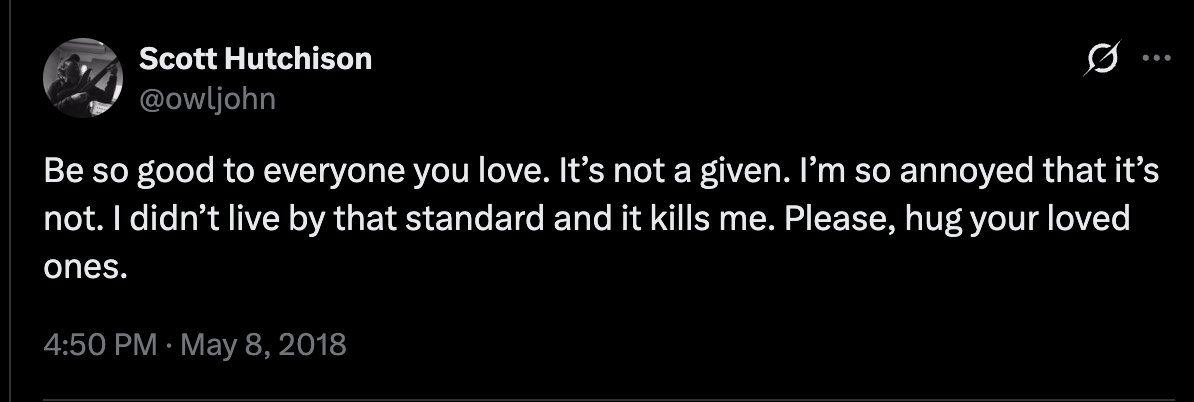
I think about Scott Hutchinson’s final tweets a lot. Perhaps more often than I should. They aren’t difficult to find—I have screenshots of them, of course, but his final words, from May 8th, 2018, are still right there, online. His Twitter account, inactive for the last eight years, hasn’t been deleted. His final words haunting. And hanging like a specter. A reminder.
I think about them a lot. Perhaps more often than I should given that, at the time of Hutchinson’s death, I wasn’t, and still truly am not, today, an avid listener of the band he fronted, Frightened Rabbit. They were acclaimed and revered, releasing five full-length albums in the years they were active, and they are still acclaimed and revered, anecdotally more so now. Eight years to reflect on the band’s work.
Specifically on Hutchinson’s lyricism—thoughtful, yes, but also there is this careful balance he often struck in his writing, between humor and pathos. And, yes, this can be difficult to hear now, which is to be expected, I suppose. This bleakness. Or this heaviness that was portrayed. Haunting. Hanging like a specter. A reminder.
I think about them a lot. Hutchinson’s final words, shared online. Before he was declared a missing person. Before his body was found. He said, “Be so good to everyone you love. It’s not a given. I’m so annoyed that it’s not. I didn’t live by that standard and it kills me. Please, hug your loved ones.”
Then, separately, he said, “I’m away now. Thanks.”
I think about this a lot. The sorrow, and the frustration, and the exhaustion. It’s visceral, really. The more that I do think about it. This place one can be driven to the brink of. Be so good to everyone love you. It’s not a given. Hutchison, in his final moments, was right. It is annoying that it is not a given, and when I fall short of that standard—the one he is describing, what I understand and recognize is that, at least for me, it is often difficult to gracefully recover from this moment.
We fail our loved ones. Never intentionally, I don’t think. We fall short. The shortcomings. The failures. They begin to compound.
There is, of course, an irony. Which is why I am here. Why I am standing in this shadow. The one cast by his final words. This reminder. Why I have asked you to join me here, in this shadow. What I am asking you to both understand and recognize. Perhaps in yourself. Certainly in me.
Because there is an irony. There’s a song at the end of the first side, on Frightened Rabbit’s final album, Painting of A Panic Attack, titled “Still Want to Be Here.”
Be so good to everyone you love. It’s not a given.
I think about that a lot.
*
The name is, I think, what maybe kept me at an arm’s length. Scott Hutchinson, himself, would later imply he didn’t like the band’s name either. “It was approximately 10 years ago that I started a band called Frightened Rabbit,” he said in 2014, when he released a single solo album under the moniker Owl John. “In that time I’ve dedicated so much of my life to that good wee band with a stupid name.”
Hutchinson was shy—painfully so, apparently. In childhood he suffered from night terrors and anxiety, and his mother would refer to him as her “little frightened rabbit.” He avoided socializing with other kids, and would play by himself in silence.
He never thought he could sing, only really beginning to do it at the age of 19. “I didn’t know I could sing,” he said in an interview from 2008. “I had been told I couldn’t.” Hutchinson began performing under the name Frightened Rabbit in 2003—and the following year the project became a duo, with his younger brother Grant on drums. The two recorded and independently issued the band’s debut, Sing The Greys, in 2006—the album was remastered and reissued the following year by FatCat Records, the UK-based imprint that would go on to release Frightened Rabbit’s critically acclaimed sophomore album, The Midnight Organ Fight, in 2008, and The Winter of Mixed Drinks, in 2010.
Frightened Rabbit signed with Atlantic Records, issuing Pedestrian Verse in 2013, and what would be the group’s final album, Painting of A Panic Attack in 2016.
Hutchinson, alongside his brother Grant, had formed what they referred to as a supergroup—Mastersystem, with Justin Lockey of the group Editors, and his brother James, releasing one album, Dance Music, in April of 2018.
Scott Hutchinson died by suicide roughly a month later.
Be so good to everyone you love. It’s not a given.
I think about this all of the time.
*
And there of course is a cloud that hangs over Painting of A Panic Attack. You cannot help but look for clues. Or signs. Indicators. Perhaps making more out of something than was originally intended, upon the album’s release. It opens with an intentionally simmering song titled “Death Dream.” There’s a song later on, at the halfway point on the first side, called “Woke Up Hurting.”
A darkness depicted in Hutchinson’s writing, often stark or harrowing, when the songs were recorded and released a decade ago. A different kind of darkness now, though—imposing, maybe. Ominous. A little unsettling, even.
You cannot help but look for the clues. Signs. Indicators.
Painting was produced by The National’s Aaron Dessner. And even if you didn’t know that before sitting down with the album, you would figure that out the longer you listened to it. Dessner, in the last six years, has become an in-demand producer, thanks to his unlikely collaborations with Taylor Swift on Folklore and Evermore, and in that time, his production techniques have grown, but he still has, like many producers, or arrangers, or co-writers do, a kind of trademark sound, or aesthetic.
There are a number of moments on Painting of A Panic Attack that sound like a National record—specifically when The National were undergoing their own growing pains in terms of finding a balance between bombast and their more brooding, morose nature. This isn’t a bad thing—these similar elements. Primarily, it’s in the somber, cavernous-sounding piano accompaniment that can be heard throughout the record. Or the moments of a swooning kind of explosive theatrically. A bellowing above the noise. And none of this is a bad thing, really. It is just something to note. An observation. A product of its time, in a sense. It’s something to give consideration to with the role of the producer. If they are someone who simply captures the band, in a moment, rarely interjecting or interfering if it all. Or if they are someone who is allotted more creative input, with their hands in truly shaping how the songs are going to sound.
I am remiss to say, even retrospectively, that Portrait of A Panic Attack is the sound of a band that was falling apart, but it does represent a creatively tumultuous time for Frightened Rabbit—a sense of tension, and urgency, rippling through the darkness within the songs included on the record.
Following the release of the group’s fourth album, Pedestrian Verses, Frightened Rabbit embarked on an 18-month tour in support of it, which left them burned out. “We all lost each other and ourselves a little bit,” Grant Hutchinson, the band’s drummer, and Scott’s younger brother, said in an interview. After the tour concluded, Scott Hutchinson relocated from the band’s native Glasgow to Los Angeles to live with the woman he was romantically involved with at the time, and began working on his solo album as Owl John.
Hutchinson, however, in relocating, felt isolated, and believed Los Angeles, as a city “felt anxious.” He would leave the city, traveling to Big Bear Lake, to focus on songwriting—rejoining the rest of Frightened Rabbit in Wales, at the end of 2014, for a writing session that proved unproductive due to his writer’s block. The songs themselves on Panic were written long-distance over the following year, with Hutchinson still in California, and the rest of the band in Scotland, with tracks sent back and forth over email, which proved to be helpful in terms of constructive, creative communication amongst the band.
Frightened Rabbit convened with Dessner at a studio near Woodstock, New York, for two weeks of initial recording sessions in the summer of 2015, then again at Dessner’s home studio, in Brooklyn, shortly thereafter.
Even in its moments of bombast, there is a fragility at the core of Portrait of A Panic Attack. Hutchison, in his songwriting, often wrote about the end of his romantic relationships. The Midnight Organ Fight, the group’s second album, was touted by music critics as “one of the finest breakup records of recent vintage” upon its release. What makes Portrait fragile, and intense, and urgent, or tumultuous, is that much of it was written during the course of the relationship it depicts.
In a conversation with Lauren Down, for The Line of Best Fit, Hutchinson describes the intensity of this relationship as an unhealthy thing. “You rely almost completely on this one person,” he said. “You cannot exist with one person alone. I think that building that place that’s so private works up to a point, but you need to let other people in….I guess there’s this person that you have an addiction to. There’s this kind of drug-like aspect of absolute elation and intense love.”
There is a desperation that you can hear, at times, within that intensity, and urgency. The tumultuousness. A need. Or a craving. It’s beautiful at times. The way this need, and this longing for someone who is already by your side, is depicted.
A difficult thing to do. To be thoughtful, and articulate, about the moment you are in. And it is perhaps a difficult thing to hear. To see these reflections of yourself in what is depicted.
To find yourself in an often fragile or intense, and ultimately dark space.
That is why I am here. I suppose. Standing in this shadow. Fragile and intense and ultimately dark. Why I have asked you to join me here, in this shadow. What I am asking you to both understand and recognize. The reflections I will ask you to gaze upon.
*
And you really cannot help but look for the clues. Indicators. Signs. If they had been there and were just missed.
The album’s slow simmering, opening track is called “Death Dream.” An arresting title—it makes sense, I think, that it begins with an icy, eerie keyboard done, that quickly makes way for a distant sounding cymbal tapping, and then these big, dramatic chords on the piano, creating the very intentional structure and pacing for the song that will, over the course of four minutes, unfold at a glacial pace, growing slightly, but never offering any kind of relief to the tension that it has worked so hard to create, and sustain.
The meticulous nature to how “Death Dream” builds is expected, in a way. You can predict when there is a break, between one verse and the next, which elements or layers, might be added to provide the slightest lift as it continues to swirl slowly—the additional synthesizer textures and ripples, and the clattering of a sleigh bell joining in as Hutchison’s voice rises for the second verse, a kind of yelping through the hazy atmosphere conjured.
“Death Dream” never ascends the way some other songs on Painting of A Panic Attack do—nor does it wish to. Hutchison’s voice, in what serves as a bridge to the final minute, is layered over itself, creating something hypnotic as a single phrase is uttered and repeated. And it is within the final minute, while more sonic elements are still being introduced, that the song doesn’t, like “come together,” but a more formal rhythmic pattern arrives—the thudding of the bass drum, and the crisp, albeit muffled, snap of the snare, with huge silences hanging in between each note, gives the song a fitting trudging procession, while there is a contrast in the other elements, like shimmery guitar string plucks that flutter, and the heavier, darker tones of what sounds like a brass accompaniment, which even with the heft they offer in the already crowded landscape of the song’s conclusion, provide something that is not triumphant, really, by any means, given the context of the song, but there is this strange hopeful, or optimistic feeling from those lower notes.
You cannot really help but look for the clues. Indicators. Signs. Whatever. If they had been there, and had just been missed.
The working title of the album, before the band arrived at Painting of A Panic Attack, was Monuments, which Hutchinson said was supposed to be representative of “a beautiful place that you go to remember something awful.” The eventual titular phrase, then, pulled from the lyrics to “Death Dream,” conveys something similar. “A beautiful depiction of something horrific,” Hutchison explained in the press release for the record. “The kind of thing you can’t stop looking at, or perhaps listening to, even though it’s rather painful at times.”
And there is, of course, a graphic nature to the lyrics of “Death Dream.” Not self-indulgent though. A kind of matter-of-factness in what is described, and how it is described. It’s poetic. Or literate. Beautiful, evocative phrase turns, woven through the portrayal of an absolutely horrifying scene.
“It was dawn and the kitchen light was still on,” Hutchison begins, with his voice hushed and in a higher register.”I stepped in, found the suicide asleep on the floor. An open mouth—screams and makes no sound,” he continues, before arriving one of the most startling expressions in the song, as well from the record as a whole.”Apart from the ring of the tinnitus of silence, you had your ear to the ground.”
The second verse continues the kind of dramatic flair within these vivid depictions. “White noise—I don’t know if there’s breathing or not,” Hutchison declares, his voice rising, growing with urgency. “Butterflied arms tell me that this one has flown. Blood seems black against the skin of your porcelain back. A still life is the last I will see you,” he concludes. “A painting of a panic attack.”
The song is, after all, called “Death Dream”—it is a dream after all. But not one you are easily able to shake. “You died in my sleep last night. You died in your sleep last night,” Hutchison explains on the bridge, his voice overlapping and layering. The expressions alternating. Creating something hypnotic, even in the morbid nature of the song.
“Death Dream” ends with a tentative, cautionary observation. And no real resolution in the wake of what has been depicted throughout the song. “Death dreams you don’t forget,” Hutchison confesses, the words, again, becoming a swirling, mesmerizing incantation of sorts. “It’s been a while since I dreamed this. Even now, when asleep, I’ll tread with care.”
You cannot help but look for the clues. The signs. Any indication.
Be so good to everyone you love. It’s not a given.
I’ll tread with care.
*
And there is this device. A technique. Whatever. Whatever you wish to call it. It happens in songwriting. Not a lot, but often. It surprises me. Delights me, I suppose. As much as something like this can delight a listener. It impresses, more than anything. The thoughtfulness that it requires.
There’s this technique, in songwriting, when the artist in question creates a distraction. It’s intentional, of course. A means of partially obscuring, at least until you arrive at the revelation. The writing itself—the lyrics, the narrative, whatever—is dark. Sad. Bleak. Whatever descriptor you wish to choose. But this device, then, dresses up that sadness, or darkness, with an arrangement that is contradictory in tone. Often infectious. Jubilant sounding. It serves as the slightest distraction. The weight of the lyrics will eventually hit you. The intelligence in this kind of songwriting comes from how the hand isn’t played right away. It is right there. Just slightly hidden. Waiting for your recognition. Whenever you are ready.
And it is just a marvel, when this occurs in a song. And when it is done well. When you realize the depth, or the resonance that a song wishes to have, and the way it wishes to convey that to you.
And there are any number of moments on Painting of A Panic Attack where this is done, and done well. Not every song on the album is as icy and deliberately paced as its slow-motion opening track. The severity and the immediacy of Hutchinson’s writing, then, juxtaposed sharply against more exuberant, or raucous arrangements and song structure.
There is, of course, a narrative at the core of Painting. And I am yet again remiss to describe it as a concept album, but it is a cycle of songs that fumbles through the decline of a relationship. And that is important. That detail. The fumbling through. The relationship, as depicted, wasn’t over. Yet. A breakup record in the sense that the unsustainable nature of this relationship is apparent. But there are still these flashes. Moments. However fleeting. Not of hope. Not really. But when things maybe felt less hopeless.
In the album’s second track, “Get Out,” Hutchinson refers to the affection of his romantic partner as an “uncut drug.” And so it does make sense, then, in the conversation with The Line of Best Fit, that he refers to the addictive nature of the person in question. There is an intensity to it. What he depicts. Dangerous maybe. Or unsettling. Sure whatever. It is alluring. This kind of unabashed desperation for someone. To need them. To be possessed by them.
And what is depicted in “Get Out”—this kind of destructive romantic whirlwind, becomes not only alluring as an idea, but seductive in how it is woven into the melody, and the slithering, explosive arrangement that surrounds it. One of the more sonically bombastic songs on Painting of, “Get Out” begins with a jittery drum pattern, sandwiched underneath warm, antiquated, buzzy-sounding synthesizers, before the steady strum of crunchy, distended electric guitars comes in over the top of it all.
There is a writhing feeling. A restlessness. You can feel it as “Get Out” has assembled itself, and you can feel in how it propels itself forward. There are other places on Painting where this feeling—this writhing, feels different. More seductive. A little darker. A slithering beckon. There is less of that here. Less seductive, comparatively, because of the instrumentation, the rhythm, and the explosive nature the song is structured around. The song’s verses slink—a playful kind of groove that you are pulled into, before you are thrashed around wildly in the bombast and theatricality of the chorus.
The playful groove, skittering on the surface of the buzzy synths and the unrelenting guitar strums, offers the slightest distraction from Hutchison’s writing, and sentiments—and in the way he observes his romantic relationship here, there is no right or wrong answer. It is simply that. An observation. From within the moment. Aware enough to acknowledge the inherently dangerous, or unsettling nature of admittedly being addicted to a person. But also understanding that he will, at least within the confines of the song, surrender to the all-encompassing feeling.
And it is quite poetic, and romantic. Or sentimental. How he describes it. “I’m in the arch of the church between her thumb and forefinger,” he sings in the opening line. “I’m a worshipper—a zealot king, cursed, a devotee of the heady golden dance she does,” he continues. “She’s an uncut drug—find the vein and the pulse. Chased it, and for a minute, I was floating dead above myself.”
In the conversation with The Line of Best Fit, Hutchinson uses the word “cling.”
“I cannot live without you but I have to find a way without absolutely fucking clinging to you,” he explains w/r/t the sentiments of “Get Out.”
“I’m in your purse—pull me out and throw me down,” he asks in the second verse. “Stick me to your lip and draw a scarlet O. There’s a name on my chest in red—the embossing of a branded bull.”
“Get Out,” even in this kind of intense depiction of infatuation, comes from a place of confusion, or tumult. There is a contradictory nature in what happens within the chorus—a literal push and pull. “Get out of my heart,” Hutchinson bellows as the snare drum crisply snaps underneath him with the punctuative chugging of the electric guitars. “She won’t, she won’t,” he responds to himself. “I saw a glimmer in the dark, and now I know she won’t get out of my heart, she won’t.”
And it isn’t a resignation, exactly, in the end, when Hutchison sings the final chorus, changing a single line in it. And if it is a resignation, it is not done so out of reluctance, but rather, out of understanding and desire, exclaiming, “There’s a heavenly scar that lets me know she won’t get out of my heart.”
*
And there is this writhing feeling. A restlessness. A nervous tension. Slithering. And in comparison to the way Frightened Rabbit explores this sensation on “Get Out,” this is much darker. Also seductive. A kind of compulsion. The beckoning. A “come hither” finger motion, summoning you into the darkness it exists in, and demanding you surrender yourself to the propulsive nature of the rhythm. Not even asking you to inevitably let go, but expecting that you will. That you will lose yourself in this moment created.
I think of a band like Joy Division as a point of reference—the morose nature of Ian Curtis’ lyricism (and vocal performance), but the rollicking, often shimmery or bouncy post-punk instrumentation and structure. The surprisingly infectious nature of a song like “Love Will Tear Us Apart,” and how even in what is depicted in Curtis’ writing, the music creates this startling, effective contrast. The disguise. Or the distraction. Just enough so that there is the eventual realization. An understanding. Frightened Rabbit finds this balance in the surprisingly glitchy “Woke Up Hurting.” Anchored by heavy synthesizers and unrelenting programmed beats, it is one of the more ominous-sounding songs on the album, working from this truly fascinating place to exist within—the rippling groove it slides into, jittering with immediacy, and the arresting, vivid self-portrait Hutchison paints and forces us to look at.
The production of a song like “Woke Up Hurting,” and even “Little Drum,” is indicative of the time, certainly—Aaron Dessner would, the following year, begin to incorporate more synthetic textures into his work, producing The National’s Sleep Well, Beast. These elements are not out of place here—they perhaps felt that way, or were maybe not as well received, upon the album’s release a decade ago. If anything, even in the darkness they plunge into—specifically “Woke Up Hurting,” they offer a slight reprieve from the otherwise very guitar-forward, “indie rock” sound Frightened Rabbit favored, and provide an alternate way for the band to achieve a dark, cavernous, often melancholic sound.
“Woke Up Hurting” begins with a metallic, chilly clang—the marrying of both the tone of the programmed drum beat, and this haunting, atmospheric sound underscoring it. There is an industrial edge propelling the song forward with an emergent nature, and the edge is only then softened by the eventual arrival of the warm melody from a buzzy synthesizer.
It is meticulous in how it unfolds. Again, as the band does on the opening track, they are deliberate in how to punctuate a specific instance within a song, with the different textual elements to “Woke Up Hurting” folding in at the right moment to offer dramatic flairs—the synthesizer, and Hutchinson’s reflective, somber vocals, carrying us to the chorus, when more organic components slide in—the understated strumming of an acoustic guitar, and the pounding coming from a drum kit temporarily replacing the programmed beat.
“Woke Up Hurting,” as it continues to swirl, operates from a restraint, with the band only releasing their grip slightly the further into the song we’re taken—never ascending higher than they wish for it to, and only lifting slightly, or more noticeably, near the end, when the song hits its hypnotic, eerie bridge.
And there is this depravity depicted in Hutchinson’s writing, on “Woke Up Hurting.” A kind of bleakness that teeters on the edge of a collapse. Lower than you thought possible. A blurred line in the portrait of excess—how much is based in truth, and how much is exaggerated for dramatic effect.
“Daybreak comes with the devil’s hum—a carcass starts to breathe,” Hutchinson utters, creating a stark image through his choice in words. “Wakes one more time to try to find a place to count its teeth and scrub the cuts from yesterday’s hot scuffle in the streets. Show me the door,” he concludes at the end of the first verse. “I need somewhere to go.”
The second verse, then, is darker still, in what it portrays, with regard to succumbing to substance abuse and addiction. “Slug through the day, sneak between the houses I have made and run sacred rivers up my sleeve,” he begins. “Pills by mouth with lemonade as the hours slow down. They all clock out of the cracked up daily grind—I’m in a back back street, coming down, I wait for the beam of light.”
There is this cycle depicted—he changes the time of day referenced at the top of the chorus. “Daylight,” and then, the second time through, “Midnight,” though the rest of the sentiments remain the same each time. “Woke up hurting with tarmac to my side. I woke up with dirty knees, he observes before scoffing. “Not for the first time.”
There is a sardonic nature to the reflection Hutchinson makes in the final line of the chorus—sardonic, at least, within the context of the song. “I woke up hurting, though I can’t quite say why.”
There is more, though. I think. Which is of course why I am here. At least in part. Why I am standing in this shadow. The one cast by the final words of Scott Hutchinson. This reminder. Why I have asked you to join me here in this shadow. What I am asking you to both understand and recognize. Perhaps in yourself. Certainly in me. You cannot help but look for the clues. The signs. Any indication.
There are a number of quotes I keep returning to from a piece that Hanif Abdurraqib published at the start of the year about the 30th anniversary of R&B singer Phyllis Hyman’s posthumously released I Refuse to Be Lonely—the album issued shortly after Hyman died by suicide.
In the essay, Abdurraqib writes, “I don’t spend much time trying to make sense of depression, as it affects me, for the sake of other people.”
I woke up hurting, though I can’t quite say why.
I often think about how humbling, at times, it can be to articulate. Or, how overwhelming and impossible it seems. To know where this feeling comes from. The hurt you wake up with day after day. For a long time, I would say that it was just a thought.
What I have come to understand, recently, is that a thought isn’t nothing.
Be so good to everyone you love. It’s not a given.
*
My best friend once described me as a beautiful, temperamental thing—like an orchid, she said.
That is something I return to. In moments when everything feels fragile. When I feel fragile.
I think about Scott Hutchinson’s final tweets a lot. Perhaps more often than I should given that at the time of his death, I wasn’t, and still truly am not, today, an avid listener of Frightened Rabbit. And I tell you all of that to tell you this—I am uncertain if it is something that Hutchinson wrote about elsewhere, but is surprising to be doing even the smallest amount of research on him, and to read a little about his shy, seemingly isolated childhood, and then find glimpses of that specifically reflected in the creeping, atmospheric “Little Drum.”
Similar to “Woke Up Hurting,” “Little Drum” finds Dessner taking risks, sonically, with his production, or if anything, he is at least pushing the band in a direction they otherwise might not have gravitated towards without his oversight on the album. The song, fitting with the title, though it is a little cloying, is structured with this disembodied vocal sample, floating faintly in the distance underneath the other shifting and spectral layers—so faint you do have to strain to hear it, intentionally sounding similar to the “Pu rum pu rum pu rum pum pum” that children’s voices repeat from the Vince Guaraldi song, “My Little Drum.”
The sample, uncredited in the album’s liner notes, pings underneath the light ripple of a synthesizer tone, which makes way for more layers—lower, heavier tones that sound otherworldly, or like tectonic plates shifting in slow motion, creating this uneasy, dreamlike atmosphere for the arrival of Hutchinson’s voice, and these elements parting, temporarily, for the more straightforward instrumentation of the chorus—Dessner’s favoring of the big, dramatic sounding piano chords, a shuffling, crisp rhythm coming from Grant Hutchinson’s drum kit, and the muffled strums of the acoustic guitar.
Recently, my mother told me that despite some “ups and downs,” my childhood was, in her words, “really not terrible,” and that I was a “good child.” I had never contended my childhood to have been terrible, or that I was a bad child. If anything, I recognize that I was more than likely an extremely precocious child—an only child, who quickly became a sullen, withdrawn teenager. And how exhausting that all must have been for both her, and for my father.
You look for the signs. The clues. Any indications.
There is a remorse, or a sorrow, that is depicted in “Little Drum,” as Hutchinson reflects on his adolescence. “I was mothered like an orchid,” he begins. “Tethered to paternal sides. I hurried home to orbit, close to where I know I’m fine. No edge of the seat. No arms ever broken.”
“The little drum inside behaves itself until you turn 25,” he muses in the second verse, the remorse turning sharply into regret. “And then it strikes this all—we’ve lived this long, and only ever half alive.”
There is a restlessness, then, that is portrayed in the chorus. A restlessness, and a kind of disappointment. “I waited for the crash to come,” Hutchinson explains. “Too many days with too little to do. I waited but nothing came at all—so many days spent in empty rooms.”
All of that, then, converges in the song’s final thoughts—the regret and restlessness. The disappointment. The remorseful observations. “It’s too late for a wasted youth,” Hutchinson pines. “All quiet on the eastern front and we dare not move.”
“It’s too late to wage a war,” he resigns. “It’s all quiet on the eastern front and we are all bored.”
There is this fragility depicted. Mothered like an orchid. A beautiful, temperamental thing. Delicate. My mother, recently, unprompted and not, telling me she did thought my childhood was “really not horrible.” I never contended that it was. I don’t think Hutchinson contends his to have been, either. In the murky atmosphere, there is no resolve here. “Little Drum” ends, then, not in uncertainty, but a sense of unease, born out of observation and acknowledgment.
A life, perhaps not wasted, perhaps not spent in a way that was exciting. What do you do, then, with this kind of reflection. If anything at all. Hutchinson has no answer. There is no right, or wrong answer really. The life we had, the life that we have now. Questions, or considerations, forming in the place where the two briefly intersect.
*
Not every song on Painting of A Panic Attack is icy, or deliberately paced. Unfolding in a kind of slow motion. And there is this device. A technique. Whatever. Whatever you wish to call it. It happens in songwriting. Often enough that it surprises me. Delights me as much as something such as this can delight a listener. More than anything, it impresses. Because of the thoughtfulness that it requires.
This technique, in songwriting, when the artist in question creates a distraction. Intentional, of course. A means of partially obscuring, at least until you are ready to arrive at the revelation. And the writing itself—the lyrics, the narrative, is dark. Sad. Bleak. In this case, a little cruel and self-effacing. This device then dresses up that darkness or that sadness or the cruelty, with an arrangement that is contradictory in tone. Often infectious. Jubilant sounding. It serves as the slightest distraction. The weight of the lyrics will eventually hit you.
The intelligence in this kind of songwriting comes from how the hand isn’t played right away. It is right there. Just slightly hidden. Waiting for your recognition. Whenever you are ready. And it is just a marvel when this occurs in a song. And is done well.
The scathingly titled “An Otherwise Disappointing Life” is similar to “Get Out,” only in the sense that it uses, with incredible skill, this songwriting device. But while “Get Out” thrashed and slithered, “Otherwise Disappointing” is absolutely enormous in the heights it ascends to—swaying with a playful smirk and bounce, then swooning and ascending with grandeur and bombast.
In how it is assembled, “Otherwise Disappointing” pulls from a number of familiar sources—the big, mournful piano chords you hear at the beginning aside, the steadily strummed guitar coming in underneath it is muffled and quivering—reminiscent of the engineering of the rhythm guitar track from The National’s “Terrible Love,” a song that foregoes any swaying, or playfulness, and heads right into the swooning ascension and the bombastic grandeur.
An additional reason that, out of all the tracks on Painting of A Panic Attack, it sounds like the most like a National song is because outside of Dessner’s contributions, it also features The National’s bassist Scott Devendorf, and the group’s frequent collaborator, Thomas Bartlett is credited with playing keyboards.
“Otherwise Disappointing” slinks along with an understanding of tension and release—simmering during the verses, with a snappy, strong rhythm, and enough atmospherics filling in the space between that quivering, muffled guitar, and the somber tone of the piano, before it all quickly builds and is allowed to soar during the voluminous chorus—becoming a torrent of sorts, with with Grant Hutchinson’s drumming becoming much more expressive, and the layers of bass, electric guitar, and synthesizers weaving together to a feeling that is on the cusp of sounding triumphant, or at least exuberant, while Scott Hutchinson bellows the titular expression, in its context, over the top of it all.
Like “Get Out,” there is this intentionally infectious nature to how “Otherwise Disappointing Life” unfolds—the subtle melody of the verses, yes, but it does hinge itself on the shout-along nature of the chorus. It’s anthemic. Intentionally so, as a means of dressing up the conflict within Hutchison’s lyricism.
And the conflict, I suppose, arrives as a contradiction. Or a moment of confusion. Because, yes, not every song on Painting exists within the overall concept of the record, “Otherwise Disappointing” is a literate reflection of a relationship on the brink. A line, tread as carefully as it can, between cruelty and tenderness, and what happens in the space where those things inevitably, and unavoidably converge.
And there are a number of poetic, or resonant lines, or turns of phrase, throughout Painting of A Panic Attack,” and “An Otherwise Disappointing Life” opens with one so surprising, and impressive, that it makes sense Hutchinson would hang onto it and bring it back a second time, shortly before the song’s cathartic conclusion. Even in as poignant as it is, there is this self-aware snark to it, which doesn't diminish, but humanizes this moment, specifically, before he moves on to the next thought.
“I have a long list of tepid disappointments,” he begins, adding sweetly, or what is intended to be sweet, I think. “It doesn’t mention you.” Though, this sentiment quickly shifts, and there is the contradiction. Or the conflict of the song. The give and take or what it is like to be within the moment. This relationship on the verge. “And if I’m honest your name could be upon it, if this didn’t feel so good.”
And it is backhanded. That is the intention. A sneer. A hard look at the relationship that is depicted, from deep within, and trying to claw your way out. The second verse continues to explore imagery and sentiments that Hutchinson introduces earlier in the record on “Get Out.” “I took a pain pill to scrape a hole we could both get lost in and cover love’s bruise,” he explains as the bombast of the arranging has receded temporarily. “So lay upon me, and push until it’s all forgotten,” he continues, before making an icy aside. “There are worse ways to lose you.”
Even in the resignation that this song teeters on the edge of. The acknowledgement of an end in sight. There is still this brilliant, fleeting burst of hope that comes within the anthemic swooning of the chorus. “In an otherwise disappointing life made right,” Hutchinson bellows above the noise. “On an otherwise disappointing night, there’s a fire. I don’t need water, I just want to wave goodbye to an otherwise disappointing life.”
There is a chilling finality that comes in the song’s short bridge, where the instrumentation drops out completely, and Hutchison returns to the first line of the song, though he alters the line that follows, creating a real sense of drama that ripples through before the finale. “I’ve got a long list of tepid disappointments—and you should burn that, too.”
The hope, then, alluded to in the chorus, is more apparent in the changes made within the final time it is shouted. Even in the cruelty, or the difficulties depicted, there is still this this tenderness and thoughtfulness that is confessed—a moment almost lost in the fury that surrounds it. “In an otherwise disappointing life, you made right,” he explains. “On an otherwise disappointing night, there’s a fire. In the hollow chapel suffering the silence, you’re the choir that sings this otherwise disappointing life back to life.”
*
I am always thinking about intimacy.
Physical intimacy, or connection. Yes. Sure. I suppose. But emotional intimacy. A closeness you find, and then share, with another. And I understand there is a place where those things might overlap. But I am thinking about a hushed intimacy. A quiet. An understanding both in a moment, and extended beyond that.
I am always thinking about intimacy, and that quiet understanding. These fragments. Moments. And how we return to them. And why. How often do we find ourselves replaying, or revisiting. The sounds coming from an open window. The way the sunlight warms a room. The creak of a floorboard. A sigh in contentment.
Something vivid and fleeting. Quiet and beautiful.
And it is a surprise, given the volatile nature Hutchinson depicts this relationship with, that there would be a song so unabashedly romantic, and tender, found on Painting of A Panic Attack.
There’s something ghostly about how “400 Bones” sounds. But maybe I cannot help myself in how I listen to the record. Or specific songs. You look for the clues. The signs. Any indication at all.
Tucked in the final third of the record, “400 Bones” isn’t dissonant by any means, but it works from this place where something tender, and quiet, converges with the inherently melancholic—all of it swirling within this kind of sparse restraint. Even when it rises slightly, or more elements are introduced, it is the quietest song on Painting of A Panic Attack—with the accompaniment under Hutchinson’s vocals mostly kept to a somber progression on the cavernous sounding piano, and what is presumably a heavily effected guitar loop—distended and warbled, distant sounding, the plucking of the strings moving with such fluidity like the curtain of a window in the slightest breeze.
There is this convergence, in terms of the song’s production, that occurs as it gathers itself. Elements both organic and not slowly coming together in ways that are truly fascinating to hear, and witness how they fold themselves into one another. Specifically, these little rushes that occur—a sound being brought to a point, then cutting out abruptly, replaced with the throbbing of a slow-moving bass line that undulates under the loose atmosphere created.
I am often remiss in using the word “cinematic” to describe how something sounds. However, there are moments where that is the first thing that comes to mind, or is the most accurate in what you are trying to convey. “400 Bones” does become cinematic, 90 seconds in, with low, dramatic, rumbling percussive elements, and a stirring, understated string accompaniment heightening the insertion of desperation and romance that Hutchison sings of.
It builds, yes, as one might anticipate with a song that is this inevitably cinematic, but it never gets away from the band—never reaching a cacophonic peak, but just rising, rising, then receding into a somber, thoughtful afterward.
And if you will allow me, I would like to break the fourth wall and address you directly. Because I rarely, if ever, go back and read things that I have previously written. I do not have a reason to do so. But in thinking about “400 Bones,” or, at least the sentiment behind the song—the idea of these moments, and the way we literally and figuratively romanticize them, and how we carry them with us, I thought about the slight similarities between it, and what is depicted in the Iron and Wine song, “Fever Dream,” from Our Endless Numbered Days.
I tell you all of that to tell you this. I wrote about Our Endless Numbered Days, two years ago, upon the album’s 20th anniversary—I wrote about the album itself, yes, but it is also about time and distance. About who I was when I first heard the album during my final year in college, the friends we have, and lose along the way—it is never anyone’s fault, really, when this happens. About how we grow, or change. About how we remain who we always have been. What we take with us and what we are simply unable to. I don’t think Our Endless Numbered Days has aged terribly well and even in spending so much time with it, to listen analytically, it is not a record I have felt compelled to spend additional time with.
I tell you all of that to tell you this. There is a feeling, yes, that Samuel Beam is describing in the tender, hushed “Fever Dream.” But it is also about specific moments, or fragments, that we wish to hold onto. To revisit later. A quiet kind of intimacy. And I don’t think, two years ago, I had the vocabulary to articulate this. Or to articulate it with confidence. A kind of wistfulness, or longing, for somebody present with you in the moment. They haven’t gone anywhere. They aren’t going anywhere. This kind of admiration, and fondness, and attention to the smallest things that make them special. That are beautiful, unbeknownst.
“400 bones, crumpled in bed—I’m the only one who knows that you’re still breathing,” Hutchinson observes quietly, in this still moment with his romantic partner. And, admittedly, it is a romantic, tender song, but there is an element of lust, or desire, mentioned in the expression “another French death.” “This afternoon is one I will be keeping,” he continues. “Where skin is painted by a brush from the sun—pull the sheet up to your neck so she can’t see us. And let the clocks do all the worrying for once. We’re passing out inside the sleeping mausoleum.”
“400 Bones’ foregoes a verse/chorus/verse structure, and instead, and fittingly, the reflections unfold in a spectacularly poetic, if not a little over the top, way. “This is my safe house in the hurricane—here is where my love lays, 200 treasured bones,” he declares. “This is my warmth behind the Cold War,” he continues, and as he continues, a difficulty presents itself. Because the sentiments are beautiful, yes. And are vivid in the portrait the paint of an intense connection to another. This kind of quiet intimacy. But it is also an album that portrays a relationship from within its demise. So this is a moment. One of the better ones. There is a sense of sorrow then.
There is a sense of sorrow, then, in lines like, “This is what I’m living for—forever coming home.”
You look for the clues. The signs. Any indication at all.
“You as my horizon line, the star I navigated by takes me back to hold 200 perfect bones,” he exclaims before the song recedes into its gentle afterward.
I think about the way small, quiet moments are depicted. The details, beautiful, and unbeknownst. The way Sam Beam, over two decades ago, sang “Sometimes I’ll hear when she’s sleeping. Her fever dream—a language on her face.”
“On absent days, I will return to this place,” Hutchinson sings at the end of “400 Bones.” “And play a silent, colour film within my head. In which the pilot leaves a code upon your face and all at once, it all makes perfect sense,” he continues, before returning to the arresting imagery, and intense feeling depicted from the opening line. “400 bones, crumpled in bed. I’m the only one who knows that you’re still breathing.”
I rarely if ever go back and read things that I have previously written. I do not really have a reason to do so. In reflecting on Iron and Wine, and Our Endless Numbered Days, and the song “Fever Dream,” I had said I could listen to an instrumental version of the song—the quiet, deliberately paced flicks of the acoustic guitar, with a mandolin coming in over the top of it as subtle punctuation, all day.
I would contend the same, for “400 Bones.” The way it begins, specifically. Before builds. And before the other elements find their way in. The cavernous ringing of the piano. And the eerie, warbled, wafting of the guitar strings in the distance. I am so remiss to describe music—the way a song is arranged and how it arrives, and how it wishes to be received, as “cinematic.” There is a boldness, or a grandeur implied with that. There’s something smoldering here. Cinematic, still. But reserved. Subtle. We’re brought to the moment before something else.
We’re brought to a moment.
A place returned to on absent days. The silent, colour film.
This kind of hushed intimacy.
*
The name is, I think, what maybe kept me at an arm’s length.
Scott Hutchison, himself, would later imply he didn’t like the band’s name either—the moniker bestowed when he was young. Terribly shy. Mothered like an orchid.
A temperamental, beautiful thing.
And yeah the thing is you look for the signs of course. Any indication.
The first time I see the name Frightened Rabbit is in the liner notes to The Twilight Sad’s debut full-length album, Fourteen Autumns and Fifteen Winters, released in the spring of 2007. Both bands formed roughly around the same time. Both originally from Scotland, though from different parts geographically. Both eventually signing to Fat Cat Records for at least a part of their respective careers, the groups toured together early on, even though there is anecdotally little if any overlap in how they each sounded, or how those sounds would go on to evolve in time.
In the list of “Thank Yous,” though, in Fourteen Autumns, Frightened Rabbit’s name is first¹.
I am sure that as someone who was reading about music on the internet, in places like Pitchfork and Stereogum, I would have been aware, the following year, when Frightened Rabbit released The Midnight Organ Fight, in 2008. I wish I could tell you with any certainty if I thought to listen, and if I did listen at all, why I had decided it was not for me. That it was not of interest at that time. But I simply cannot recall. The name is eventually what kept me at an arm’s length. And it’s stupid really. Isn’t it. I am so temperamental and beautiful. So fragile. Overly sensitive. The way I recoil abhorrently at things like the depiction of violence against animals in a novel.
The way the name kept me at a distance, especially in 2010, when my spouse and I adopted a companion rabbit.
The first, and only—for a long time, anyway, song that I knew by Frightened Rabbit was “Swim Until You Can’t See Land,” released as a single in late 2009, eventually appearing on the group’s third full-length, The Winter of Mixed Drinks, from the following year. I remember hearing it on the radio—I thought it was jaunty, sure. Rollicking. I am remiss to describe it as sounding “twee” because I do not think it is that precious or that cutesy-sounding. But there is a ramshackle jubilance to it that I would just associate with the band, as their sound.
I did not think it was for me—or, maybe, so many years ago, it did not compel me. And this was a time, I think, in my listening of contemporary popular music, where I was not as aware, or as understanding, of the device, or the technique, that is often used. That a band like Frightened Rabbit had been using. I was unaware of how morose, or how bleak, Scott Hutchinson’s writing was, and how the instrumentation was offered as a distraction. A dressing up. Using the jauntiness, or the jubilance, however ramshackle, as a disguise.
I used to work for a small radio station, for a few years. An hour, every weekday, in the afternoon. I remember cloyingly, and perhaps in considering it now, foolishly, playing the first and for a long time, the only song I knew by Frightened Rabbit, in November of 2010, after my spouse and I had adopted a companion rabbit. Rabbits, even living in a home, frighten easily.
The name kept me at an arm’s length.
I think about Scott Hutchinson’s final tweets a lot. Perhaps more than I should.
Be so good to everyone you love. It’s not a given. I’m so annoyed that it’s not. I didn’t live by that standard, and it kills. Please, hug your loved ones.
I’m away now. Thanks.
I think about this a lot. The sorrow and the frustration and the exhaustion. Visceral, really. The more that I do think about it. This place someone can be driven to the brink of. Be so good to everyone you love. It isn’t a given and he was right in his final moments. It’s annoying that it is not and when I fall short of that standard—the one that he is describing, what I understand and recognize is that, at least for me, it is difficult to recover gracefully from that moment.
For a number of years, I’ve thought about, with regard to mental health, or mental illness, rather, the expression, “treading water.” And I have, in time, come to understand why someone, inevitably, decides it is time to drown.
The band’s breakthrough album, The Midnight Organ Fight, concludes with a minute-long track—“Who’d You Kill Last Night.” There’s tape hiss and slight warble to how it sounds—a kind of sonic intimacy that offers the kind of feeling of being in the room with the group as they are recording. The song, quickly paced, is plucked out on two acoustic guitars, and there is only one line, sung twice, with a kind of loose, drunken, remorse. “Who’d you push down the stairs last night? I would have liked to have been a part of that.”
In 2019, a year after Hutchinson’s suicide, a tribute album to Frightened Rabbit—specifically the material from The Midnight Organ Fight, was released. A number of marquee name acts contributed, like Julien Baker, Ben Gibbard of Death Cab for Cutie, Craig Finn from The Hold Steady, and yes, The Twilight Sad also appear.
There’s a 90 second cover of “Who’d You Kill Last Night,” performed by Aaron Dessner, with vocals from CHVRCHES Lauren Mayberry on the album as well—it softens, or maybe provides a little restraint to the freewheeling nature of the original, with Dessner’s guitar playing being much more precise, or meticulous, and Mayberry’s vocals giving a gentle turn on the song’s single line.
I remember hearing this cover playing in the background of one of Hanif Abdurraqib’s Instagram stories—desperate to know what song it was, I replayed the story, on my laptop, while holding my phone close to the speaker, with Shazam open².
This, at the time, was still not enough to nudge me toward listening to Frightened Rabbit.
Abdurraqib, for a few years, hosted a podcast called Object of Sound. And there’s an episode he made in late 2022, in honor of Hutchinson’s birthday—in it, he speaks with Ben Gibbard, and Georgia MacDonald from Camp Cope, giving them the opportunity to talk about their own relationship with the band—specifically Hutchinson’s songwriting. The balance of humor and pathos.
At the beginning of the episode, Abdurraqib talks about his history, and relationship, with the band’s music, and his acquaintanceship with Hutchison, which began in 2011, during an interview that was, admittedly, not going particularly well.
And if you will allow me, again, I would like to break the fourth wall, and address you directly.
Because I have been, for months now, really, preoccupied with the idea of perception. How we wish to be perceived by others. How others may perceive us. Where there are misunderstandings. The space that forms in the distance growing between the two.
I think about how we perceive ourselves. And why. And if that perception ever changes in time.
And I tell you all of that to tell you this. Abdurraqib, at the beginning of the episode, reflects on this—specifically, Scott Hutchinson as a person who existed outside of the songs he was writing. “A person is more than what they present to the world,” he explains. “What you put into the world is going to be received in a way that you have no control over. And you have no control over how you are perceived by the world, due to what you give,” he continues, before adding. “And how you are narrowed through that process.”
I have been preoccupied with the idea of perception. How I wish to be perceived by others, and the miscommunications, or misunderstandings, that occur because of how others do ultimately perceive me.
I think about how that does, in the end, effect, often negatively, how we perceive ourselves. And if that will ever change, in time.
And if you will allow me, I will continue to break the fourth wall.
For a few years, I had a podcast where I had conversations with people about songs that were important, or impactful to them. The intention was never for them to tell me about their “favorite” songs, but rather, memories, or experiences, throughout their lives, that were connected to specific songs.
After talking with people I knew, at first—co-workers from the job I had at this time, and old friends from college, I became emboldened and began asking musicians I admired if they’d be guests. Sydney Sprague was the first artist I asked to come on the show and she graciously accepted—in our conversation, she talked about the song “Bird is Bored of Flying,” which is the final track on the album Dance Music, from Hutchinson’s side project, Mastersystem.
The album had been released in April of 2018, and Hutchinson died a month later.
“Do you wonder why the bird is bored of flying,” he asks in the song. “It never asked to be alive. To be a bird. And never cared for heights.”
In my conversation with Sprague, I remember her sighing as we talked about the song, and about Hutchinson, and in a sorrowful frustration, she said, “God dammit Scott.”
You look for the signs. Any indication.
*
And there is an irony of course. That is why I am here. Why I have been standing in this shadow. The one cast by the final words of Scott Hutchinson. This reminder. And it is why I have asked you to join me here, in this shadow. What I am asking you to both understand, and to recognize. Perhaps in yourself.
Certainly in me.
There is this irony. There’s a song at the end of the first side on Frightened Rabbit’s final album, Painting of A Panic Attack titled “Still Want to Be Here.”
In his reflections on Frightened Rabbit, on the episode of Object of Sound that was dedicated to Scott Hutchinson, Hanif Abdurraqib talks about his earliest experience with the band. “I don’t know if anyone listening has been in the depths of a really immense depression where it feels like you have no way out, but you have no road map for how you got there in the first place,” he recalls. “When you find a song or an album or a film or a book that gives you that road map for how you got there, and gives you hope that maybe it’s not as bad as you think it is in the moment.”
“It’s so easy to become obsessively connected to that thing.”
This doesn’t happen often. So when it does, there is something miraculous, I think. When an album, or a song, finds you when you are in the moment when you need it.
That is why I am here, standing in this shadow.
My memory for minutiae is not what it used to be. Because for as much as I can and often do recall, there are other things, even recent, that I am just unable to remember all of the details about. Because it would have been in November of last year, around the time of Scott Hutchinson's birthday, that the series of Instagram stories from Hanif Abdurraqib about Frightened Rabbit, and Hutchinson’s impact as a writer, is what gave me the nudge to listen to the band.
But what I do not remember is how I selected their final album as my starting point. And within their final album, how I went to “Still Want to Be Here” first, before anything else.
There is an irony, I suppose, that I understood in the title. Or the sentiment within
An album, or a song, will find you in the moment you need it, you see. Which is why I am in this shadow, still, and why I have asked you to stand in it with me.
The perfect place may never exist.
There is a kind of restraint that is impeccably sustained throughout “Still Want to Be Here.” It glistens, and shimmers—there are the lighter textures you can hear from the moment it begins. But it works from within this smolder, and reserve. Not a place of tension, really. And it is not a song seeking any kind of catharsis, or release. The percussion is quiet in how it rumbles underneath the rippling, gossamer textures of synthesizer, piano, and guitar, gently tumbling forward, building a foundation that teeters into this kind of optimistic, hopeful sound.
“Still Want to Be Here,” in its restraint, only ascends slightly, and as perhaps expected, during the chorus—introduced with the pinging of the snare drum and the introduction of other percussive elements, the atmosphere lifts, just a little, but still slowly, and intentionally, churns with a reservation, creating something that is soothing, and slightly mesmerizing in how it continues to weave the textures within this specific space until its final moments.
The perfect time might be years and years away.
And there is of course a bleakness within the act of writing about a kind of all-consuming relationship that was careening towards its inevitable demise. There are of course bleak observations throughout Painting of A Panic Attack. There are the contradictions. The flashes of not hope, exactly, but a resignation to how things are in the moment.
There is this balance, then, that occurs on “Still Want to Be Here.” The balance between sorrow, or remorse, and of hope. Or of a wanting. A kind of reaching. A clawing towards something that you might never be able to grasp again.
“The perfect place may never exist,” Hutchinson muses in the opening line. “The perfect time might be years and years away. The city is overweight, and it’s pressing on the pair of us. We scowl and sweat beneath the overbearing crush.”
He continues to draw a vivid albeit difficult portrait in the second verse. “There is shit all over the street outside our house now,” he scoffs. “Junk fiends dance at the bus stop next to the rodeo clowns. Nowhere to run, so we hide like mislaid infants,” he continues, before barking, “Fuck these faceless homes and everyone who lives in them.”
And you can listen to this song, or understand it, in a very literal way. The resentment and frustration that is depicted—it is not difficult to believe Hutchinson is writing, in part, at least on one level, about his experience relocating to Los Angeles. The city he thought “felt anxious.” A relocation, though, he was willing to undergo for the all-encompassing relationship he was involved in at the time. And that is where the first layer of this song, then, intersects with the second.
“But I still want to be here, want to be here,” he explains in the chorus, repeating it like a plea, or something he is not only trying to convince another person of, but himself as well. “I would live in a devil’s ditch just to be near you,” he proclaims in the first chorus, changing it to “I would live in a shallow pit just to be near you,” the second time through.
Because there is this hope. The hope we hang onto. These optimistic shreds we cling to, often with desperation. It is an admission. And this hope is reflected in this specific moment. Hutchinson stated he still wants to be here, in a place that is admittedly not perfect. And he still wants to be there, with this person, even in the volatile nature of their relationship, as he details it.
There is a third layer, I would contend. Subtle, maybe. An implication. And yes you do look for the signs. Any indication.
There is something miraculous that happens, when an album, or a song, finds you in the moment when you need it. That is why I am here you see. I think you must understand now. Why I am here, standing in this shadow and why I have asked to stand with me.
There is an irony, I suppose, that I understood in the song’s title. In the calming, gentle way Hutchinson sings the titular expression. “I still want to be here.”
For a number of years, I’ve thought about, with regard to mental health, or mental illness, rather, the expression, “treading water.” And I have, in time, come to understand why someone, inevitably, decides it is time to drown.
In his piece about R&B singer Phyllis Hyman, and her posthumously released album I Refuse to Be Lonely, Hanif Abdurraqib says, “I don’t spend much time trying to make sense of depression, as it affects me, for the sake of other people.”
Near the start of the essay, he says this. “Few people understand loneliness and even fewer still understand depression, and even fewer still understand what it is to want to die. I have grace for all this,” he continues. “All of these things are concepts and realities the average person attempts to avoid confronting.”
I think about how many mornings I woke up hurting, though I could not, and still often cannot, say quite why.
I told my best friend, recently, how humbling, and truly embarrassing it feels, at least for me, to explain—to not only be that honest with not only yourself, but then the ask comes in being that honest with another. To find yourself, once again, in this place, and then to articulate yourself.
For a long time, I would say it was just a thought but I understand that a thought isn’t nothing.
There is something miraculous that occurs when an album or a song finds you in the moment when you need it. And I understand the irony now. It was, of course, not intentional a decade ago, but it is impossible to look away from today. There is something reassuring though. As reassuring as it can be, to me, in this moment, in the gentle, and calming way, Scott Hutchinson’s voice still lives, and the way he sings the phrase, “I still want to be here.”
It is a reminder. Why I am here and in this shadow.
Shortly after Hutchinson’s death, Hanif Aburraqib wrote a brief reflection for Pacific Standard.
“There is bravery in the very act of staying alive when your brain is convincing you that to do so is a less-than-worthwhile idea. But bravery itself doesn’t save a person who is sold on the idea that living isn’t something they can do anymore.”
You look for the signs. The indications.
At the end of the piece, Abdurraqib talks about “Floating on The Forth,” which appears near the conclusion of The Midnight Organ Fight—the Forth, referring to The Firth of Forth, the body of water where Hutchinson’s body was found near.
In the song, Hutchinson sings, “Fully clothed, I float away. Down the Forth, into the sea—I think I’ll save suicide for another day.”
He spoke, days before his death, about that song specifically, in an interview for Vice.
“Suicide is a real thing,” he said. “It’s a real thought. It’s a thought that I’ve taken to a place I’m far less comfortable with.”
“I’ve gone 90% of the way through that song in real life,” he continued, before shifting away from the inherent darkness. “But at the same time, it’s gratifying. It’s heartening to know that I’ve been through that, and I stood there performing that song alive and feeling good about it. It’s a tough one. My mum and dad were at the show in Glasgow. We can joke about it now, but it must be really hard to hear your son sing about that.”
There is this space that forms within the overlap of this dichotomy. The thought. And a thought isn’t nothing. And the kind of hope that we wildly thrash ourselves towards and cling to as tightly as we can.
There is something miraculous that happens when an album of a song finds you in the moment when you need it and perhaps when you need it the most. Something that makes you feel understood, or acknowledged. Something that isn’t asking you to find the words to articulate what is on the edge of your tongue but remains humbling and embarrassing and sometimes impossible to confess.
And this is why I am standing in this shadow. Why I have been. Why I will be. And it is why I have implored you to stand in it with me with the hope that you will also understand.
Be so good to everyone you love. It’s not a given.
I think about this all the time. More than I should maybe.
1 - There was no way to shoehorn this into the piece, but after walking away from performing for a number of years, Grant Hutchinson, Frightened Rabbit’s drummer, was asked to join The Twilight Sad as a touring member.
2- A small aside to say that I do wish that using Shazam to identify a song you hear in public did not feel as embarrassing as it does.
