In Your Soul, Your Past Resides Forever
And its origin is religious. And many things, I suppose, are religious in their origins. The dark night of the soul. It’s described as a phase of the passive purification in the mystical development of an individual’s spirit. The expression is taken from a poem by St. John of The Cross, written in the mid-1500s, about the journey of the soul to the mystical union with god. The “dark night”—darkness, then, represents that the destination “god” is unknowable.
The dark night of the soul is a stage of final and complete purification—marked by confusion, helplessness, stagnation of the will, and a sense of withdrawal of god’s presence.
And I suppose that its contemporary meaning, or understanding, is similar. As similar as it can be. It’s often used to describe a “crisis of faith.” And yes it was religious in its origins but as many things religious in their origins it has become less so over time. The dark night of the soul can be used, now, to depict an extremely difficult and painful period within someone’s life.
In The Crack-Up, F. Scott Fitzgerald writes, “In a real dark night of the soul, it’s always three o’clock in the morning, day after day.”
And I think, as best I can, right now, in this moment, I understand what he means by this. Or, if anything, what that feels like. What it is like to exist within this space. It is literal and figurative. Because there is this desperation. I feel it often. Perhaps you do, as well. Because I woke up this morning, as I often do, around 3:30. Yes, hours removed from when I did fold myself into bed, and shut my eyes. But so close to the edge of the hour I rise for the day. My brain, alert enough, beginning to do the math of how much time there is left, crumpled under the blankets, before the alarm will go off. My brain, alert enough to notice the silence, or stillness, in the room. The temperature. The discomfort I might, already, feel in my body. My brain, alert, and unable to quiet itself for another 90 minutes.
It’s always three o’clock in the morning and there is a sadness that descends in these moments. At this time of the morning. Nearly every morning, when I am awake much earlier than I both need to be, and wish to be. A dread that fills. A restlessness. An unease. A feeling that, upon rising, and fumbling into the day—the first sip of coffee, letting the dog out and feeding him breakfast, the sound of my own breakfast—the cereal hit the porcelain of the bowl—there is this feeling that is not impossible to shake. But rather, most days, it is difficult.
It’s always three o’clock in the morning, day after day. I think, as best I can, right now, in this moment, understand what he meant by this.
*
And it seems dismissive, or perhaps backhanded, to refer to one’s interest in something as a phase. To be dismissive is not the intention. A fixation, perhaps, then, instead. But we find ourselves fixated. Hyper-fixated. The clothes we adorn ourselves with. The food we consume. The books we chose to read and the films or television we view. The music we listen to. What we gravitate towards for a period of time. A fixation or a phase. It often passes. The interest or the compulsion, for whatever reason, wanes over time—months, years. The chance that it will eventually be replaced by something else specific.
And it was always difficult to describe then, as it might, in fact, be difficult to describe, or explain to you, now. This fixation, from a number of years ago, that did ultimately last for quite a while, until it waned. Eventually I was just less compelled. Not as enthusiastic. I couldn’t even tell you why, exactly. There was no real moment, or instance. And if you spend enough time on the internet researching other artists and performers, you eventually forget, or lose track of how you got there in the first place. And I tell you all of that to tell you this. I do not remember how I found myself so drawn to ambient, experimental, and instrumental music. You see, it was difficult to describe then, and it is difficult to explain, or describe now. Three words, clumsily strung together. They can be used separately, yes, but there is space where they oscillate around one another, and intersect, and converge.
And something remarkable can happen within that intersection and convergence. Music without lyrics. Music that is quiet, or hushed. Unobtrusive. Something that is out of the ordinary or challenging. Difficult to describe. The tracks themselves, often sprawling in length, defy being referred to as a “song,” or at least I struggled to address them as such. Compositions, I would say. Again, it’s clunky. An ambient, experimental, and instrumental composition. A piece built around movements. Slow and intentional shifts in tone, or volume, or intensity. Different elements being introduced or fading into the ether. A moment sustained. Hanging in the air and slowly expanding and shifting until there is silence.
And there is, of course, a difficulty with all of this. Or a challenge. Some of what you hear, the further you wade, and look, can be harsh or dissonant. Some of it can be unnerving. Some of it can be self-indulgent. Music, I think, regardless of the genre, is supposed to speak to you. There’s something about it that commands your attention. Your thought. An infectious melody. A soaring chorus. Introspective lyrics you see reflections of yourself in. The challenge, then, in time, became to find ambient, experimental, and instrumental music that still spoke to me. That would command my attention. Would compel me and fascinate me in the way it worked with sounds, and layers, and textures. A pop song can, when all of the elements come together, make you feel something, yes. Of course. But something unconventional. Something lengthy. Sometimes eerie. Sometimes somber. Something that asks a lot of you, as a listener. Of your time and patience and, in a sense, your imagination. This can make you feel something too. There’s a transportive nature to it. It takes you somewhere, and all you are left with, really, is the feeling.
*
And it’s one of my favorite pieces, or compositions, from Andrew Hargreaves’ project the Tape Loop Orchestra. And, really, it is one of my favorite ambient, experimental, and instrumental pieces of music, ever. The title alone is remarkable. “Yesterday, This Would Have Meant So Much to Us.” Hargreaves was always incredible with phrase turns like this, as titles, in the earliest days of releasing work under the Tape Loop Orchestra moniker. The expression, even after a decade, still runs through my mind regularly. Haunting. Evocative. Captivating. It helps that the piece itself is also all of those things. Released via the Hibernate label at the start of 2014, “Yesterday” is 22 minutes exactly and that is the thing with Hargreaves’ work—his compositions regularly constructed around the length, or rather, the capacity and limitation of whatever medium will eventually house them.
And that is the thing with a lot of ambient, experimental, and instrumental music. It is often released through idiosyncratic means. “Yesterday, This Would Have Meant So Much to Us,” outside of being available digitally, was originally issued as a limited edition 3” mini CD-R, which was awkwardly attached to a foam spindle, that had been affixed to a postcard, serving as the track’s liner notes.
And I had the CD-R. Of course I did. There was a time when international shipping rates were more reasonable in price than they are today and there was a time when I was very willing without so much as batting an eyelash to order idiosyncratic, limited edition releases from the United Kingdom, or elsewhere. The mini CD-R. No identifying markers on its top surface. Just a white label. The track’s information burned into the blueish green bottom side. Too small to slide into the CD player in my car. Only safe, really, to carefully set in the center of the disc tray of my home stereo and I do not remember the circumstances. Or how many years it was after the envelope with the postcard and the mini CD-R arrived at my home. I just remember the disappointment and the frustration with myself. The disco cracked. Dropped, maybe. Not enough care shown in the end. I still have the postcard with the spindle on it, somewhere in the house. The ephemera, of course, pile up. The ghosts of fixations and phases that haunt corners and shelves as the months turn into years. The track itself, all 22 minutes of it, still exists, of course. A file on a computer hard drive. But the disc, reluctantly dropped into the kitchen trash can. It’s somewhere now. It’s been there for years. Slowly decaying into nothing.
And there are words I often return to, when describing music, both in conversation with others, and when writing about it analytically. Words I understand that I often overuse. One that I do not think I use, though, as a descriptor, is “cinematic.” It is, perhaps, used, and overused, elsewhere. But I understand the intention. What it implies when it is used. Something not large in scale, or scope, but something grand. Stirring. Affecting. Elements coming together, working towards a moment. Something vivid. And despite whatever reservations I might have about using the word “cinematic” when writing about, or talking about, contemporary popular music, I can admit that there is a cinematic quality to much of Hargreaves’ output as the Tape Loop Orchestra, with “Yesterday, This Would Have Meant So Much to Us” being, perhaps, the most cinematic, just in terms of how both movements that make up the track’s 22 minutes slowly move towards one another—the haunting, evocative rushes and sweeps of strings, swirling around in the first section, eventually being replaced by haunting, disembodied vocal samples, then glacial, somber tones that shift in slow motion until they spiral into silence.
And if you spend enough time on the internet, as I did, and still do, researching other artists and performers you eventually forget or lose track of how you got there in the first place and I tell you all of that to tell you this—I do not recall how, at the end of 2012, and into the beginning of 2013, I found Andrew Hargreaves and the Tape Loop Orchestra, but I was fascinated. I still am, in a sense. Even as this fixation, or phase—the interest in ambient, experimental, and instrumental music is mostly a part of my past. I was fascinated, and still am, by the way he works with pacing and intention. The gradual nature of his compositions. The patience he asks of us, as listeners, while they unfold slowly. And where they will take us over time. Fascinated with the tone and texture. A specific aesthetic. At least at the time. This time. This distance these sounds and faint melodies felt like they were being broadcast from. Dusty. Fragile. Brittle. Decaying. A secret that is being whispered to you and you are leaning closer and closer as to hear it better and with more clarity before it slips through your fingers.
*
And the thing is that the algorithm does not always serve us. Or, it does not always serve us what we wish. Or how we wish it would. Because it is difficult to keep up. To know what every artist you have, perhaps, ever had a passing interest in, is doing. Or has been doing. A phase. A fixation. What are they up to. Are they still active. Despite your efforts, what have you missed. Social media accounts you interact with infrequently, if at all, no longer appear in your feed. Promotional emails you perhaps signed up for, at one point, now simply piling up in a specific tab of your inbox you are not interested in navigating to, even briefly.
1988. Burnley noir. VHS maximum compression. Digital conversion crunch and table deck warble.
And the thing is that sometimes the algorithm does serve us. It surprises us. We are perhaps not in the right place at the right time. But we find ourselves in a place, in a moment, that will lead us somewhere unexpected.
50 copies only CS. No digital. No repress.
I spend less time on the internet now than I used to. Or maybe just less time frequenting certain pockets of it. Nothing feels good. And the internet often makes it worse. But you miss things, then. Are unaware. Perhaps it is of little consequence. Something you can live without. But we find ourselves in a place and in a moment and it will lead us somewhere unexpected.
I begin seeing posts about it, from Andrew Hargreaves’ Instagram account, a few days before the cassette is released. There’s something mysterious about how it is presented. Vague. Shadowy. This is intentional of course. Some of the posts have no audio. Just a carousel of images. Grainy stills from a 1988 television drama, Midnight Caller, featuring Gary Cole as Jack Killian, a disgraced former police detective turned overnight talk radio host, who refers to himself on the air as “The Nighthawk.”
Some of the posts do have audio that accompanies. Short clips. Out of context. The sound plays alongside more images from the series. It’s moody and warbled. A juxtaposition between something that is eerie and unsettling, and comforting. Alluring. This kind of contrast, and line walked between the two, is something that Hargreaves has always done well in his pieces as the Tape Loop Orchestra. Finding the places where things can be a little harsh or dissonant or unnerving, before seamlessly guiding us somewhere more inviting. Soothing. Hypnotic. There is always a hypnotic, mesmerizing quality to his work.
The clips—out-of-context excerpts from the larger piece- contain bits of dialogue spoken by Cole from the series. His voice, floating amongst a bed of churning, warbled textures. A little unnerving. A little hypnotic. “The moment when we fully believe in another person is the moment when life becomes worth living,” he explains in one, shared by Hargreaves on March 12th.
“Now I know that every night I’ve been there for you, you’ve been there for me,” Cole says in another, posted on March 15th. “And I’d like to say thanks—but they tell me you don’t have to do that with family.”
And that is the thing with a lot of ambient, experimental, and instrumental music. It was often released through idiosyncratic means, and it still is.
There are 50 copies available. Released on cassette. There’s no digital version available. Made available on March 15th, at 8 p.m. in the UK—mid-afternoon in the United States. It sold out quickly. All 50 spoken for. I sat huddled at my computer on a Sunday. An enormous snowstorm outside. My spouse, on the couch, watching the Stanley Kubrick adaptation of The Shining in the background. I refreshed the Industrial Coast website until the cassette appeared, and without batting an eyelash, as I once used to do so often, purchased it.
*
I heard the word “hauntology” for the first time around six years ago. It’s part of the full title of a book by Mark Fisher that a friend recommends I read. Ghost of My Life. And for as much as I can recall—remembering details that are of little, if any consequence. I mean, real minutiae sometimes. I cannot remember why she suggested it. Just these fragments of the exchange we had in February of 2020. I remember not being able to get off the couch. Or if not being able to, really struggling to do so. Of her sitting in the chair, on the other side of the living room. She asks if I’ve ever heard of Mark Fisher. I look up the book on my phone. The full title—Ghosts of My Life: Writings on Depression, Hauntology, and Lost Futures. I half-jokingly tell my friend that she had me at “writings on depression.”
I remember not being able to get off the couch. It’s February 2020. Things are only going to get worse.
I read Ghosts of My Life. The end of March. It takes me until the beginning of June to finish. Sometimes I get in over my head with books. Sometimes with music, too. There is an allure and a compulsion, and with music, how I have reflected, when something did not initially connect with me, but perhaps does later, however long. Years and years. I eventually get there. But I understand that, at the time I initially approached it, I was just not ready for it. I don’t know if I have approached books that way. If I’ve opened something up and realized, within the first few pages, that it wasn’t going to work and that I could, if I was so inclined, come back to it when I was ready. I sometimes get in over my head. I will stick with something even if it is not resonating, with the hopes that, in the end, there will be a connection of some kind. But I am left feeling, as I was left feeling when I inevitably finished Ghosts of My Life, like I was simply not smart enough for it.
Fisher writes a lot about pop culture, but does so intellectually. Analytically. Perhaps, if I am remembering correctly, a little pretentiously. Perhaps I recognize some of that in my own analysis. He writes about the films of Christopher Nolan. He writes about music. Electronic music. The shadowy and then anonymous producer Burial. About 808s-era Kanye West and James Blake. He also writes about ambient, experimental, and primarily instrumental music. He writes a lot about Leyland Kirby, who released a series of well-regarded albums under the name The Caretaker—heavily influenced by Stanley Kubrick’s The Shining, Kirby’s ghostly compositions explore memory and its gradual deterioration, nostalgia, and memory.
In my copy of the book, I put three page flags. One of them is in Fisher’s reflection on Burial’s 2006 self-titled debut. He writes the album feels like the tantalizing ache of a future just out of reach. “Burial,” he writes. “Is haunted by what once was, what could have been, and most keeningly, what could still happen.”
Mark Fisher died by suicide in 2017. I tell my friend, after looking up the book and seeing the full title, that she had me at “writings on depression.”
The word hauntology is philosophical in its origins. The concept was introduced in 1993 in the book Spectres of Marx, by Jacques Derrida. A range of ideas referring to the return or persistence of elements from the social or cultural past, as if to haunt the present. In time it was adapted to describe any number of other things, including a genre of music based around loosely defined stylistic features that evokes cultural memory, and aesthetics from the past.
I realize that a lot of contemporary popular music can reference an aesthetic from the past. But what is so specific about this—the idea of hauntology, or its use as a descriptor, is that it isn’t a homage. It is an actual shadow cast. The implication of something that isn’t sinister, exactly, but there is a darkness. There is a reason, I suppose, that the word “haunt” is part of the concept.
I realize, without knowing it, that I have been giving consideration to this idea, specifically within contemporary popular music, for a long time. But I don’t think of the word, or really understand the weight of it, until I see it again recently, used within the description of this extremely limited edition cassette—just 50 copies exist. Issued by the small imprint Local History.
Timeslip drifts. Hauntological grime. 1980s Burnley noir. Trust, this one is unlike anything else you will ever have heard from the legendary Tape Loop Orchestra.
Liam Sprod, of 3:AM magazine writes that hauntology, as an aesthetic, is “firmly rooted in the idea of nostalgia as a disruption of time,” adding that the distance offers a sense of loss and mourning. Sean Albiez, an academic, states that the genre, or movement, of hauntology is likened to “sonic fictions or intentional forgeries, creating half-baked memories of things that never were—approximating the imprecise nature of memory itself.”
I realize that without knowing it, I have been giving consideration to this idea for a long time and in thinking about all of this now, something I write down, on a scrap of paper, in my kitchen, is this—“The feeling of loss over a future that was never going to happen.”
*
And it is, of course, intended to be an experience. There are only 50 copies of this cassette. And the compositions themselves are not available digitally. The tape itself sold out quickly. And that’s the thing about ambient, electronic, and instrumental music—that it was often released through idiosyncratic means.
And that’s the thing about this. These words on the page I have already written and the words on the page that have yet to appear. I understand it is as idiosyncratic, if not more so, to write about something like this. Something that barely exists save for a select few. But it is intended to be an experience. The whole thing. That’s part of the allure. The compulsion. The extremely limited nature of it. The cassette arriving in the post. The short, handwritten thank you note enclosed within the envelope. The intentionally mysterious, murky nature of it all. What it reveals to you at first and what is revealed through subsequent listens. It is immersive. Again, this is part of the allure. Because it is easy to pause, or stop something on, when listening on the computer. Or on your phone. You could get up to shut off the cassette deck, yes. But the pieces themselves demand you do not. That you sit with them, and listen, uninterrupted, until the tape comes to an end. The clunking sound of the mechanisms echoing through the house.
The pasts that it asks us to confront, or perhaps reconcile with it. The futures we mourn.
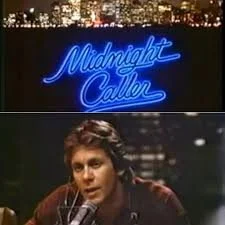
And I have been referring to this cassette as Midnight Caller. Andrew Hargreaves, in an exchange we have over email about the release, calls it The Nighthawk. Both phrases, or names, appear on the cover of the release, and neither is incorrect. He’s called it both, he tells me, but is uncertain if there is an actual title to the composition.
And the structure of the piece—as it unfolds, slowly, over the cassette’s first side, is not unrelenting by any means. However, it does simply just begin. Hargreaves, in how he has arranged the layers, is not interested in easing you into the world he wishes to create and guide us into. And so it is startling, how the central elements—the instrumental composition, and the excerpts from the television program Midnight Caller, do not begin in a collision, exactly, but they are set loose at the same time, figuring out their way around, and then towards each other the longer Hargreaves sustains it, and the longer we sit with intention, and listen.
“We must never lose sight of the fact that what we have to fear the most is ourselves,” Gary Cole explains, within the first few seconds. And the piece itself is not menacing. Not really. But it is intense. Ominous. A darkness that quickly envelops. Creeping. And it is what Hargreaves has done exceedingly well on previous releases—working, in time, to find the balance where this kind of unsettled, or uneasy nature doesn’t recede exactly, or lighten, but allows space for other feelings to surge through. Because there are moments that are less uneasy. I am remiss to say “soothing,” but there are extremely hypnotic portions to the piece—those are perhaps most noticeable, or affecting, on the cassette’s second side, which features the composition without the snippets of Midnight Caller woven throughout.
There is comfort. Or an assurance. It never softens. Not really keeping us, as listeners, at an arm’s length but it also remains on an edge of something. Like it is just moments away from tipping back into something slightly less pleasant. But it can be and often is surprising in the shifts it takes. Hypnotic yes but there are places where an unexpected, and ultimately infectious melody will drift, at least for a few moments, before it the dissonance, or darkness, returns. A kind of perpetual tension and release, always on the verge of one extreme, or the other.
The complexities, and the way the different elements to the piece are woven together, and how Hargreaves retains control over them, is more apparent on the cassette’s second side, immersing us in the heavy drone he uses early on, and the way the tone of it shifts, slowly, as it continues to undulate and suspend itself, as a haunting, screeching or scraping sound is then brought in the distance, arriving in bursts, then quickly receding.
But it isn’t all dissonance. It isn’t all eerie. Because within that, Hargreaves does eventually introduce this somber, slow piano melody. Warbled and a little crunchy sounding from how it has been manipulated. It unfolds like a codeine drip. The notes tumbling into the churning that surrounds it, softening the edges slightly when it does arrive.
And it is in this continued intersection—the darkness that continues to swirl, with the other textural elements introduced, and then removed, offering respite and contrast, that the remarkable does occur, and is sustained, with grace, until the very final moments before all the sounds truly do decay, and flicker out into nothingness.
And it seems dismissive, or perhaps backhanded, to refer to one’s interest in something as a phase. Being dismissive is not the intention of course. A fixation, perhaps, then, instead. And we do find ourselves fixated, as I did, many years ago. Both listening to ambient, experimental, and instrumental music, and attempting to write about it, in my earliest days of analysis and criticism of contemporary popular music.
A fixation or a phase. It often passes. The interest or the compulsion, for whatever reason, wanes over time. And what I have come to understand, in time, is that the way I write about, and think about, music has changed. And it is not impossible, exactly, but it has become increasingly difficult to write, with depth and sincerity, about ambient, instrumental, and experimental music. There are no lyrics to decipher, or to find reflections of yourself in. There are only sounds—the way they move. The shapes they take. Their tone. And in the end, how they make you feel.
*
And it isn’t unrelenting. Not really. Paced well enough, as the track unfolds on the first side of the cassette, to be on the cusp of perhaps feeling a little overwhelming. But assuring enough that, in time, the startling nature with which it begins does subside, even when it reaches its darkest or most dissonant moments. The bits of monologue from Gary Cole, as Jack Killian, from the 1988 television series Midnight Caller. Insights. Offerings. Reflections. The remarkable happens. It continues to happen. The way that these excerpts are strung together—very obviously independent of one another, yes, but there is also this connectivity, and in that, a surprising and welcoming humanity, to be found.
In explaining the process of putting this piece together, Hargreaves explained to me that to prepare, he made what he called a “mixtape” of all the sign-offs from Cole’s character on Midnight Caller, listening to it as he was out and about, then noting the ones that jumped out, or caught his attention.
And it is daunting. I think it is. Intimidating. Taking on something like this. Sifting through three seasons’ worth of monologues, gathering ones that were of more interest, or poignancy than others, and then arranging them as the final, thoughtful layer of a complex foundation. Daunting. But also impressive. Admirable. It is remarkable. How imaginative this is. The places it takes you if you allow it to.
There is this connectivity and humanity found. Rippling throughout there is a sense of loss, or a grieving. And like the idea of a future lost, there is often this sensation, in these reflections, or something that is just out of reach. And a palpable desperation for a connection.
“We must never lose sight of the fact that what we have to fear most is ourselves,” Cole begins—the first excerpt heard, mere moments after the piece on the first side of the tape begins. Not a warning, exactly. There is a foreboding nature to it though, I suppose. A reminder, if anything. Or an acknowledgment.
These snippets, then, are arranged and arrive in a way that leads us somewhere, or rather, to something. An actualization or understanding about ourselves, yes, but also the human condition.
I used to write for a newspaper. I was asked to cover a number of different areas, some of which were of more genuine interest to me than others. Often the local arts and entertainment stories were the ones that were most compelling to work on. Regardless of whether it was a visual artist, the director of a local theatre production, or a singer and songwriter, I would end most of my interviews by asking the person in question what they hoped someone would “take away” from the experience—from going to see a play. From wandering through a gallery. From sitting and listening to a live performance. I never contended it was an eloquent question. Admittedly it was a little clunky and pedestrian in how it was phrased.
I was always surprised when it was continually met with the response—“That’s a great question,” and then a long pause from the person with whom I was speaking, as they attempted to collect their thoughts.
And I am of course always interested in the moment. The moment we sit down in a theatre and the lights dim and the actors take the stage in the darkness. The moment that a singer opens their mouth and the first note resonates. The moment we fix our eyes on a painting, or sculpture.
The moment the record begins to spin and the tone arm slowly lowers itself. The moment we hit the play button on the cassette deck and the tape begins advancing.
But I am more interested in what comes after the moment. We are brought to this place, yet, but what compels me more is the feelings we are left with, for however long, in the moments after. What we will continue to ruminate on, Or how whatever it is we’ve watched, or gazed upon, or listened to, will affect us in the days, or weeks, or months, or years to come.
And there is, of course, more at work, or happening, on Midnight Caller, or The Nighthawk, or whatever you want to call it, than what you can hear when listening to the piece. Hargreaves explained that overall, he is “interested in giving people a place to slow down, take time away from whatever pressures the world is throwing at them for at least as long as the record lasts.”
“I am trying to work out my own emotions that lie beyond words,” he continued.
The piece itself dates back to 2012, and for Hargreaves, it has taken on a larger, or more personal meaning in the interim. It was originally assembled as part of a proposed collaboration between himself, and Leyland Kirby—Hargreaves told me the two of them met in Barcelona in 2010, striking up a conversation about old television shows, and discovering a shared admiration of Midnight Caller, with Kirby, at that time, having come into possession of VHS transfers of the entire series. Kirby, in 2012, suggested they work on a project together based around the show, and Hargreaves recalled he, “got straight to work, looping and mangling the lonely smooth and sinister jazz to create a sound bed for Jack ‘Nighthawk’ Killian’s words of wisdom.”
Further development of the collaboration never materialized, though, and the track ended up filed away in Hargreaves’ archives as he moved on to other things.
In our exchange, Hargreaves told me that his fondness for and genuine interest in the show Midnight Caller dates back to when it was originally airing in the late 1980s—he and his brother would watch it with their grandmother—whom he affectionately refers to as Nana. “Weekend bedtimes with my Nana didn’t follow the strict rules of my parents and as all grandparents do, would allow us to ‘stay up late,’” he recalled. “I have vivid memories of watching Midnight Caller with my Nanna, the thrill of staying up late, the glamor of San Francisco—compared to my small hometown of Burnley, a post-industrial northern nightmare—and the exotic allure of talk radio.”
“Perhaps my love of the show is closely tied to that of my Nana,” he continued. “And why it has always had a place in my thoughts.”
“I’m trying to work out my own emotions that lie beyond words,” he told me.
Hargreaves explained that his father passed away recently, having been diagnosed six months prior with CNS Lymphoma. “It was shocking, as he didn’t show any symptoms, until suddenly it appeared that he had a stroke—he hadn’t.” He recalls this span of time as chaos for himself and his two siblings as his father underwent aggressive treatment. “We would visit him daily in hospital—53 miles away, and when he was discharged back home we became his caretaker, making sure one of us was with him at all times.”
On the precipice of grief, and loss, he started re-watching Midnight Caller, thinking of his grandmother’s passing in 1995—the unfinished composition came to mind, and he sent it over to the label Local History for consideration to be released.
For Hargreaves, there is of course the personal attachment to the pieces. “For me, two people that I love dearly have been folded into the work,” he said. “And I don’t expect this to be transmitted beyond my own reading of the work,” adding he would prefer that Midnight Caller serves as a means to begin further dialogues with listeners, rather than a fixed meaning
There is, admittedly, a little theatricality to the way the piece unfolds and Hargreaves is aware some listeners may find it humorous, though that is of course unintentional on his part. “On another re-contextual level,” he continued, “they might find some comfort in the soothing tones of Jack ‘The Nighthawk’ Killian in these strange times we are living in.”
“It may be open to a whole hauntological reading—more interestingly to me, there will be 50 individual readings, some that I won’t be able to imagine,” Hargreaves concluded. “And all of them are correct and fine with me.”
And I am trying to work out my own emotions that lie beyond words. And these snippets, taken from Midnight Caller, are arranged and arrive in a way that does lead us somewhere, or rather, is going to lead us to something. An actualization for understanding about ourselves, yes, but also the human condition because what is surprising, the longer you spend time with Midnight Caller, is the overall universality of these portions of monologue.
And some of this, if you are able to listen, may not resonate with you. Some of it, of course, did not resonate as much, if at all, with me. But perhaps even more surprising than the universality, is the poignancy and reflection the piece offers.
“The time of night when you’re most alone is when you feel the magnetic field of companionship most forcefully,” Cole says, his voice floating through the heavy ether. “It is when you are drawn to the souls of friends lost. In these hours, before dawn, you recall the words you never uttered and regret emotions you never expressed.”
“The greatest gift we can give those that love us is to get back up again,” he says elsewhere. “Sometimes the runner stumbles. Love is what we want the most and understand the least. The moment when we fully believe in another person, is the moment when life becomes worth living.”
“Old friends remain our link to the past. Best friends are bridges to our better selves. New friends are the promise of a future.”
“Somewhere in your soul, your past resides forever.”
And perhaps, one of the most reflective, for me. “Now, as we enter F. Scott Fitzgerald’s dark night of the soul—where it is always three o’clock in the morning…”
*
Midnight Caller. The Nighthawk. Whatever you wish to call it. I have called it one of those names. Andrew Hargreaves has called it both, he tells me, amongst other things. There is no real, formal title. And the composition appears twice on this release—the cassette. 50 copies in existence. The composition appears twice because, as Hargreaves explained to me, he recorded two separate takes, then placed the excerpts of monologue from the television show over the one he felt was the better of the two.
And there are subtle differences, of course, between the two sides. Outside of the obvious, there are these anecdotal feelings, or experiences, from listening to the piece without the inclusion of Gary Cole’s voice floating through. The second side to the cassette, to me, feels heavier. Darker. More dissonant at times. There is more of an intensity in the tension created and sustained, and the kind of shadowy, murkiness that Hargreaves wishes to take us as we listen. There is less to soften it, or offer reprieve. It is overwhelming, at times. And we cannot help but to allow ourselves to be enveloped by it. The way it can and does surround you. An experience. Something that, as it unfolds, demands your attention.
“I knew I wanted to feature the piano motif that ran through the show’s more ‘tender moments,’” Hargreaves explained to me in our exchange. “And mix this with the ominous synth beds. The noir style tension of dark and light of the show was, no doubt, quite formative in my taste making and definitely an area of interest that has run through the whole Tape Loop Orchestra project.”
The piano elements that ping throughout do soften the edges. As do the other incidental sounds that perhaps could not be filtered out completely in the samples from the show that were extracted and used—often Cole’s voice is clear, or as clear as it can be in this context. But there are places where it is compressed and warbled to the point where it is difficult to understand. Like a muffled voice coming from another room—and you are listening, as closely as you can, your ear pressed against the wall, hoping to make it out.*
And many things are religious in their origins. And many things become less so over time. The dark night of the soul. Originally found in a poem by St. John of The Cross, from the mid-1500s, about the journey of the soul to a mystical union with god. In time, it came to mean a “crisis of faith.”
In time, it depicts an extremely difficult and painful period within someone’s life.
F. Scott Fitzgerald, in The Crack-Up, writes, “In a real dark night of the soul, it’s always three o’clock in the morning, day after day.”
“Now, as we enter F. Scott Fitzgerald’s dark night of the soul,” Gary Cole, as Jack Killian, from Midnight Caller, muses. “Where it is always three o’clock in the morning.”
And, I think, as best as I can, in this moment, I understand what this means. Or, if anything, what it feels like. What it is like to both literally and figuratively exist in this space. There is this desperation. And I wonder if you can feel that, too. And I wonder if you were to listen to Midnight Caller—if you were to sit, with headphones connected to the cassette deck in your home, and be alone with both this composition, and your thoughts, I wonder if you would understand that desperation. The way it ripples to the surface. A longing. A need for connection.
And, I think, as best I can, in this moment, I understand what this means. Or, if anything, what it feels like. A space, or a feeling, literal and figurative. A desperation. A darkness. I wonder if you can feel that, too. I woke up this morning as I often do, at three o’clock. Hours removed from when I did fold myself into bed and shut my eyes waiting for sleep to overtake me. But so close to the edge of the hour I will rise for the day. The math, then, of how much time is left, crumpled under blankets, before the alarm will go off. My brain, alert, and aware of the silence or stillness in the room. The temperature. The discomfort that might already be radiating through my body.
My brain, alert. Unable to quiet itself for another 90 minutes.
There is a desperation.
It’s always three o’clock in the morning. And there is a sadness that descends in these moments. At this time of the morning. Nearly every morning. When I am awake much earlier than I both need to be and wish to be. A dread that fills, quickly. A restlessness. An unease. And it is these feelings that upon rising and fumbling into my day—the first sip of coffee, letting the dog out and then feeding him breakfast and the sound of my own breakfast—cereal hitting the porcelain of the bowl. There is this feeling. It’s not impossible to shake. Most days, it is difficult. It lingers. As morning becomes afternoon and sometimes as afternoon becomes evening and then I fold myself into bed again and then it is three o’clock in the morning. The dark night of the soul.
A difficult, painful period. And sometimes it seems like it is never going to end. This feeling of sadness, or sorrow. This darkness. Like it will never recede completely.
And I am always thinking about this. About how the past beats inside like a second heart. And the pang of loss for the futures we were never going to have. A life unlived.
I am always thinking about how we are haunted. What haunts us. And why.
It is always three o’clock in the morning. Day after day. A difficult, painful period.
And there is solace. Or comfort. I understand that. I wonder if you do as well. Because it is, I think, something we are looking for. Reaching for. Clutching onto as tightly as we can. The small, good things. These glimmers. I keep returning to this. It often feels like it’s the only thing that I have.
On the first side of this cassette, as the darkness swirls, offset as much as it is able to be by the assurance of Gary Cole’s disembodied voice, he tells us that, “The right people are always there when you need them.”
He tells us that, “Best friends are bridges to our better selves.”
He tells us that, “The greatest gift we can give those that love us is to get back up again.
Even in the dark night of the soul, there are still these small, good things. These glimmers. We clutch onto them.
I am always thinking about that.
