I Can Just Listen
This is no mistake. There is no escape from this place.
And it is in this moment when I understand that there is a difference between anger and anguish. They are not in opposition. No. Not exactly. And there is of course the way that they can be and perhaps often are tethered to one another. But, what I realize, in this moment, is that they originate from different places. And they can, as two things that are not all that dissimilar might do, begin moving towards one another. The space, or distance, between the two feelings, or extremes, becoming smaller. And what forms, then, in the center. When there is the convergence of anger and anguish.
The last few years, waiting here. Just hoping for a sign.
There is a difference between anger and anguish. I wonder if you’ve ever considered this. If you understand what I mean. And I have been waiting most of the day for this. Standing outside, in what is more or less a parking lot, adjacent to a restaurant. It’s hot—early June. A mostly cloudless sky. The air that surrounds me, eventually, becoming stale with the stench of beer. Of cigarettes. Of weed. Of sweat and sunscreen and body odor. For most of the day, just like a handful of the other attendees, I cowered where I could find shade. The waning shadow cast by the building. The crowd, or at least those who felt compelled enough, or empowered enough, to approach the stage, for thirty minutes at a time, finding themselves then half-heartedly standing in the direct light of the sun.
It’s the second day of Caterwaul. A three-day music festival in Minneapolis. My first time attending, and it’s the fifth year for the event. And you can buy a pass that gets you into all three days—Friday night, and then all day Saturday and Sunday. But I buy a single ticket, for Saturday. Because, you see, I struggle to occupy myself on the weekends. Saturdays, specifically. It behooves me to get out of the house. To find something to do that is not just going to a coffee shop, or to the library, with my laptop. You run out of things to look up, online. You run out of words to write, on the page. Because, you see, I do so often second-guess my ability to do things like this. To do things on my own. Succumbing to an anxiety that ripples quickly to the surface. Then slowly sinking into a seemingly endless well of sorrow. I talk myself out of things so easily.
I talk myself out of things so easily. I surprise myself, sometimes, by this ability. But, what I understand is that it behooves me to try and in this moment I am trying.
And what I find is that there’s some contention around this year’s festival. Some uncertainty. One of the co-founders, Rainer Fronz, the head of the Minneapolis-based label Learning Curve, has been unwell. Fronz is in the cardiac ward of Fairview Hospital, waiting for a heart transplant. The festival itself, days before it begins, drawing some criticism online for cutting two bands from the lineup because of a lack of funds. Conan Neutron, another one of the event’s organizers, explained on social media that advance ticket sales for Caterwaul were down this year. The crowd, on Saturday, at least throughout the day, isn’t sparse. Not exactly. But it does not feel, by any means, like it is packed.
And I pick Saturday because it behooves me to get out of the house. To perhaps, for just the day, depart from the charm of the small town I have lived in for the last two decades. To find something that will potentially occupy my brain in such a way and for enough of the day that I do not find myself as I regularly do find myself overcome with this horrible, seemingly endless sense of sadness. One that is so difficult to articulate. Where it comes from and what it feels like and how it reverberates throughout my entire being. How it begins in my eyes and when I shut them tightly how I can feel it making its way through the rest of my body.
I select Saturday because there are over 30 bands playing across the three days of Caterwaul, and I ultimately find myself most interested in many that are scheduled for the second day. But there are of course the bands that I am not as enthusiastic about. I am far less compelled or interested in the hoarse screams and the disaffected pretentiousness from a seemingly young group that hits the stage early in the afternoon; or the insincere, performative antics and sophomoric inclinations of another band that is on towards the end of the day.
But maybe, by that point, I had just become impatient.
Though I am so compelled by, or genuinely interested in the snarky, blistering, fuzzed-out trio Burned or Buried, from Chicago, Illinois. Or in the breakneck, ramshackle theatricality of The Hammer Party—the thick, New England accent of their lanky frontman Dan St. Jacques resonates as he speaks in between songs. “We’re wicked psyched to be here,” he rasps.
Intimidating, self-aware, and goofy, St. Jacques spends part of the band’s set off the stage, standing within the small crowd that has gathered around him. He’s not antagonizing them. No. But he tries to rile them up, as best as he is able.
He is not only performing. He is a performer. There is this showmanship. It is fascinating to watch. The trust, or faith, he has in the crowd, as he stands mere inches from them on the hard pavement of the parking lot.
And I am charmed, and then reinvigorated later in the afternoon. Another band from Chicago—the electric and ferocious duo Heet Deth. Singer and guitarist Laila Eskin truly commanding the stage, seething behind the microphone. And there is this confidence, and this connection—one that you can really feel, between Eskin and the band’s recently acquired drummer. Their friend Amanda—Amanda with a broken leg, who is careful in how she positions herself behind the drum kit, but is still very capable of bashing out the rhythms with precision and a seriousness. The two of them wear matching black T-shirts with the Heet Deth logo in the center; they both have bright, elaborate shapes painted around their eyes in stage makeup. The music, of course, is volatile—shrieking at times. It’s also rollicking. There is a jubilance to it. The way it bounces and I find something so inherently wholesome about two friends, making music together.
And just a bit, these last few months, I swore I saw our way out.
The sun has not set. Not yet. But it has begun its descent and is no longer directly above the parking lot adjacent to Zhora Darling, in Minneapolis. The temperature shifts slightly. Becoming more comfortable to step out from whatever pockets of shade you had perhaps found yourself in during a better part of the day. There is more of a crowd by this point. Or, perhaps, more attendees have started to cluster closer to the stage. The second-to-last band is about to go on. The band that, as part of the lineup of the second day of Caterwaul, I was most compelled by. And I have been waiting most of the day for this. This moment. When I understand that there is a difference between anger and anguish.
Shane Mehling, the bassist in Great Falls, looks a little like Tom Hardy. The actor. Just a little. I think it’s his eyes. Maybe I’m making it up. Maybe I have, in this moment, forgotten what Tom Hardy the actor looks like. And maybe I’m the only one, in this crowd, in this parking lot, who might see it. But it’s one of the things that I am thinking about during the thirty minutes of stage time the band is given. And Mehling is, without a doubt, a hulking presence. The way he stalks around, flailing and thrashing his enormous bass guitar. At times, thrusting himself—like, his entire body, towards the very lip of the stage. There is little, if anything, that then separates me, and the people I am standing closest to, in the crowd, from him. The look in his eyes and the expression on his face that remains during the entirety of their set. And this feeling. Intense, yes. Sure. But what comes after that. That is one of the things I am thinking about during the thirty minutes Great Falls are on the stage. The moment I have been waiting for. What comes after the word “intense.” Antagonistic. Confrontational. Something bright and fleeting that exists in the space between thrilling and terrifying. Because once, a number of years ago, I told someone, half in earnest, half in jest, that one of the reasons whatever my order is going to be from a coffee shop, it has to be “extra hot” and I never wait to take the first sip, is because I just want to feel something and in this moment the moment I have been waiting most of the day for the moment where I understand that there is a difference between anger and anguish I am thrilled and I am uncomfortable and it behooves me to try and I am trying and Jesus Christ for just a little while let me feel something for once.
*
Great Falls is unrelenting and torrential. The band, from Seattle, Washington, formed in the late 2000s—with both Shane Mehling and guitarist, and vocalist Demian Johnston having played together in the group Playing Enemy. The current iteration of Great Falls was solidified when drummer Nick Parks joined shortly before the group recorded their 2023 full-length, Objects Without Pain.
And on stage, at Caterwaul, on a Saturday evening in June, from a parking lot adjacent to a restaurant, Great Falls are given, as all the other acts that preceded them during the day, a half-hour. And for that half-hour, they are unrelenting, and torrential. There is a fury, of course, and you can hear that in their recorded output. A volatility. Seeing the band perform live, even for all of thirty minutes, is truly unlike anything I have ever experienced. Great Falls are loud. They are dissonant. So much of their work takes place within something discordant, and they are rarely if ever interested in finding resolve. Their songs—sometimes sprawling in length—are restless, often shifting and writhing within themselves, over and over again, and they operate from a place of unrest. An unease. Discomfort. I think it goes without saying. There is a darkness. Pitch black. And there is a heaviness. Literal, yes. But figurative.
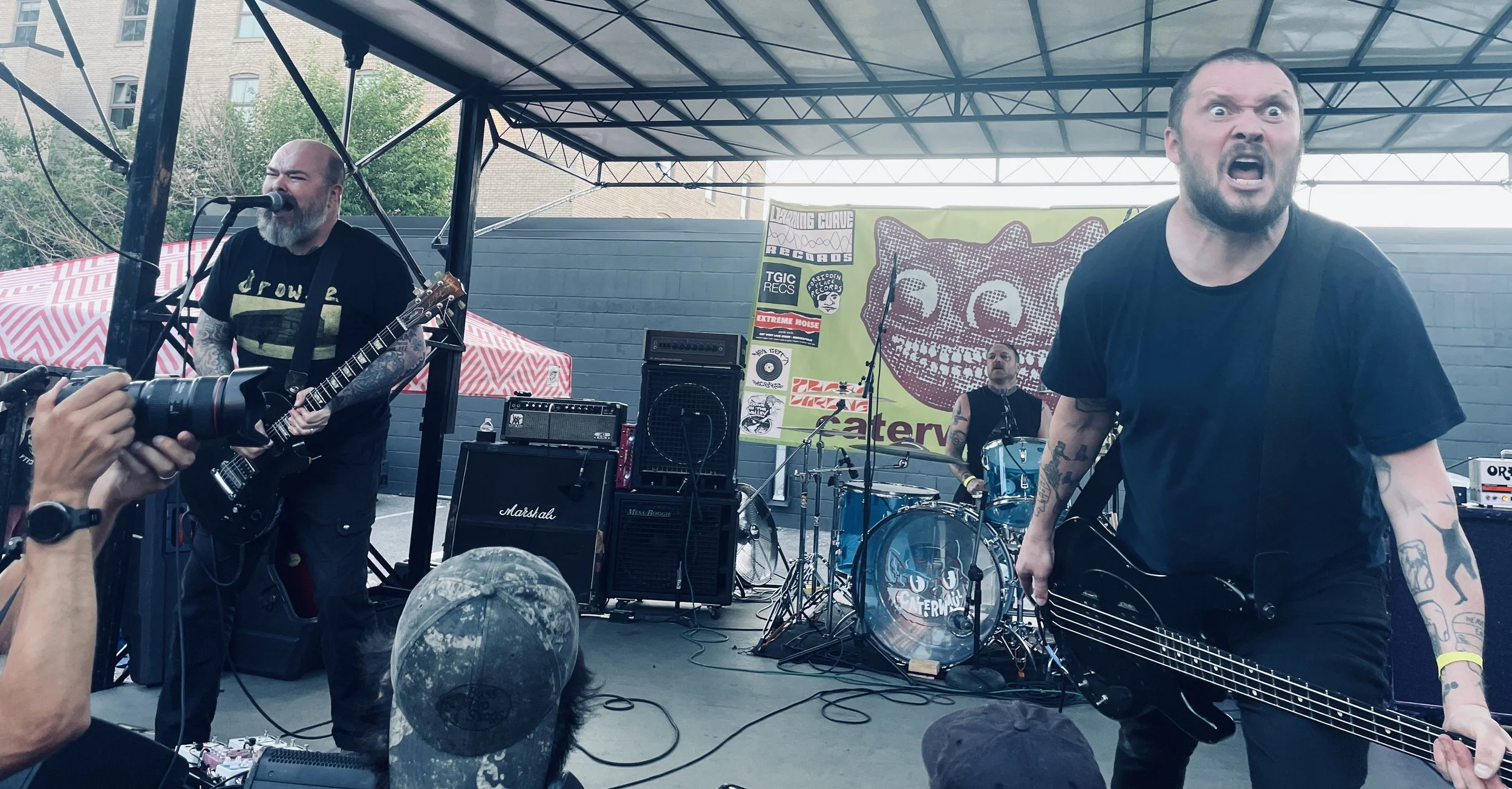
There is this space that exists. When something is harsh, or hideous. Difficult. But there’s something beautiful that occurs too. Something wondrous. Something that can and often does surprise. Thrill. Elate. Exhilarate. And this is the moment I have been waiting most of the day for. It behooves me to try and I am trying and I step away from the waning shadow cast by the building, where I have stood and watched many of the performances on the second day of Caterwaul and I walk towards the very front of the stage, as the band that plays prior to Great Falls is collecting their equipment, and as Johnston, Mehling, and Parks, begin to set up their gear. So much of the band’s work takes place in dissonance. Something discordant. Harsh. They are given a half hour, and they begin their set with “Dragged Home Alive.”
The lengthy, unpredictable opening track from Objects Without Pain. It starts with Johnston repeating a distended, tense chord progression on the electric guitar. A meditation that lasts, like over 40 seconds. Meticulous in the pacing. The timing. There is a silence, and space, that hangs so heavy in between the strums. And when he opens his mouth, to deliver the first lines of the song, he’s actually stepped away from the microphone. Shouting them out. There is a desperation to them. How they sound. The way they land, with specificity, in those spaces. In between the thick, resonant sounds of his guitar strings.
“The last few years, waiting here,” he bellows. “Just hoping for a sign. And just a bit, these past months,” he continues. “I swore I saw our out.”
Parks, then, comes in on the drums, playing a steady, crisp, slow rhythm that falls in underneath Johnston’s guitar. And the thing about Great Falls is that so many of these songs exist in a state of unrest, and a restlessness. There is, like so many things, a difference between the two. But they can and often do occur at the same time. In the same breath. One of those is so much more volatile than the other and there is an abrupt shift—the tempo quickens, and the drumming becomes more frenetic, as Mehling starts to pound away on the strings of his bass.
And there is this moment.
This moment that is both beautiful and terrifying, when Johnston, still far away from his microphone, and Mehling, lurching towards whomever is in the crowd, closest to the lip of the stage—they both bark, “This is no mistake. There is no escape from this place.” And it is in this moment, seeing it happen in front of me, and hearing it. This experience. Just these few seconds within a song that spreads itself over six minutes. This is the instant when I understand there is a difference between anger and anguish. And there is this rush. The thrill. The discomfort. Let me feel something.
*
There is this contrast—again, these are things that are not in a real, or an actual, opposition to one another. Not really. But two things. Feelings, or sensations. Beginning from opposite ends. Slowly converging on one another. What happens, then, in the center of that. Because so much of the music of Great Falls is both claustrophobic, and enormous. Both can be true. This contrast that exists. These feelings and sensations. And the collision that occurs when they intersect.
Great Falls is voluminous—yes, of course, in a literal sense. They are a loud band. Demian Johnston’s guitar tone is snarling. Ferocious. Sharp, distended edges to every single note and chord. Nick Parks’ work behind the drum kit is punishing—the thundering double bass drum is unrelenting, and he attacks the rest of the drum kit with this remarkable and blistering precision. And Shane Mehring’s bass often slices through the fabric of the song—thick, tightly wound. Resonant. Surging with intention.
And this creates something torrential. Ever moving, or shifting. Propelling itself forward.
It is fascinating. This juxtaposition that occurs. Because within the scope, and literal enormity of the band’s sound, and how they structure their songs—there is such a bleakness that hangs above and it hangs in such a way that it feels impossible to get out from under it. I hope you understand that there is this ceiling to it all. There is this darkness. And within this darkness, Great Falls do inevitably not only ask you to but demand that you confront something that you are no longer able to outrun, or look away from. And in this darkness, and in this enormity and scope, it does all become oppressive. Encompassing. And in just how oppressive and encompassing it is, you understand just how low the ceilings actually are. How little space you have to move. How there is a risk in the end that you are going to suffocate within yourself.
There is a difference between restlessness and unrest. And they are perhaps tethered to one another in some way. Maybe less so than anger and anguish. Originating from different places and then slowly moving towards one another. Not dissimilar. Because there is this overlap that can occur and often does. But I understand that one can exist without the other. I understand that sometimes one becomes the reason, or the cause, for the other. Because in the center of The Bite That Grows Up—the new full-length album from Great Falls, amongst other things, there is an unrest. And from the moment it begins to its final, searing, breathless moment, The Bite That Grows Up is restless. Absolutely unwilling to remain in one place for longer than it needs to. Volatile and explosive in how it writhes and thrashes and kicks against itself in an effort—often desperate, to break free from itself.
The ceilings are low on The Bite That Grows Up. And somehow, it is expansive. Gigantic. There is this contrast. What the darkness feels like and how large something can grow within it before there is simply no more room for either you, or what you have been trying to remain just a few steps ahead of.
And it is remarkable. All of it. Exhaustive. The way Great Falls, across the album’s eight songs, spanning 40 minutes, play with the ideas of sound and space, and scope. The horrible sense of tension perpetually building even in what inherently feels like a constant state of release. An unending rush of catharsis. Great Falls, as a band, asks for your patience. For your attention. The deliberate way they work towards something—the unpredictable shifts. The detonative nature. There is such thought and intention to it. And in the discomfort and unease and the fury they are asking for your time, yes, but also an understanding. For your understanding.
There is no cure for the human condition. And there is of course something horrible within all of us. And there is an unflinching, personal narrative threaded throughout The Bite That Grows Up—perhaps the most impressive element of the album. It’s concise and vivid. Fragmented. Confrontational and confessional. Stark in its observations of the self and what it comes to then acknowledge about others. And in this conceit, there is another juxtaposition. This contrast. Things not in actual opposition to one another. Another surprising element to the album and the band. Because in the fury, and dissonance, and walls of scathing noise, there is something wondrous. Beautiful, really. And in the discomfort of what Johnston not only writes, but howls and bellows—a voice boiling over with anguish, there is something comforting about this. That you are, perhaps, not alone in the darkness. In what you have been trying, and failing, to outrun within yourself.
*
This is why I’m here. I need help.
I came across this expression many, many years ago. “I’m torn between the fiction I am, and the reality I imagine for myself.” And I think about the way we write ourselves into things. The way I write myself into something. This version of myself and what it will reveal. How it will make those revelations. Exaggerated or heightened. A truth, though, within. The difficult places we find ourselves. The understanding or the acknowledgment it will, in time, guide us to. The difficult reflections asked of us.
I am always thinking about The Work. The rigorous nature of self-discovery. Of the ways we wish to perhaps improve ourselves. Growth. Change. The continuous effort required. The things about ourselves we are then asked to confront.
And there is a narrative that unfolds across each of the eight tracks on The Bite That Grows Up. A story. This notion alone—the concept album, the song cycle, whatever you wish to call it—is incredibly ambitious. How Great Falls approach this, though, places them on another level of intelligence. Bite, even if it were not constructed, and held together in such a manner, is an album that even in trying to keep up with, or stay a step or two ahead of it, it has already outwitted you.
“I enter some church—counting stairs,” Johnston shouts, in the album’s opening track, “A Small Weakness.” “Maybe there’s a joke. Maybe I break the ice.”
And it does help, I think, to have some kind of even rudimentary knowledge of the concept The Bite That Grows Up is structured around—Johnston, in his writing, throughout the record, is vivid yes. But again. This contrast. The writing is intentionally sparse. Just these fragments. Enough to depict something that is both clear, or understood, but still clouded with ambiguity. Confusion. Disorienting. The band of course wants to disorient you.
I’m sorry. I think I’m done.
Each song is like a chapter unfolding in the narrative. “A Small Weakness,” then, serves as an introduction, quickly pulling us into the world the album creates. And create, I suppose, is an important word. Because in the narrative, Johnston has created a group therapy session for himself. A church basement. The coffee’s hot. A reluctance to participate, and the reluctance to confront what has brought him here in the first place.
“I’ve been sent here, but I’d come by myself,” he explains. “This is why I’m here. I need help.”
There is a difference between anger and anguish. I understand that when I watch Great Falls perform in a parking lot next to a restaurant in Minneapolis. And I understand that again when I listen, and when I give consideration to what I presented on The Bite That Grows Up. This fury. The tempestuous nature of the band’s sound. It is so heavy, and it is so dark, and it comes from a place of pain. Of sorrow. Of desperation.
The vocals, as the narrative continues on “A Small Weakness,” begin to overlap—not a conversation but an exchange, between Johnston and the facilitator of this group that he has created. “I’m sorry,” he says. “I think I’m done. I’m not sure about this.” Though he quickly shifts from his hesitancy—“Okay, I’ll stay around. I am sorry. Okay, I’ll stay,” he concedes. “I can just listen,” he says, but there is still this uncertainty. This fear in the discomfort. Because the last thing he bellows is, “I should run.”
And I feel like it is worth noting and perhaps I already should have stated as much and perhaps you have gleaned as much, at this point, if you were not familiar with the band before now—but it is worth noting that Great Falls, in the music they make, are not following any traditional structure. There is no verse/chorus/verse. There are no choruses. You could contend that it is all verse. The way Johnston’s narrative unfolds with intention, yes, but there is this declarative, stream of consciousness in how it arrives. And it does feel like in talking about the music included within The Bite That Grows Up, the word “song” isn’t the right word. Not exactly. Compositions. There is a compositional nature to so much of this album. And maybe this is not the right kind of comparison to draw, but there is such virtuosic and meticulous musicianship on this record, that in how a track, a piece, a composition, and yes a song—in how many shifts there are, and how unpredictable it becomes, it does feel at times similar to a jazz performance. The trust and understanding the members of the group have in one another, and the precision required to keep up with one another to propel themselves, as a whole, forward.
And there are constant shifts throughout The Bite That Grows Up—each track simply refusing to remain in one place for very long. “A Small Weakness” is perhaps the most inherently restless of the album’s eight compositions. Restless, because it is in this state of perpetual motion, quite literally tossing itself forward. It also comes from a place of unrest. There is the self-exploration and confrontation that occurs in the narrative—the discomfort of Johnston’s writing reflected in the otherworldly, torrential, and tumultuous arrangements.
The song begins with this brief—and I mean, like, three seconds—blip and burst of crackling and distortion before we are quite literally thrown headfirst into the already churning, torrential sounds. Ferocious guitar chords. Rattling bass notes. Clattering, bashed percussion. This undulates, crashing into itself, before there is just this split-second reprieve, then it comes back, though with a little more of a sharper, dissonant edge on Johnston’s guitar playing. Searing. And this is all of, like, thirty seconds into the song. These stops and shifts and adjustments in intensity.
“A Small Weakness” continues to writhe. Turning further inward shortly before the lyrics begin. Glitching and skittering with less instrumentation before everything comes rushing back in such a volatile, pointed way. The musical equivalent of falling down a flight of stairs, but there’s actually no end to the stairs, and your increasingly mangled body just keeps tumbling and tumbling and tumbling until a little over the two-minute mark, when things feel like they are settling. Not a calm. But just a moment to breathe. Mehling’s thick, long bass notes circling around Johnston’s plaintive, distended guitar string strums. An atmospheric fluttering noise just underneath it all. And as he howls the expression, “I need help,” a gigantic, crunchy, fumbly squall of guitar feedback crashes in, overtaking everything until the arrival of another punctuative instance.
As Johnston inhales and then bellows, “I am sorry,” “A Small Weakness” explodes again, returning to the similar torrential rhythms from earlier, albeit briefly, before it doubles down on itself—without warning, picking up speed and growing even more in intensity. Becoming frenetic—moving with such a breakneck pace that it feels like there is no way the band, however dexterous they are, can sustain this frenzied momentum for very long. And they don’t. It turns inward again—returning to that moment to breathe, the atmospheric fluttering. The resonant bass guitar. The flick of the down-tuned guitar strings. Johnston’s voice, hoarse with anguish and sorrow. “I’ll stay around. I am sorry,” he explains, before the song—the song—enters into its final movement, not picking up speed but more momentum. Growing more robust with the percussive flourishes keeping the rhythm, and the layers of guitars piling themselves up over the final sentiments.
It screeches and trudges. Before it collapses into noise. Johnston, still screaming himself raw, “I should run.”
*
And there of course is this connective nature throughout The Bite That Grows Up—the pieces connected through Johnston’s narrative, and where he wishes to lead us. But the tracks themselves are also loosely connected. The ending of one and the beginning of another. Often fleeting moments of reprieve from the intensity that is unrelenting in how it courses. They are still distorted or dissonant. There is really nothing harmonious about Great Falls or Bite. But in how the flutter, and jitter, they provide a fascinating gasp of air before you are plunged back down, further and further.
And because of the connective nature to The Bite That Grows Up, each side of the record is somewhat self-contained. A break between acts. The first half concluding with the stuttering, thrashing, towering crunch of the sprawling “Hailstone Numbers,” which, after a jumble of distended guitar drone and feedback, offers a literal moment of silence before the second half begins. “Nicotine in The Spine,” opens with a few cavernous, moody notes trickling out on a piano, before it is abruptly interrupted, and we are tossed back into the unrelenting tumult.
“Nicotine in The Spine” was released as the first single from The Bite That Grows Up. And I am uncertain if “single” is the correct term, or offers an accurate description. And maybe this is giving too much consideration to how I talk about music, or how I think about music—specifically, in this moment, how I am collecting my thoughts about Great Falls and The Bite That Grows Up, and how to approach, with care, an album that challenges its listeners.
Because, anecdotally, when you use the expression, “first single released from the album,” you think, or at least I do, about accessibility. You think about contemporary popular music and pop music in more traditional ways. A small slice of what is to come. Indicative of the whole. But able to stand on its own. To compel. An invitation. In that sense I suppose at least for me, “Nicotine in The Spine” is successful as a single because it did compel and it does offer an invitation. It is indicative of a whole. And you can if you were so inclined to remove it from the whole, it can stand on its own though like the other tracks on the record, it does simply work better within its context.
Great Falls are not composing material that is infectious. There is no enormous hook. The thing about this band and this record is that none of this is going to get stuck in your head the way a pop song does. The way a melody from, say, a song off of Day and Night, the most recent Carly Rae Jepsen, does. But. I tell you all of that to tell you this. Great Falls are making music that you will be thinking about. Ruminating. Lingering. The heaviness hangs like a specter and Johnston’s writing—in what he is attempting to confront and what he is then asking you to confront about yourself as well, will haunt you long after the record comes to its abrupt close, taking its final, desperate, pained gasp.
And the thing about this album, and how abruptly the songs begin—specifically “Nicotine in The Spine,” once you are in the song, it feels like you are just a few steps behind, and you will spend the rest of your time simply trying to catch up. Musically, it is that far ahead of you, as the first notes come slamming down. And they slam. The impact, coming out of the few seconds of out-of-tune, haunting piano keys, makes your body shudder. The intensity and visceral nature of this band is something you can not only feel figuratively, but quite literally. Ratting your bones and rumbling your organs with just how heavy it is.
In a recent episode of the podcast Punk This Week, co-host Nina Corcoran, said there are “a lot of ways to write songs,” and I have been thinking about that, in relation to this album. Thinking about that in terms of accessibility. How welcoming something might be to a listener and what is going to keep someone at an arm’s length. Anecdotally, “Nicotine in The Spine” is one of the more accessible songs in its structure. It is still full of erratic shifts in tone and tempo, but there are perhaps more opportunities to ease, or settle into a specific direction, or movement, within the confines. Does that make sense? I hope it does. These songs, pieces, compositions, whatever you want to call them. There is this momentum that just keeps pushing everything forward, but in a place like this, Great Falls does give a little more time or space to specific ideas. There is such a snarl to Johnston’s guitar tone—it screeches in a way that is so memorable. Truly a distinctive edge, early on, before arriving at the halfway point where the song lurches and stumbles, with these enormous, emotive swings that Parks’ creates through his frenzied, blistering drumming. Everyone in the band does it—playing with the space that exists in between notes. Not a silence. Not always. This pause. There is such a weight to it and Parks knows how quickly to pummel across every drum on his kit, and when to hold. A pause within the rhythm and momentum before he finds it again and crashes down on a cymbal, pushing ahead again.
Like “A Small Weakness,” within the ferociousness, there is a place where everything recedes for just a moment, before there is this dramatic build—a hi-hat cymbal keeping time while Johnston plays this sneering riff on the guitar, his voice still in so much agony, bellowing above it, with Mehling’s bass, rumbling through, then gnashing its way into the momentum that is swirling in a way that feels like is never going to stop, becoming unnerving as it thrusts you into the writhing and thrashing tension and cacophony of its final moments.
There is an interview in New Noise with Mehling and Johnston from around the time Objects Without Pain was released, and Johnston talks a little about not so much his process with writing, but the approach he takes. His candor is surprising—at least to me. “I have to write the lyrics and I have to sing, which are two things I totally hate doing,” he explains, before adding that he often pulls from uncomfortable situations or circumstances for his writing as a means of trying to work through, or process them.
“Lyrically, everything I do is authentically me,” he says elsewhere in the interview. “It definitely comes from my real life situations,” he continues before adding that it’s not one hundred percent accurate storytelling. “You listen to those lyrics and you would think I’m the world’s most divorced guy but I’m not. I’m happily married. Every relationship has issues and I often pull from interpersonal relationship issues as inspiration. It’s therapeutic in a way for me to write about my concerns and my insecurities.”
I think about that a lot. The fiction we are, and the reality we imagine for ourselves. The way we write ourselves into something the way I write myself into something this version of myself and what it will ultimately reveal. How exaggerated or heightened are the circumstances. What part of myself am I exploring. Exhuming. There is this truth and that is the thing. It is still authentic. These difficult places we find ourselves and the understanding or the acknowledgment we are guided to and the difficult reflections we are asked to confront.
The past beats inside like a second heart. I’m always thinking about this. There are always these things we are carrying with us. Fragments from another life and another life and maybe you are like me and you wish you could get out from under all of it but maybe you are like me and you have been asked to acknowledge just how much of that—how much of these specific moments, or fragments, have shaped who you have become, and in acknowledging that how do you if at all reconcile with it.
In “Nicotine in The Spine,” Johnston howls, “You should hear how I was raised,” holding that final word out just a little longer before taking a breath. Because the idea of family, and what is inherited, is at the heart of The Bite That Grows Up. The ways in our lives we were perhaps failed. Not given what we were needed at the time. In that moment. And how that does go on to inform so much. The way we see ourselves, then, failing others. Our shortcomings. These ideas are explored across the album—different fragments, or vignettes. Or, within the construct of a group therapy session, in a church basement—it is Johnston having these exchanges with himself.
“This is true,” he barks at the beginning of the song. “I scream in my child’s face. When I break down—give me that phone. When I broke down—what can dad do to keep you safe,” he continues, screeching. “When I break down, my eyes tear up. When I break down, I start to give up.”
The anguish, and disappointment in himself is a sharp and difficult contrast to something Johnston says earlier in the record, on “Worse Than Sleep”—“This is so easy. I’m a great dad.”
“With help, maybe you’ll be okay. I’m not doing well,” he confesses. Then later, “I’m not prepared. I’m barely dad. You should run to the woods.”
*
And I had been waiting most of the day for this moment. Standing outside in a parking lot, adjacent to a restaurant. It was so hot. Early June. A cloudless sky. For most of my time on the second day of Caterwaul in Minneapolis, like many others, I cowered where I could find shade. The waning shadow cast by the building. The crowd—the faithful, or those who felt empowered or compelled enough to do so- approaching the stage, for thirty minutes at a time, half-heartedly standing in the direct light of the sun.
I bought a single ticket, you see, for Saturday. Day two of three. I struggle to occupy myself on the weekends. Saturdays, specifically. It behooves me to get out of the house. I struggle to do things on my own. To have stood in this parking lot for most of the day, there is a version of me that could never have done this. Going to a concert alone. Going to festival alone. I second-guess my ability to do things. The anxiety that ripples to the surface, then slowly sinks into a seemingly endless well of sorrow. And I have managed to avoid standing directly in the sun for as much of the afternoon and into the evening as I could and I have managed to avoid growing too anxious, or sorrowful, even though I understand there is little holding it all back.
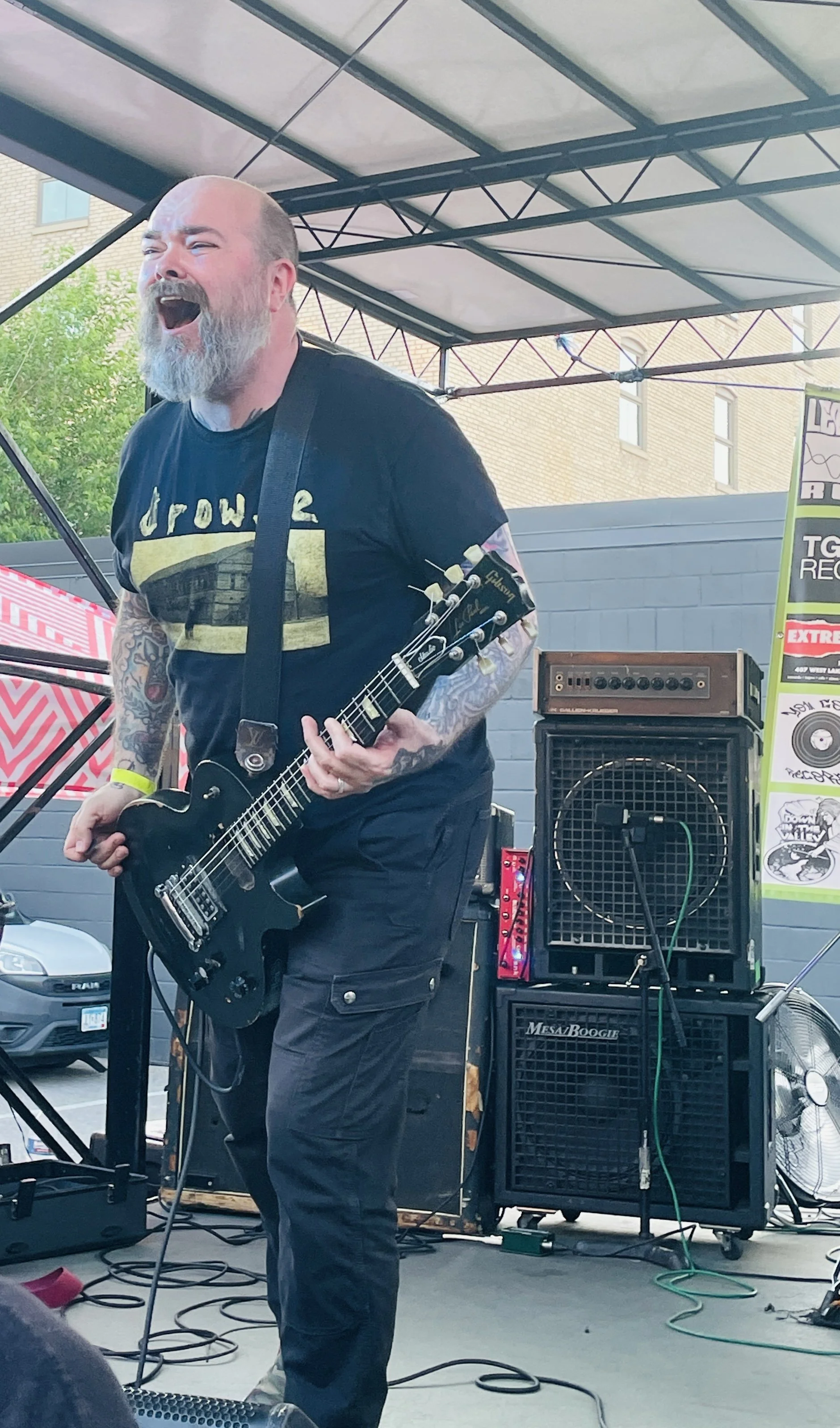
And Great Falls is the penultimate band for Saturday evening. The sun has begun its descent, and the temperature, as the band is setting up their equipment on the stage, has become more reasonable. Great Falls, of all the bands that I have watched, is the one I am anticipating the most. The band I was most compelled by. I have been waiting most of the day for this moment and I try to find a confidence within myself as I position myself close to the front. There’s no barricade, or anything, separating the band from the audience. There is this trust then that forms I suppose. When there is nothing between you and the performer. You are opening yourself up to something. I am trying and think about how once a number of years ago, half in earnest and half in jest, I told someone that one of the reasons whatever my order is going to be from a coffee shop, it has to be “extra hot,” and I never wait to take the first sip is because I just want to feel something.
This is no mistake. There is no escape from this place.
Great Falls, in the thirty minutes they are given, are loud. Blistering. Ferocious. It’s overwhelming, in a way. This thrill. It’s exciting. The allure and the compulsion of something with a sharp edge. Volatile. Cathartic. And there is this sense of menace. Confrontational. Antagonistic. I watch as Nick Parks bashes away from behind the drum kit and I watch Demian Johnston creating a torrential wall from his guitar as he bends his knees just a little and leaning away from the microphone before he screams and when he screams what I understand is that it is not something I had ever really given consideration to in the past but there is a difference between anger and anguish. And I cannot take my eyes off of Shane Mehling. How unpredictable he is on stage. The way he thrashes himself and his bass around. The way he looms and the way he lurches over the edge of the stage, his face inches from mine because there is nothing to separate the band from the audience and I am just trying to feel something.
There is nothing to separate the band from the audience and when I think about watching Great Falls perform for a half hour in early June, I think about the man who was standing in front of me. Weird and wiry. Smaller. Maybe a few years older than me though I cannot be certain. The back of his head. His hair cut in a conservatively coded way. And I could not tell, from his motions, and the way he moved his body, if he was having a good time, or if he was terrified. Or if that was the point. If the good time, for him, was in the terror. There is nothing to separate the band from the audience and every time, during the half hour, Mehling would confrontationally thrust himself out towards the edge of the stage I kid you not this man standing front of me seemed like he was trying to shield himself. Putting his hands up in a slightly defensive manner. Cowering. But what I could not tell was if this was a bit. If this was funny to him—to recoil in fear, or terror, in a comically exaggerated way. It continued to happen, and this man—this small, seemingly timid individual, was moving his body around so much, potentially in fear, that a joint fell out of his pocket and he ended up stepping on part of it, crushing it slightly.
Someone standing next to me picked up, and tapped him on the shoulder, joint in hand, alerting him to the fact it had fallen from the pocket of his shorts. He seems a little bewildered and even though I cannot hear the exchange taking place, from the way he is moving his hands, I understand he is trying to offer it back to the person who picked it up.
They awkwardly, politely decline.
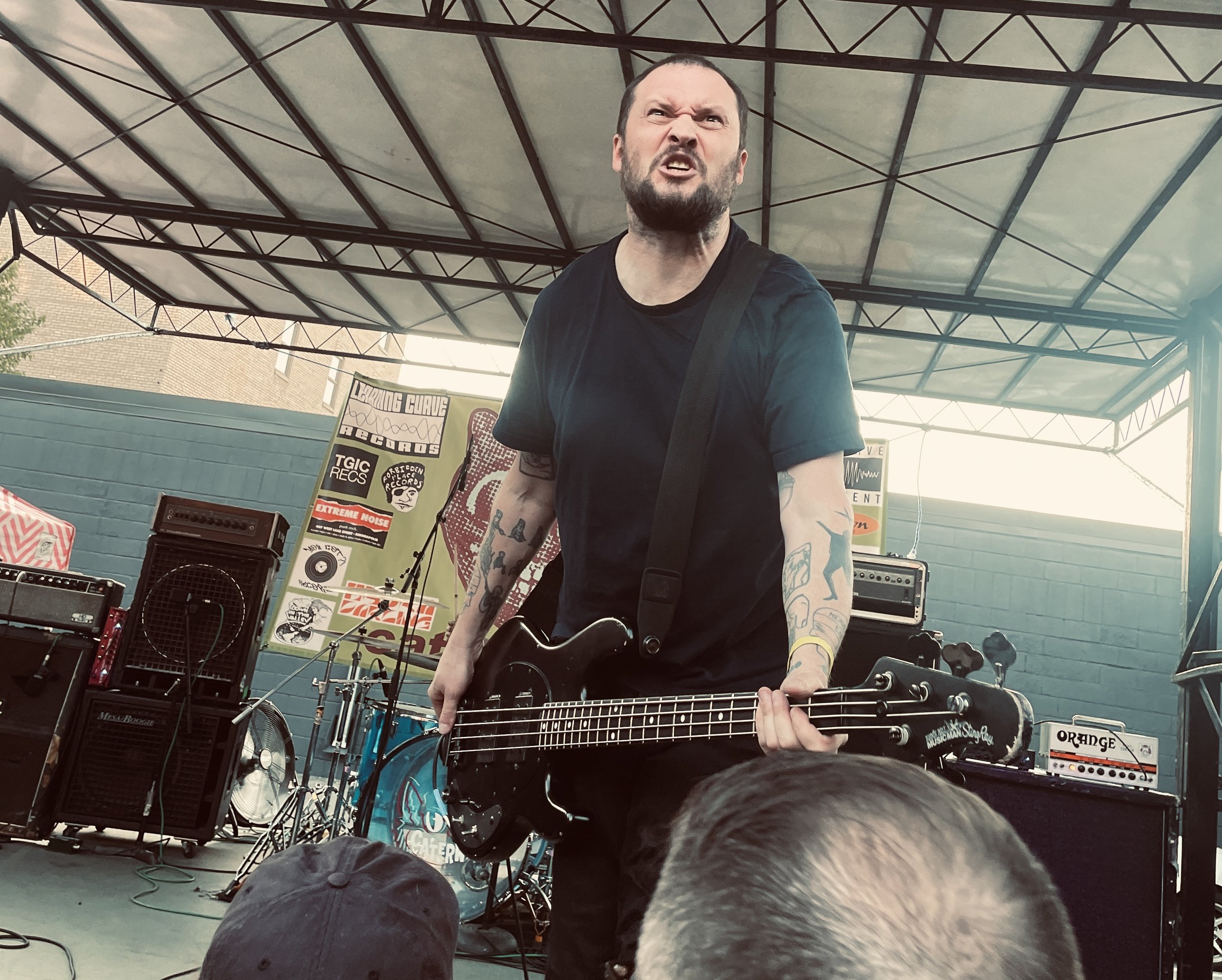
Great Falls end their set with the closing track from Objects Without Pain. “Thrown Against The Waves.” On the record, it sprawls out over 12 minutes—taking up the final side of the second LP. And it is a song that does require that much time to build. To keep churning within itself. There is this place, even in the abridged version that the band plays at Caterwaul, where they are very clearly working toward something. They lock into this rhythm. The same notes kind of staggering or stuttering over one another. As it is performed live, you can watch Johnston working with a looping pedal, constructing the layers, and the mounting tension, that will inevitably see release in an enormous, cathartic final gasp.
And I had never really thought about it before. Not in until this moment. The moment I had been waiting for. The moment when I just want to even briefly feel something. Something else. Something other than how I feel so much of the time. But I consider Great Falls. And their sound. The wall of noise that they craft. The way this material is presented. And what is at the heart of this presentation. And now anger and anguish are not so dissimilar but they are also not the same thing. Because there is this sorrow, and desperation, that comes through in both Johnston’s writing, but also in how his lyrics are delivered. Even in how they are screamed, his voice is not raised in anger. Or rage. No. It is a clawing toward something just out of reach. It is done in exasperation and it comes from this vast and endless darkness and yeah maybe that is the point. That regardless of how hard you look or how frantically you search, it feels like there is actually no way out of this. This is no mistake. There is no escape from this place.
*
The end of Johnston’s narrative arrives in The Bite That Grows Up’s closing track, “What No One Can Give”—across seven minutes, a space where he tries, as he is able, to reconcile with the experiences, and memories depicted, and as he vacates the imagined group therapy meeting in a church basement, there is this want for a hope that can be seen just over the horizon.
And it is powerful. Effective. Disorienting. This final moment. The way the band continues to shift through tempos and levels of intensity, pushing it to an absolute breaking point in the final seconds—the song does just stop. One last anguished exhalation.
Some of Johnston’s most harrowing observations from within the album’s narrative, and what it explores, come within “What No One Can Give.” There is an implied urgency to the way he flees the church basement, sprinting towards his life, wherein he wishes to be an active participant, and where more than anything he wants the best for his family. Specifically his daughter. “I am failing,” he howls. “Helping while wrecking our lives. Hoping while wrecking her life.”
And there, of course, is a surrealism to the entire album. The conceit. This church basement. An imagined group therapy meeting. The coffee’s always hot. This place, so far inward. The fiction we are and the reality we imagine for ourselves. In the album’s final moments, in desperation, things begin to blur in a way that implies that hope, but it is still underscored by a starkness. “We had tried,” Johnston yelps. “Tell me it worked. That she’s alright. That she’s okay. She got that job. She’s in that band,” he continues, as the sound becomes more and more overbearing and torrential. Shattering. The way the drums rumble and the guitar screeches and the resonant thudding of the bass notes. The narrative ends. “And I got old,” Johnston muses, accepting what is ultimately fated. “And I love the calls. I sit on my porch and dream of the group. This family we built. The dogs have run off—I stand to call them. They find me in the morning.”
And it is surprising. The way it ends. This literal, and figurative final gasp. Startling. The narrative brought to this definitive point. But why is this surprising. It really shouldn’t be. Given the tone of the album. The tone of the band. This should not be a surprise at all. This discomforting feeling that lingers long, long after you’ve finished listening to the record.
*
And it is overwhelming. An album like The Bite That Grows Up. A band like Great Falls. That is the intention, though. A world built, that we are invited into. Something experienced. Listening with thought. Listening for the meticulous details. The small moments. The songs, pieces, compositions, whatever, always propelling themselves forward. A breathlessness. Unrelenting. And that can be what is so compelling about it. The things to note, each time you listen. Tones. Sounds. The way something feels. The way the snare and cymbal hit like an actual fist at a point on “Worse Than Sleep.” The crispness. How sharp they are. Punching through the distended chugging of the guitar. The things to note, each time you listen. The loop that plays, just briefly, in “Hailstone Numbers.” Dissonant. An arrhythmic bending and fumbling of a few notes on the guitar. Wonky. The loop itself isn’t seamless—there is such an abruptness to it when it cycles back onto itself and begins again. Hypnotic and uneasy.
The things to note. Each time you listen. The moments of dissonance. The way the band plays with literal noise. Like it is an instrument. Or brandishing it like something to be afraid of. The way there is this tension always seeking release. The way the lyrics, and how they are wailed, are not drowned out by the music, but they are fighting for space. To be heard and to be understood or acknowledge. The difference between anger and anguish. What happens when those two things begin converging on one another. What forms in the center.
And the notion of family. Of what we inherit. Of our shortcomings. Of course all of that is difficult to confront. To reconcile with. If you can. You don’t actually have to. Your nature might be one to offer grace. You can play against yourself, though. If you no longer can, truly, offer that grace. And it is overwhelming. The ask of this album. What it wants you to confront. And it’s surprising. How you not only listen but you experience and in the church where the coffee’s always hot and there is a seat for you within the group meeting—where does this album take you. Because I think about the album’s second track, “Pinned Against Time.” The shortest track on the record. And yes it is worth mentioning, I think, how deliberate the structure of The Bite That Grows Up is. The way it is bookended with tracks that somewhat mirror one another in running time. Another small compelling detail about the album when there are so many small compelling details about the album. But I think about the song “Pinned Against Time” and why it is so upsetting. What it makes you consider, as you listen.
It begins with the discordant, crackling atmospheric flutters and warped, quivering piano loops that ripple up at the end of “A Small Weakness,” seamlessly carrying one song to the next and “Pinned Against Time” throws you into this spiraling, rapid-fire hit of the snare drum with these huge, distended, snarling riffs from the guitar. The word frenetic doesn’t even begin to articulate what this feels like. How quickly it is moving and the intensity it conjures from the moment it begins until it sputters out into a burst of sharp feedback in its final seconds.
I think about what we inherit. Our shortcomings. How we confront it and reconcile with it if we are able. If we are willing. I think about how there are moments, from the past, that are still hanging—suspended in time, and how I return to those and how I have been asked to acknowledge the detriment they caused at that time and I have been asked to understand the detriment they are still causing now. I have not seen or had an actual conversation with my father in over 20 years. I think about the short one, or two line emails he will send to me around holidays and how I am no longer in a place where I can will myself to respond to them. “He was a sad man. That’s where I got it,” Demian Johnston screams, his larynx shredding, at the beginning of “Pinned Against Time.” “I have his eyes,” he admits. “You’d think I’d see—see what’s coming?” And I think about the difficult and fractured relationship I have with my mother. The things that, in time, have been half-spoken or will continue to go unsaid. The things that have been misunderstood. Were always misunderstood. The grace that I had extended in saying that she had done the best she could at the time, under the circumstances. I also think about the signs and how they were missed or just ignored and how I became the person I am right now in this moment. I think about The Work that I keep putting in and how daunting that all feels because there always the things that I am thrashing and kicking against but I think about inheritance and near the end of the song Johnston yells, and repeats, “See the resemblance.” Because there are the things we can never get out from under. There is no mistake. There is no escape from this place. And when you listen to a band like Great Falls, what you hear at first is the noise. The fury. The intensity. Whatever comes after intense. And you hear Demian Johnston’s voice. But hearing and listening are not the same thing and when you listen to what he is desperately trying to convey you understand that his screams come from this deep well of sorrow that has run out of options because sometimes it seems like it is never going to end and even though they are tethered together some of the time, there is a difference between anger and anguish and I hope that you understand that.
