Closer to Fine
On my 42nd birthday, Alyssa gives me a copy of Joan Didion’s posthumously and then-recently published Notes to John. I had expressed to her my reservations about it, when it had been announced—uncertain how I felt about the presumably private correspondence between Didion and her husband, John Dunne, being made available, just a few years after her passing.
Inside the book, Alyssa wrote, “Maybe the second half of 2025, into 2026, will be the year of you being nosy. Happy birthday, my bud.”
Notes to John is a collection of emails, mostly spanning from 1999 until 2001, that Didion wrote to her husband, detailing sessions with a therapist she had recently started working with. The narrative that develops, then, is about the relationship the couple have with their daughter, Quintana, who, during the years depicted, was struggling with addiction to alcohol.
The book becomes a prelude to the meditations on grief Didion had previously published—The Year of Magical Thinking, which is about Dunne’s death in 2003, as well as Quintana’s declining health from pneumonia, septic shock, and an eventual brain injury; and Blue Nights, which is about Quintana’s death in 2005.
And I tell you all of that to tell you this. There is an exchange Didion has with her therapist, depicted in Notes to John, that I keep thinking about.
“What just made you sad,” he asked.
I said it was nothing really.
“It was a thought. A thought isn’t nothing.”
Those were the words I had used when I had originally tried to explain this. When I wrote this for the first time. That it was just a thought.
I had not, at that time, understood a thought isn’t nothing.
*
I had been sorting laundry.
And there are these moments I come back to. Sometimes they are incredibly specific to a time or place. Some of them just occurring within the minutiae of the day. These instances carry a weight that I have not yet been able to let go of.
The upended hamper with its contents spilling out onto the concrete floor of the basement, and the overwhelming nature of a feeling. This feeling. Kneeling, with the laundry piled around me. The labored, heaving exhalations coming from my muffled, exhaustive sobs.
This is no longer sustainable. This feeling.
I was eating lunch.
Another moment I come back to. The middle of December. I sit across the table from Alyssa, and neither of us is having a particularly great day, but we are still trying to have a nice lunch together. We are still trying to enjoy one another’s company. Our eyes meet across the table and it is perhaps understood, though it is unspoken, and over the sound of the conversations at the tables adjacent to ours, and over the sound of the music playing above us in the restaurant, I look at her, my very best friend, and without prompting, I say, “I am afraid.”
She takes just a moment before asking, “What are you afraid of,” and I wonder if she already knows the answer but I tell her anyway.
“I am afraid it is always going to feel like this.”
*
The first time someone mentions transcranial magnetic stimulation to me, I am in a psychiatrist’s office. Autumn. Four years ago. The morning sun coming through the window of this man’s impossibly, comically narrow workspace, warming it—the room isn’t uncomfortable, yet, in temperature, but I can understand how it can, and more than likely does, become so.
He’s sitting behind his desk. Huddled, really. Obscured behind two large computer monitors. The desk itself is positioned in the room in such a way so that he is, quite literally, backed into a corner while he is seated.
This is my first appointment with him, coming as a referral from my primary care provider for managing the continued use of my antidepressant—refills she would no longer sign off on, passing me along and making me somebody else’s problem. He introduces himself—Marc. And after we exchange pleasantries, he sits down behind his desk and awkwardly says, “And this is what I look like without a mask,” as he begins sliding the thin, disposable face mask over his nose and mouth, down to his chin.
I am uncertain how to respond, and the best I can offer him in return is, “It’s nice to meet you.” He then asks, after a beat, “May I see the rest of your face, without your mask?”
This is surprising, and maybe it’s just the cumbersome and unnatural way he has asked, his words slowly hang in the air. But I am struck with the feeling I have made a mistake. I humor him, though. There is no way not to. The temperature in the room is already starting to rise from the sunlight beating on the window. I take the cloth of my face covering between my fingers, and I pull it down over my nose and mouth, exposing them briefly, and feigning a smile, before quickly pulling my mask back up, and tucking the top of it under the bridge of my glasses.
It is near the end of our allotted time when he mentions, amongst other potential alternatives or unconventional methods of treatment, transcranial magnetic stimulation. And he has spent a majority of our time together hiding behind his computer monitors—eclipsed by them, really, looking over the medical records and documentation I had provided him—asking me if I recall the antidepressants I had tried at different points in my life before settling on the one that I have been on, regularly, for nearly a decade.
He asks if I remember them by name. If I remember the side effects. How unpleasant those side effects might have been.
He asks if I remember any benefit, or relief, I may have felt while they were prescribed to me.
I don’t believe this was Marc’s intention, but in his comically narrow office, growing warmer by the minute, I am frustrated. Annoyed. I feel stupid—ill-prepared. My medical history feels like a test I simply did not study well enough for.
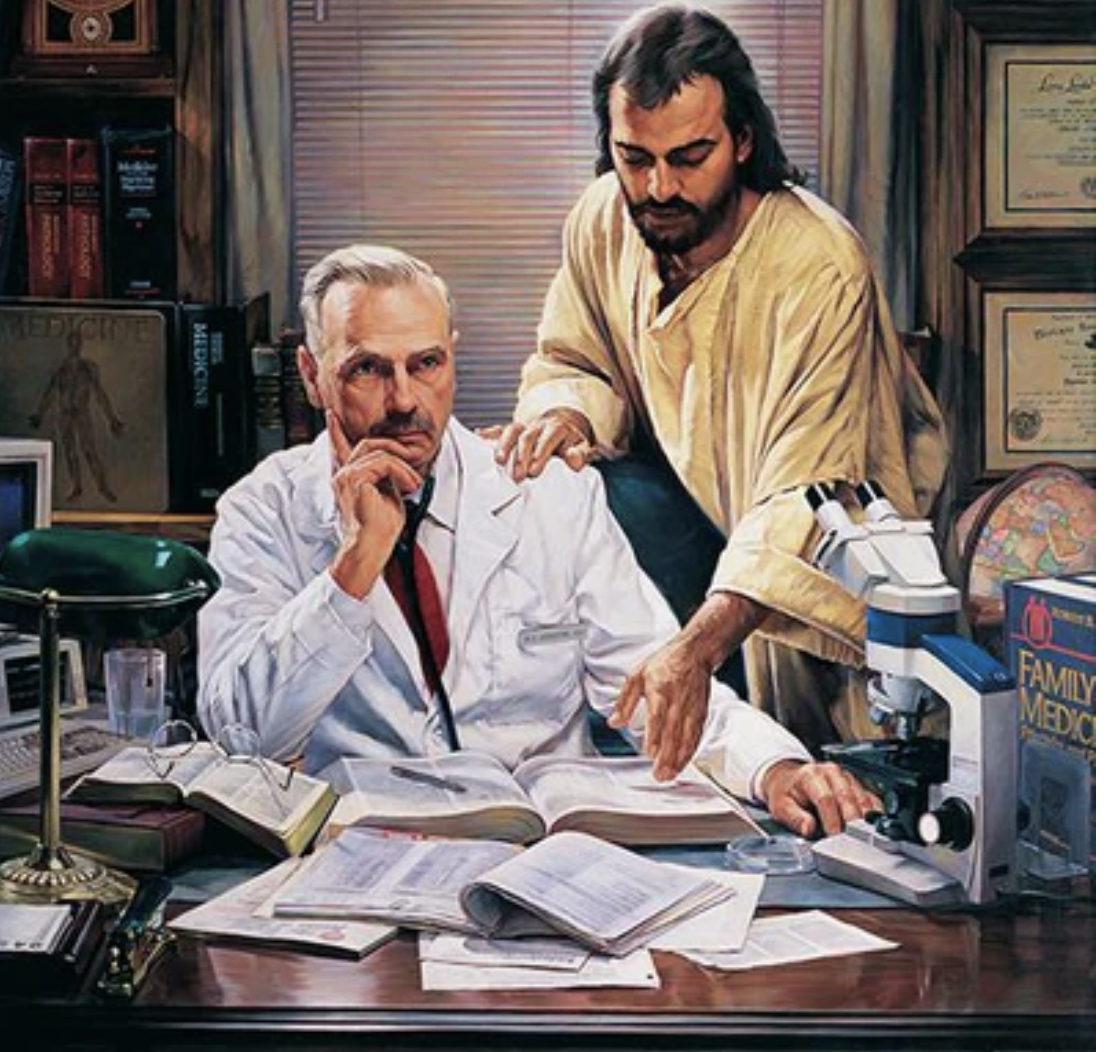
To my left, in his office, are bookshelves. On one shelf, sitting alone, there is a small, framed print of the painting “The Difficult Case,” from the Christian visual artist Nathan Greene—a painting that depicts a caucasian Jesus Christ, standing behind a flummoxed-looking physician, seated at a messy desk, the surface of which is strewn with medical textbooks.
Christ has one of his alabaster hands on the doctor’s shoulders, comforting or reassuring him; his other hand is reaching down to turn a page.
I wonder if I might be a difficult case. Or how many people Marc treats could be considered difficult cases. I wonder if he will ask for guidance from Jesus Christ to help with my potential treatments.
While Marc is busy, shrinking further behind his computer monitors, his eyes fixed upon my medical records and documentation, I quietly fumble with my phone, quickly and discreetly taking a photo of “The Difficult Case,” as it rests, framed, on a shelf all to itself.
In the alternatives he mentions, for as archaic as it is, electro-convulsive therapy is still offered, and when he mentions ketamine assisted therapy, and the time commitment required, all I can think of are the logistical barriers. Transportation to and from. Time away from work. And in this moment, I am hesitant about the treatment itself.
He mentions transcranial magnetic stimulation last and admittedly, he doesn’t know much about it, explaining it is the least invasive treatment, comparatively, but it is even more of a time commitment—traveling to a provider, every day, for a number of weeks, until your treatment is complete.
The logistical barriers. My spouse and I at this time are a one-car family.
I talk myself out of so many things before I even give them honest consideration.
Sitting in the car, after the appointment ends, I shut my eyes tightly before I turn the key in the ignition. The interior of the car, like the psychiatrist’s office, is stuffy—warmed by the continual rising of the sun.
And I had met Alyssa in a book group just a few months prior to this. We were quickly becoming good friends, and she was already invested in me and my well-being, and had wanted to know how this appointment had gone. I send her the photo of “The Difficult Case,” before I close my eyes one more time, mashing down on the brake pedal, throwing the gear shift into drive. The car lurches forward.
I open my eyes.
*
Always beginning on a Thursday, and wrapping up on Labor Day, the Minnesota State Fair, colloquially known as the “Great Minnesota Get Together,” runs for 12 days—and for nearly all of those days, in the evening, there are concerts scheduled in the fairgrounds’ expansive grandstand.
And despite the rising ticket pricing making it arguably unaffordable for some to comfortably attend, and despite the snarky commentary on the internet w/r/t the appearances from this artist or that act, the entertainment selected each year, as a whole, does try and in many cases does succeed, in offering something for everyone.
As an organization, the Minnesota State Fair makes a big deal about announcing each grandstand performer in the months leading up to opening day. The double headlining bill of the Indigo Girls and Melissa Etheridge, scheduled for the fourth day of the fair, was the first of the 2025 grandstand shows to be revealed—some nine months prior, in December.
On the phone, I tell Alyssa about the announcement, and ask if she’s interested in going.
She was emphatic in saying yes. That we must.
Alyssa is a state fair enthusiast.
She has been since she was a teenager, and I wonder if now her enthusiasm has grown, or intensified, since she and her husband, and their young son, live close to the fairgrounds—a 20-minute walk if you’re keeping a brisk pace, and an even shorter commute via bicycle if you are so inclined. She is there every year on opening day, and often goes at least one more time during the fair’s 12-day run.
Prior to befriending Alyssa, I was admittedly nonplussed about the Minnesota State Fair.
I had only attended once, in 2007, the year after I relocated from Iowa to Minnesota—ever the contrarian or curmudgeon, I had believed it to be something that was simply not for me. But just a few years into our friendship—what I understand is Alyssa’s enthusiasm for the fair is contagious.
I don’t think I could ever match the levels of excitement she has for it—nor do I wish to, or really feel I need to.
But it is fun. More fun than I had given it credit for previously.
It certainly helps going to the fair with someone who knows their way around the grounds—knows where specific food and drinks are. Someone who can lead you through the crowds and noise confidently. Alyssa, occasionally looking over her shoulder, to ensure I am only a few steps behind her.
“Hi,” I say to her, when she glances back to check on me. “I’m still here.”
There is something, we determine later, inherently low stakes, at least for us, about attending a show in the grandstand during the Minnesota State Fair.
It is a seated venue, so you don’t have to arrive early in order to muscle your way through the crowd to get close to the stage. You can sit comfortably in seats that you were comfortable with the ticket price of—and the higher in the stands you go, you have a rather impressive view to behold of the stage, the enormous Ferris wheel off to the right, and the sun setting behind the skyline of downtown St. Paul to the left.
It is an experience that, even with the noise from the rest of the fair and the slow-moving hordes of people, lumbering to their seats or to buy refreshments, is pleasant.
It is an experience where you do not have to be a rabid super-fan of the artist, or act, performing—regardless of your level of knowledge of their canonical works or recognition of deep cuts, you can still have a nice time, even if you do not know every word, to every song, by heart.
*
There is really no one person who can be attributed as the “inventor” of transcranial magnetic therapy. An English physicist, Anthony Barker, is credited, during the 1980s, with exploring the use of magnetic fields to alter electrical signaling within the brain, and eventually, for the development of the first TMS device. This device, however, was intended for research and diagnostic purposes. The potential for therapeutic uses was a later discovery.
Approved by the FDA in 2008, transcranial magnetic stimulation, or TMS, uses “magnetic fields to modulate the brain’s neurological activity…effective for treating certain psychiatric and neurological disorders, particularly treatment-resistant major depressive disorder.” The process “delivers magnetic pulses through a specialized helmet, targeting areas of the brain associated with mood and anxiety regulation. These pulses induce electrical currents in the brain cells to enhance communication in key pathways that affect mood, anxiety, and behavior.”
There is, at least for me, something humbling that occurs when you find yourself here. The place where you have exhausted other options. Because in the middle of February 2025, until the very end of March, for 36 days, I drove 27 miles, one way, to receive transcranial magnetic stimulation. I am selective, at first, with whom I tell about my decision to begin treatment. And early on, I begin referring to it as “brain magnets.” Or, sometimes, “getting zapped.” In the morning, on the telephone, Alyssa will ask me what I have planned for the day. “I have brain magnets at 9:30,” I say.
Or, in the evening, my spouse, Wendy, upon her return from work, in setting her bags down on the chair in the living room, will ask, “How was getting zapped today.”
“Transcranial magnetic stimulation” is admittedly cumbersome to use in conversation, which is, at least in part, why I begin referring to it by other names. But it also comes from this humbling place. The feeling, and how it is no longer sustainable and it hasn’t been for a very long time, and you must make this admission to yourself about how bleak things are.
You look for the slivers of humor, or lightness, where you can find them.
*
Amy Ray and Emily Saliers began performing together as the Indigo Girls in 1985—acquaintances since grade school, the two became better friends, and started playing music with one another in high school. After forming, they released a 7” single, and an eponymous EP, followed by their independently released debut full-length, Strange Fire, in 1987.
The duo signed to Epic Records the next year, issuing their self-titled full-length in 1989—peaking at number 22 on the Billboard 200 charts, Indigo Girls went gold six months after its release. In 1990, Saliers and Ray were nominated for the Best New Artist award at the Grammys—they lost to, of all acts, Milli Vanilli; however, the Indigo Girls did not walk away empty-handed, winning the award for Best Contemporary Folk Recording.
Indigo Girls, which also includes the song “Kid Fears,” featuring additional vocals from R.E.M.’s Michael Stipe, is perhaps best known for its opening track, “Closer to Fine,” a song that is also arguably the duo’s most recognizable, or enduring.
I often think about the line that opens the second verse of “Closer to Fine.” “Darkness has a hunger that’s insatiable. And lightness has a call that’s hard to hear.”
Saliers and Ray remained with Epic until 2004, releasing seven additional full-length albums for the label, including Rites of Passage in 1992, which features another well-known single, “Galileo.” The Indigo Girls have issued 15 studio albums to date, with the most recent, Look Long, arriving in 2020; and both have also recorded albums without the other—Emily Saliers released a long-gestating solo album in 2017, and Amy Ray has seven albums under her own name.
The duo is long considered to be queer icons, and has championed a number of environmental, political, and civil rights causes throughout their career. That spirit is present, certainly in the duo’s songwriting—at times, it is subtle, but there are other places where it is much more apparent.
On the fourth night of the Minnesota State Fair, before easing into the final three songs of their 90-minute set, the Indigo Girls play a slower, snarlier song from one of Amy Ray’s solo efforts. Titled “Laramie,” Ray introduces the song as being about Matthew Shepard—and elsewhere, in the chatter in between songs, Ray makes very encouraging remarks about supporting LGBTQIA youth, as well as their teachers and families.
Ray is the chattier of the two, and elsewhere in the evening, she comments on all of the good energy within the grandstand, encouraging us as an audience to take that energy back out into the world with us, and to do something good with it.
A little veiled. A little ambiguous. One of those declarations that is well-intended certainly, and the kind of exclamation in between songs to generate an enthusiastic or positive response from the already rapt crowd. For me, the more that Ray speaks in this moment the less her sentiments actually land where I wish they would. She continues rattling things off—something vague about starvation. I cannot help but think about the absolutely horrific images I have seen every day, leading up to this night, of the ongoing genocide occurring in Palestine.
The intentionally blocked aide, and the starvation that people are facing—specifically children.
The word “starving” booms and reverberates through the night. Pockets of the audience cheer as Ray continues her platitudes. Alyssa and I glance at each other quickly. A moment understood, though unspoken. We smirk. We resign ourselves.
It is the thought that counts.
*
In Notes to John, Joan Didion has this exchange with her therapist that I keep thinking about.
“What just made you sad,” he asked.
I said it was nothing really.
“It was a thought. A thought isn’t nothing.”
There are moments I come back to. A specific time or place. Sometimes just the minutiae of the day. A Friday in November. 2023. A difficult, humbling acknowledgment. An even more difficult admission to myself.
It’s called “chronic passive suicidal ideation.” The space that exists between no longer wanting to be alive, but not actually wanting to die. You aren’t a risk to yourself. It is a thought. Literally. For me, often a thought right away, in the morning, when I tumbled out of bed. A thought. One that would sometimes linger into the afternoon.
One that would sometimes still be there, in the evening, when I folded back into bed.
November 2023. A Friday. Morning becomes afternoon. It was a thought and it would eventually pass but what happens when it doesn’t. When the thought does not recede as the day continues. What happens when it comes more intense. Visceral. What happens when it consumes you and you spend portions of the day sobbing on the kitchen floor because for the first time, you are truly afraid.
An acknowledgment and admission that something is actually wrong.
*
Melissa Etheridge, originally from Leavenworth, Kansas, picked up the guitar at the age of eight, and performed in area country and western acts while still in high school—attending Berklee College of Music in Boston, Massachusetts, she dropped out after a few semesters and moved to Los Angeles to launch her career.
Becoming a regular fixture performing in lesbian bars around L.A. in the mid-1980s, and early championing by a music business manager, Bill Leopold, Etheridge inked a deal with Island Records in 1986. Her self-titled debut, which was recorded once and rejected for sounding “too polished” before she re-recorded it to sound more raw, arrived in 1988.
Etheridge’s Wikipedia refers to her debut as an “underground hit”—a puzzling way, at least to me, for it to be described—the album reached number 22 on the Billboard 200 chart, and the single, “Bring Me Some Water,” garnered a Grammy nomination.
Melissa Etheridge’s follow-up, released the next year, also peaked at 22, and she steadily built her listenership through incessant touring in support of it.
It was Etheridge’s fourth album, Yes I Am, released in 1993, that was her true commercial breakthrough—or, if anything, pulled her out of being a performer with a strong cult following, introducing her to a wider audience. The album has been certified six times platinum in the United States, and features both the smoldering, lusty, bluesy single “I’m The Only One,” as well as the acoustic, mid-tempo plea “Come to My Window.”
The title of the album was, at the time it was released, thought to address her sexual identity. However, for the album’s 25th anniversary, Etheridge alleges that both the album’s title, and its titular track, were not statements on that at all. Regardless of how it was intended, and how it has been perhaps culturally misinterpreted, the co-headlining tour for Melissa Etheridge and the Indigo Girls was aptly named the “Yes We Are” tour.
Etheridge, in the years following the success of Yes I Am, has issued nine additional full-length albums or original material, along with a record of Christmas songs, and a covers collection of soul and R&B tunes.
Like Amy Ray and Emily Saliers, Etheridge has also spent large portions of her career as an advocate, primarily for gay rights, as well as the environment—she contributed an original song to the documentary about Al Gore’s campaign to educate people on climate change, An Inconvenient Truth.
Etheridge, in the banter she has with the audience in between songs, unlike her tour mates, does not attempt to engage in any observations on social justice—she is, more than anything, wistful for the mid-1990s, referencing this era more than once during her 90 minutes on stage at the Minnesota State Fair.
Before playing the single, “I Want to Come Over,” from her 1995 album, Your Little Secret, she talks about how it was, more or less, much easier to sneak around and visit a lover in the 90s, lamenting about how now, everyone has a camera on their phone.
*
When the needle is going into my arm, she whispers, very close to my ear, “I promise it’s worth it.”
It’s the way it is whispered. It becomes suggestive. Alluring in a way that I had not anticipated. Perhaps that just comes with the act of whispering. There is something desperate and seductive in the way her words hang, and it makes me uneasy. Despite her assurances in this moment, it was actually not worth it.
Five months before I begin transcranial magnetic stimulation as a means of treating my severe depression and chronic passive suicidal ideation, I try ketamine assisted psychotherapy.
An article from Psychology Today explains the earliest use of ketamine in a therapeutic environment dates back to 1973, and with enough research, and through the personal anecdotes from patients, in 2019, the substance became the first psychedelic drug approved by the FDA to be used for treatment-resistant depression.
Per the article—“The trance-like state that ketamine can produce relaxes the walls that often come up when trying to address painful emotions. With these walls down, patience can access things in a controlled environment. After the experience, the patient and provider sit together and discuss what came up.”
Following an initial evaluation, the provider paired me with a therapist—Faye. Her role was to, per the clinic’s website, “prepare me for and support me during the experience, and help me explore insights that arise after.” And I was skeptical certainly but more than anything about this process, I was apprehensive. I had no experience whatsoever with any psychedelic substances, so even administered within a therapeutic setting, it was difficult for me to see this as something I could push myself to do.
In preparation, the word “neuroplasticity” was used. The treatment would, temporarily, alter the plasticity of my brain, making it more receptive to processing something in a different way. And what Faye had said, during one of our conversations, was that I could not go into this with an expectation. I could have intentions, yes.
But I could not expect that I would be “fixed.” Cured.
My consideration of ketamine assisted psychotherapy began around a year prior to the moment I sat in the recliner in the provider’s office, feeling the poke of the needle and the warm rush injected into my left arm. There was the brief, informational phone call with the clinic. The young man I spoke with. I asked him questions—probably not the right ones. I jotted down vague notes, picking certain things out of his responses that, at the time, I felt were important to write down. “Learn goals and intentions.”
Or, the cumbersome, “Curate an experience that will be a good experience.”
“Have someone that you know drive you home.”
Faye, in our conversations, wasn’t pushy. Not entirely. Zealous, at times. What I understand now is that she was dismissive. Unsympathetic to my initial hesitations about the process. You are supposed to have trust, or a level of comfort with the therapist you are paired with and it is hard, I think, to form that as quickly as it was implied I needed to. There was an unspoken urgency to it all.
I met with Faye three times, I think, in preparation, and it is during the third conversation that we select the date I will receive the treatment. The injection. At the clinic, they refer to it as “the medicine.” It’s scheduled late in the morning on a Thursday in September. My spouse, Wendy, takes the day off and will be the one to drive us back home from the provider’s office, some 39 miles away.
She brings her work laptop with her and sits in the waiting room until the session has concluded, and in my haze, I’m guided back out and handed over to her.
In preparation for the treatment, you are required to fast. I’m not allowed to eat anything, in case the introduction of ketamine into my system makes me nauseous; I’m not allowed to drink anything because they do not want you to have to use the restroom after the needle has gone in.
I am a person of habit. Small, but specific comforts. Not being able to have any liquids at all for seven hours is annoying because I am not able to have coffee in the morning. And I understand that my attitude about this does not make me special or unique. But, because of this, I am admittedly grouchy, and tied, and anxious, when we arrive at the provider’s office.
The room where the ketamine will be administered, and where I will sit during this experience, is partially lit by a translucent skylight—the space is cozy, and comfortable, I guess, but still sterile and rigid. Formal. Trying to remain professional while still putting someone at ease. In the corner, in the portion of the room that is not illuminated by the skylight, there are two chairs. One is for me. The other is for Faye.
I’m provided with a blanket and an eye mask, and given a pair of large headphones—a curated playlist of instrumental and ambient music is already floating quietly both from a speaker somewhere in the room and from the headphones. And before I tuck myself in, the clinic’s nurse practitioner stands above me with the syringe of ketamine. As I remove my arm from the sleeve of my sweatshirt, she asks how I am feeling, and I tell her that I am annoyed about not being able to enjoy my coffee that morning.
I feel the slight poke of the needle against my skin, and as I feel the warm rush, she leans forward, close to my ear, and assures me. She whispers, “I promise it’s worth it.”
*
I often think about the line that opens the second verse of “Closer to Fine.” “Darkness has a hunger that’s insatiable. And lightness has a call that’s hard to hear.”
And I often think about the first line of the song.
“I’m trying to tell you something about my life.”
The evening of the Indigo Girls and Melissa Etheridge concert at the Minnesota State Fair is lovely—a Sunday, near the end of August, and it’s unseasonably cool as Alyssa and I hustle to get into our seats for the 7 p.m. start time, ascending higher and higher into the grandstand.
Amy Ray, Emily Saliers, and their five-piece band live band are prompt as they take the stage, playing 17 songs in their allotted 90 minutes—foregoing the charade of ending their set, saying good night, and then coming back out for an encore, they save “Galileo,” “Kid Fears,” and as perhaps anticipated, “Closer to Fine,” for the final three songs of the night—joined by Etheridge on vocals for the final two.
Pulling material from around eight of the duo’s albums, the set, prior to its conclusion, is relatively well paced with a kind of give and take between slower songs, or tunes that have a little bit more of an edge to them, like “Faye Tucker,” from Come On Now Social, “Chickenman,” from Rites of Passage, and Amy Ray’s snarling ode to Matthew Shepard, “Laramie”—and songs that are a little breezier, or gentler, like “Power of Two,” which appears near the top of the set, and the jaunty, shuffling groove of “Get Out The Map.”
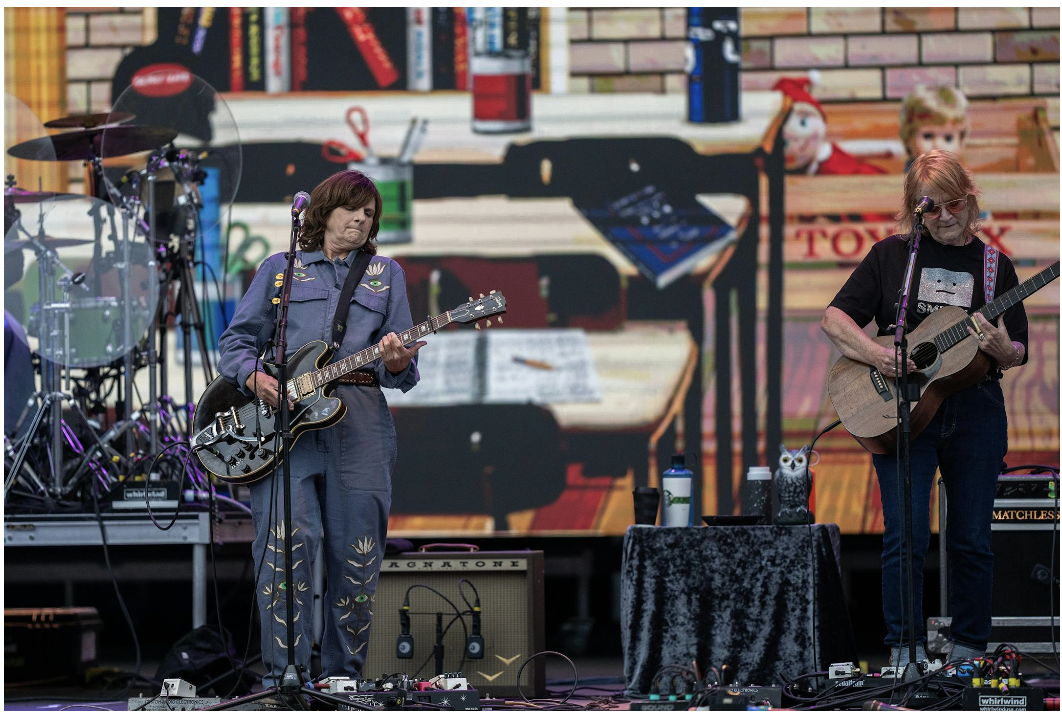
90 minutes is a long time on stage, and it is a long time to keep an audience or at least most of an audience engaged. Their set, even in the balance it strikes and sustains, only really loses momentum when they perform a slower, shaky cover of “Midnight Train to Georgia.” On this tour, the group has been accompanied by Lucy Wainwright Roche—the half-sister of Rufus and Martha Wainwright- and within the second half of the Indigo Girls’ set, she is given the chance to perform a song on her own while the rest of the band leaves the stage.
She performed “Open Season,” from her 2010 album Lucy—telling the audience she felt compelled to because of how the lyrics lent themselves to performing with the cacophony of the fair as a backdrop. “Open season on a broken heart—this is the year they take the summer apart. There is magic to the carnival arts,” she sings. “And I can hear the sound.”
Giving Wainwright Roche an opportunity to perhaps introduce herself to a larger or somewhat unfamiliar listenership this way is admirable, and “Open Season,” regardless of whether it is the studio version from Lucy, or this sparse version performed by her, alone, with an acoustic guitar, is a song worth listening to, and giving consideration to the lyricism. But, this moment, and the unsteady Gladys Knight cover bring the pacing down enough that it does take time for Saliers and Ray to find the momentum again as they work towards the jubilant finale.
When Melissa Etheridge saunters on stage, already strumming her acoustic guitar in an extended build-up for the first song of her set, “Bring Me Some Water,” the sun has disappeared, and dusk has settled comfortably over the grandstand. Etheridge is flanked by three band members, and the quartet play 11 songs during her 90 minutes—placing more recognizable tunes like “I Want to Come Over” and “If I Wanted To,” near the top, and playing “Come to My Window” and “I’m The Only One,” back to back, right before the end—a jam-heavy, sprawling 15 minute version of the lusty “Like The Way I Do.”
Etheridge’s persona on stage serves as a contrast to the Indio Girls—she really is a rock star. It’s apparent from the raspy, powerful bellow she commands, and wastes no time conjuring within the first two songs of her set. You can tell she gets a thrill from how she indulges—not just singing these songs, but really performing them and giving them room to breathe, offering a number of extended instrumental breaks for solos.
And in her banter with the audience, again, a contrast—Etheridge is a little goofy. A bit of a drawl hangs on her voice as she reminisces, more than once, about the 1990s. Like her tour mates, her set is paced so there is this kind of rise and fall in tone or enthusiasm, with Etheridge intentionally slowing things down early on with the tender ballad, “You Can Sleep While I Drive,” which Amy Ray and Emily Saliers come back out on stage to sing with her.
And I almost did not recognize “Come to My Window” at first. She forgoes the slow, spectral intro from the studio recording, and perhaps it is just the muddied nature of the venue’s sound, or perhaps it is that the song, in the last three decades, takes different shapes and is performed with different tempos and inflections, but she almost arrives at the iconic openly line before I understand what is happening—I can feel the surge of recognition rippling through the crowd as the notes ring out and she sings the first line. “I would dial the number just to listen to your breath.”
Perhaps if I had sat down and given analytical consideration to Melissa Etheridge’s songwriting prior to this concert, then this might not surprise me as much as it does, but what I am struck by, in this moment, and as the concert is ending, is just how much she writes about yearning, and lust, and the intersection between the two. There is a very specific kind of longing depicted in a phrase turn like “I would dial the number just to listen to your breath.” A restless, desperate longing that is palpable even as she sings it now.
It is this thrashing towards someone she has described in “Somebody Bring Me Some Water,” and that she will describe in “Like The Way I Do.” That she’ll return to in the bluesy stomp “I’m The Only One,” which she introduces with a smirk to the audience—“Remember, Minnesota….I’m the only one.”
“I’m the only one who will walk across the fire for you,” she howls in declaration. “I’m the only one who will drown in my desire for you.”
We slowly begin descending through the grandstand while Etheridge smolders through the final song, “Like The Way I Do,” from her self-titled debut. “Baby, tell me, does she love you like the way I do?” we hear her asking as we navigate the late Sunday night crowd. “Does she stimulate you? Attract and captivate you?” As we maneuver our way out of the fairgrounds, Alyssa stops to order fried pickles—stopping and savoring a few bites before we continue walking.
Every night of the fair, as the entertainment from the grandstand concludes, there is a small fireworks display—at 10:30, we hear the first one soar through the night sky, watching it burst and ripple against the black sky. A number of food stands and attractions have shuttered for the night but the fair remains alive and vibrant with the sounds of the carnival rides in the distance and large groups of young people gathering everywhere.
Alyssa walks quickly, carefully holding onto what remains of her fried pickles, weaving us through the crowds towards an exit. She occasionally looks over her shoulder, to ensure I am only a few steps behind.
Hi. I’m still here.
*
Alone, in the car, careening down the highway.
There are these moments I come back to. It’s the middle of March. I am halfway through the 36 days of traveling for my TMS treatments and it is explained to me that we have arrived at the “make or break” portion of the process. If I have not started to notice a difference in how I feel—which at this point, I had not—adjustments in intensity and frequency to the magnetic pulses will need to be made for the remaining sessions, in hopes that there is still time to see improvement.
Alone, in the car, careening down the highway I cry because I am afraid it always going to feel like this.
For treatment, I sit in a small exam room in the provider’s office—the chair and my body positioned a little awkwardly underneath the TMS machine. It’s hulking and noisy, and my head, then, is clumsily secured into the helmet, which I can only describe as looking like something from the movie Tron. And it is the look of it. And, I mean, yes, the process of the treatment itself. But I was skeptical throughout. If it is a grift. Or a pseudoscience that I have fallen for but my insurance covers it so what is the harm.
Guadalupe—my technician. I see her every day. She has a soft, reassuring voice and a nervous, kind smile. Short dark hair. A tattoo on her neck that peeks out of the collar of her scrubs, and I wonder sometimes what her life was like before this one now. The one where she wears different sneakers to accentuate and complement the color of her scrubs. The life where she fetches me every day from the waiting room and leads me to the end of the hallway.
The one where she sits at a desk working on administrative tasks, while the TMS machine runs, zapping pulses into my head.
The feeling created by the pulse of the coil both does and does not hurt. Not painful. A little uncomfortable. Disorienting if you are not prepared. There’s a rhythm you eventually figure out, and when to brace yourself. There’s this muffled, singular beep I can hear coming from somewhere in the room, and then the coil pulsates quickly. Then it stops. And everything is still. A moment. Like, two or three seconds. Sometimes it feels like an eternity. The way the silence hangs in anticipation.
Then the beep again. Just one. Soft. In the distance.
Over the sound of the earplugs, crammed into my ears, and the dull roar of the fan from the TMS machine, I can hear Guadalupe shout to me, “I’m going to start you in three, two, one.” She waits until the first pulse has finished before asking if everything feels okay.
I cautiously raise my hand, and give her a thumbs up. The beep. The pulse. My hands involuntarily trembling.
Everything is still.
*
Prior to when I felt the poke of the needle and the warm rush of the injection, I had politely but firmly declined to both Faye and the nurse practitioner what was being referred to as a “booster” dose of ketamine. I was told this is offered to patients—an additional dose administered while you are still very much having an experience from the initial injection, as a means to “go under” even further.
And I was already hesitant enough about the dose I was being given. Hesitant, still, even as I sat in the chair, blindfold on, tucked under a blanket, about the entire process. I did not think it wise, during my first time with ketamine assisted psychotherapy, to be given an additional dose.
I did not want to be taken any further “under” than I was already going.
And it is difficult to articulate with clarity what my experience was like once I received the injection of ketamine. Once the blindfold was placed over my eyes. The headphones nestled over my ears. The blanket tucking me in. I felt this nervous anticipation. Something was about to happen I just was not entirely certain what.
What I remember was seeing, or visualizing, rather, a lot of squiggling, pulsating, organic shapes and colors. Everything a vibrant shade of yellow. Then, later, a lighter blue. All of it whooshing and rippling and swishing around within the rhythms created by ambient, instrumental music from the headphones.
There is a state in between. Awake and asleep. Aware and not. The volume of the music seemed to be fluctuating, sometimes sounding so distant that I could barely hear it. Other times, not oppressive, but it was so much more intense and prevalent. A confusion occurs in this state in between. Too self-aware to surrender completely. I wondered how much of this was the ketamine. How much of it was me, still in control. “Am I high? Am I doing this right?,” I remember thinking.
I felt the need to check in with my body, at times. To remember I had arms and legs. A way to remain tethered to something. I would move my hands and extend my fingers. A reminder there that whatever I was hearing and visualizing, I was still a body. Crumpled in a recliner.
I’m still here.
In preparation, what Faye had said to me was that I could not go into this with an expectation. I could have intentions, yes, but I could not expect that I would be “fixed,” or cured.
My concern, then, two days after my session, is that I have done something incorrectly. That I had not set my intentions properly. That I was not as receptive as I could have been, or should have been, to the experience.
I have the thought that I so often have. That I do not want to be alive. A thought isn’t nothing. I had not understood that before.
Four days after my experience with ketamine assisted psychotherapy, I have my follow-up appointment with Faye. The “integration” meeting—where we discuss what might have come up for me, during my session.
I look at Faye, as she appears in the window on my computer screen, and I can see the disappointment in her face before she even begins to speak. Because nothing came up for me during my session. No revelations in the moment. None in the days that followed.
I explain to her that within days of the treatment, I was still very much experiencing chronic passive suicidal ideation. And she tells me if I were going to have a positive response to the therapy, it would have happened already. I would have noticed a change. She implies, heavily, in a tone that can only be described as condescending, that if I had not declined the “booster” dose, maybe my experience would have been different.
She implies that, in this moment, I am wasting her time. That I have wasted her time, as well as my own. There is nothing to integrate and no further conversation to be had. The meeting ends quickly, and abruptly. The window she appears in on my computer screen goes blank and I am left staring at my own reflection.
I’m still here.
*
At the beginning of the year, Hanif Abdurraqib wrote a piece about the 30th anniversary of I Refuse to Be Lonely, the posthumous album from R&B singer Phyllis Hillman, who died by suicide five months before it was released. There is a quote from it that I keep thinking about.
“Few people understand loneliness, and even fewer understand depression, and even fewer still understand what it is to want to die,” he writes. “I have grace for all of this. All of these things are concepts and realities the average person attempts to avoid confronting.”
My fear was that it was always going to feel like this, and for a while, it didn’t. Not all of the time. Not cured. But in moving through the “make or break” portion of transcranial magnetic stimulation, the adjustments to the frequency and intensity of the pulses were made. And the change, then, for me, during the final weeks, was so subtle that I was the last one to notice, or at least to acknowledge, what others had observed. My spouse. My best friend. The staff at the clinic.
And it was surprising. I was reluctant, at first, to truly accept it. The reprieve unexpected. And, yes, for a while, it didn’t always feel like this.
Darkness has a hunger that’s insatiable.
The evening of the Indigo Girls and Melissa Etheridge concert at the Minnesota State Fair is lovely. The end of August. Unseasonably cool. And before I leave the house, I text Alyssa to tell her I am on the way, but also to prepare her for the state she will receive me in. Because it is difficult—humbling, really, to truly articulate what it feels like to want to die. To tell someone what you are experiencing so that they understand as much as they are able to in the moment.
I default to “I am not feeling my best today.”
And if you will allow me, and perhaps forgive me, I would like to break the fourth wall and address you directly. Because we have arrived at the place where I require so much of this to converge. And what I understand, each time I have sat down to write this, and I do hope you will offer me grace, is that the flimsy conceit with which I have attempted to string everything together is, in the end, quite heavy-handed.
From the backseat of a Lyft, on the way to the fairgrounds, Alyssa tells me about her day before she stops, and when our eyes meet, she mouths the words to me, “Are you going to cry?” I shake my head no, and what I want to tell her in this moment is that you have asked me not to go anywhere, and I have assured you time and time again that I will not, but there are days when it does feel impossible.
I am trying to tell you something about my life. In time, the further removed I am from the rigors of the transcranial magnetic stimulation treatment, the positive response I felt, and that others noticed in me, has receded. And I find myself, often, as summer wanes, in a place too familiar.
A thought isn’t nothing.
As we enter and begin ascending the steps within the grandstand, Alyssa and I are both overcome with what we describe to one another as a kind of calm or a reassurance resonating from the crowd. We are not the youngest people in attendance—Etheridge and the Indigo Girls have attracted a predominately female presenting, queer, Gen-X audience, and even in the smallest pleasantries exchanged with others in the grandstand—a “pardon me,” or “sorry! Sorry about that!,” as we slide through the narrow space to get to our seats, there is this intense, and surreal sense of peace. In this enormous expanse of strangers, and within a moment when I am admittedly having a difficult time emotionally, I am struck with this remarkable feeling of being well cared for.
In writing and in thinking analytically about pop music, I am always listening for a perfect opening line. And there is a declaration at the beginning of “Closer to Fine.”
“I am trying to tell you something about my life.”
Emily Saliers is the sole credited songwriter of “Closer to Fine,” and she’s explained it was inspired by time with her family in a cabin in Vermont—a rustic setting that, as she explained, “can make you feel very philosophical…that song is about not beating yourself up too hard to get your answer from one place.”
“There’s no panacea, that in order to be balanced or feel closer to fine, it’s okay to draw from this or draw from that, to draw from a bunch of different sources,” she continued. “So it’s about being focused, but looking for the answers, and in the end, knowing that you’re going to be fine.”
In the end, you’re going to be fine.
The second verse of “Closer to Fine” begins with the line, “Darkness has a hunger that’s insatiable. And lightness has a call that’s hard to hear.”
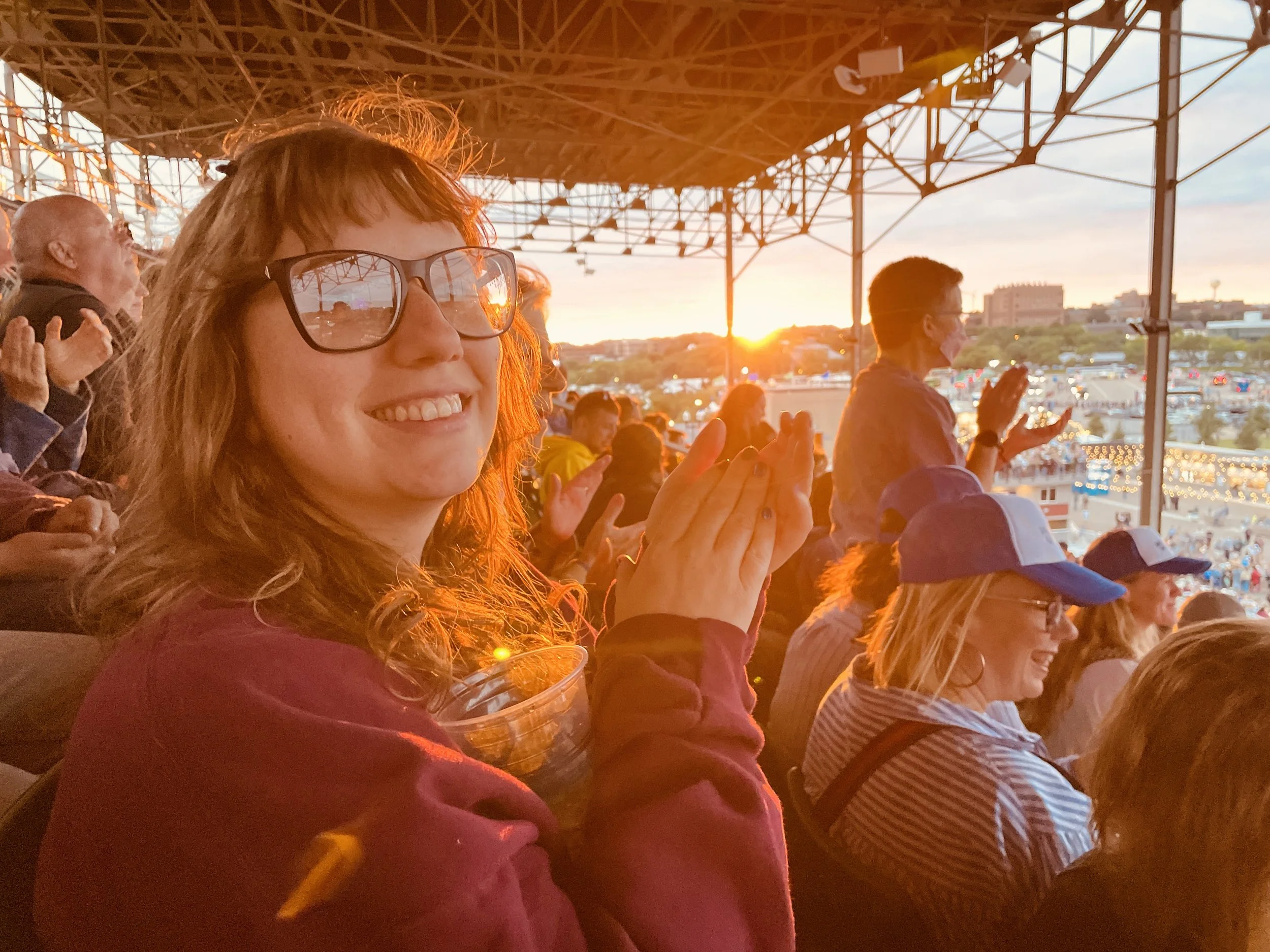
Above us, the overcast sky clears as the Indigo Girls perform. The sunset over the fairgrounds is breathtaking—alive with rich oranges and golds, as the sun descends behind the St. Paul skyline.
The colors are radiant as they shimmer on the face of my best friend.
And you will have to forgive me. Because we have arrived at this place and even now I worry that I have forced it. That is the ending wanted, but not the ending earned. I have brought you to this moment with me. The moment that culminates in jubilance. And thousands of voices bellowing, “I went to the doctor, I went to the mountains. I looked to the children, I drank from the fountains. There’s more than one answer to these questions pointing me in a crooked line. And the less I seek my source for some definitive, the closer I am to fine.”
You think, I have been brought to this moment and the essay writes itself.
What I understand is that it is perhaps expectant of me, and heavy-handed to reveal that, as the Indigo Girls performed their final song of the night, I was bracing myself, in the grandstand, to feel something. To welcome something revelatory. To cling, desperately and tightly, to the assurance offered that in the end, I am going to be fine.
I am trying to tell you something about my life, and it is that I am afraid it is always going to feel like this.
I am still here.
