A Warning Sign, When You See It
“…and the mornings are still bad and at one point she says Mornings are hard for you aren’t they and she sits next to me on the couch and gives me coffee and I lie in the sun…” - Chloe Caldwell
There’s a heaviness to the morning—not from you, you should know.
And I have said as much before. Perhaps you know that. Perhaps you understand, as you are able to, because maybe it is this way for you, as well. But, it is always worse in the mornings. Nearly every morning. All of it. And maybe it has to do with the quiet, or the stillness, when the day is new, and there is the potential.
There is the sound of my dog, once he settles after the clamor for his breakfast. The slow breathing in, and out—sometimes turning into a deep snore, as he is splayed on a couch cushion. The sound of the clock on the dining room wall ticking. The clicking sound of the thermostat, and then inevitable whooshing of warm air pushing up through the vents where the walls of this house meet the floor. There are these sounds yes but there is also such a quiet. Nearly everything is still. It is before my spouse rises for the day, and readies herself for work. It is before I call my best friend, as she is settling into the first part of her morning, the sound of Teams notifications, from her work computer, occasionally rippling through the conversation.
The sound of her glass straw hitting the side of a large glass jar, from which she drinks water. “Sorry,” my best friend will tell me on the phone. “Sorry for all the clonking.”
In the stillness, though, and in this quiet, there really is no escaping it. And that’s the thing, you see. Regardless of whatever efforts I have put forth, and no matter the distance I think I have put between myself and it, the feeling always comes creeping back.
There is a heaviness to the morning.
And, if it is a day, when a kind of fortune reveals itself, that heaviness will slowly dissipate as the sun rises, and the morning slowly becomes afternoon. The stillness, or quiet, filling with the busyness. The sound of the metal tags jangling on my dog’s collar. The sound of a glass straw hitting the side of a glass jar on the other end of the telephone. The sound of the edge of a kitchen knife, going through a vegetable, hitting a cutting board. The sound of a car door closing. The keys in the ignition. The sound of my co-workers conversing.
Perhaps creating just enough of a distraction.
If it is a day, when there is no fortune to be be found, that heaviness is something, then, I carry with me. The sounds that do fill up that stillness, or quiet—all of them, simply unable to compete with the volume of the heaviness that can, and often will, rendering me immobilized. And if not immobilized, it is a feeling where I am pushed into moments of gasping sobs.
And moments of a very real, visceral fear.
There’s this part of the song “Arrival,” by Hannah Pruzinsky—the first single issued in advance of their second full-length, Red Sky At Morning, that I keep coming back to, the more I think about it.
“I know that my thoughts are good—that’s what she told me,” they sing in a voice that rises to a higher, fragile register, before dropping back down, and then, as Pruzinksy delivers the next few lines, they do so in a way that conveys so much—singing through what sounds like resigned, gritted teeth, and a kind of urgent, assurance.
“I’m good. Stabilized—good. Stabilized now. I can clear the cycle.”
And there is really no escaping it, you see. That’s the thing. Regardless of the efforts I put forth or the distance I think I have put between myself and it, the feeling always comes back.
It is always worse in the mornings. And in the moments of very real, visceral fear, what I am most afraid of is that it is always going to feel like this.
*
And there is something inherently fleeting about contemporary popular music.
It is, often, representative of a moment. Something specific. A time. A place. A feeling. The time passes. The feeling changes. The moment hangs, though. A reminder. Sometimes. Not all the time. It is a difficult balance. It is for me. Maybe it is for you. As as listener. You invest yourself in an artist, or a song, or an album, when it arrives into the world. You take it with you through that year. And as one year ends and another begins, what do you bring with you. How often, if ever, is that artist, or that song, or that album, something you return to as we continue to move through time. As you are introduced to other artists. You hear new songs. You are compelled by new albums.
And this is not to be dismissive, because it is a challenge to find that right balance. And I think, without complicating this even further, at the end of the year when you are reflecting on things that were resonant, you end up giving consideration to the idea of the life of the album versus how an album lives. If that makes sense.
I tell you all of that to tell you this—there are the artists, songs, and albums, from any calendar year, that you may be compelled by, that you do not bring with you, for whatever reason, much further into the next 12 months. And there are the things that, from the moment you hear them, you know that, for whatever reason, they will stay with you for a long time.
No Glory, Hannah Pruzinsky’s debut full-length under their moniker H.Pruz, is one of those albums. The whole record is truly remarkable in how hushed, and fragile it is—there is a palpable intimacy to not only how it sounds, but to Pruzinsky’s lyricism as well, which is often fragmented, or a little shadowy or ambiguous in how the phrases are strung together, but the portraits they paint are incredibly vivid, and ultimately, haunting.
Referring to Pruzinsky’s song, “Dawn,” as “sleepy” is not intended to imply that it is uninteresting. Far from it. But there is a haze to how it unfolds. An intentional pacing. It never hesitates. But it does take its time, gorgeously and organically traveling itself in slow motion. And in that, amongst the poetic, fragmented writing, is a phrase turn that will, without a doubt, always remain with me.
“There’s a heaviness to the morning—not from you, you should know.”
And I am often thinking about the life of an album, in comparison, or rather, contrast, to how an album lives, because I am much more fascinated with how an album lives. How it extends itself, for whatever reason, or whatever means, beyond what is expected of it, or anticipated. How it becomes something you carry with you through time. How it grows with you.
Because there is a shelf life to contemporary popular music. An expiration date before it is pulled and replaced. And in a number of instances, often replaced with something similar. Often replaced by something new, from the same artist. Or group. There are demands that are placed. Perhaps you have come to understand this. We as listeners whether it is intentional or not will place demands on the artists we listen to. We ask for more, even after they have already given so much.
There are demands. Perhaps you have come to understand this. Or you have observed it. An album is written and recorded. There is the inevitable rolling out. Singles are issued. A release date arrives. Live shows are performed. It is sustained for as long as it seemingly can be. Sometimes much longer than it should be, depending on the field within contemporary popular music we are speaking on. I am thinking of the mechanics of “pop music.” Of the album, the tour, the deluxe edition with a handful of extra songs, another leg of the tour. A welcome overstayed beyond the shelf life. Somewhere in there, another album is assembled and released and runs the risk of offering diminishing returns.
It is rare, and in how rare it is, it should be acknowledged and treasured, when an artist is sharp enough, and thoughtful enough, to release a record one year, and then return the following year with another full-length that, more than anything, is a statement on growth, or development. An album that is not interested in repeating the statement already made, but is intentional in the new, and often bolder statement it wishes to share.
I, again, tell you all of that to tell you this. Following the release of No Glory, in the spring of 2024, Hannah Pruzinksy has remained both extremely busy and creative.
Outside of recording and releasing Two Birds with their band Sister., founded with their best friend and longtime roommate Ceci Sturman, Pruzinsky has put together a wildly ambitious follow-up to No Glory—Red Sky at Morning. Released alongside an imaginative and interactive companion piece—an originally conceived role-playing game that also serves as a lyric book for the album, Red Sky finds Pruzinsky continuing to grow, and easing into an impressive and very noticeable kind of musical confidence. There was a looseness, or a ramshackle kind of nature to how much of No Glory sounded, or was arranged.
And Red Sky at Morning is not, like, slick, or overworked by any means. It is still a very organic and often intimate affair in how it sounds. But, there is a tightness, and a trust, you can hear woven into this collection of songs. This is, I think, because of the collective Pruzinsky worked with to record the album—primarily collaborating with their partner, multi-instrumentalist Felix Walworth, who is a member of the beloved indie folk outfit Florist. His Florist bandmates, Jonnie Baker and Emily Sprague, are also credited with myriad contributions, as are the members of Sister.—Sturman provides vocals on one track, and the third member of the group, James Chrisman, provides piano and electric guitar throughout.
Both Red Sky at Morning, and No Glory, are albums that have a through line, or a larger idea, or notion, that runs throughout. No Glory was written as a response to a number of big life changes Pruzinsky was experiencing—there is a kind of sorrow, and a palpable kind of want, or desire, that ripples within those songs. A kind of fumbling, and grasping for something larger within the hush, and the quiet. And even in the ambiguity of the songwriting or the kind of shadowy nature of how the songs themselves ultimately unfolded, Pruzinsky was not, and is not, one to shy away from being reflective or personal in their writing.
Red Sky, then, is a natural continuation of that—and it is an album that really exists in the space created in between a convergence, or collision. A further exploration of themes, or ideas, that are much, much larger, all while understanding there is a need to reflect deep within—doing so with a real warmth, and a staggering grace and intelligence.
*
There is a dextrous nature to Pruzinsky’s outings as H.Pruz. You could hear that throughout No Glory—that, while it was a collection of songs existing primarily within a hushed and often woozy, or dreamy environment, there were these moments of tension, or an edge, rippling up towards the surface. Their work in Sister., I think, provides more of an opportunity for that tension, or edge, to be explored—and as a whole, there is this kind of cumulative feeling to Red Sky at Morning. It still can and often does operate from somewhere intimate and quiet, but Pruzinsky’s dexterity as an artist means they are not afraid, and as the album continues to unfold, are interested in embracing, as they are able, dissonance, or a creeping kind of feeling tucked just beneath the surface.
I am remiss to describe the album’s second track, “Arrival,” as sounding ominous—I think, last year, in writing about certain moments on No Glory, I think I was also hesitant to use that word simply because it, I think, is a little heavier than necessary. But there is a feeling as “Arrival” quietly gathers itself—one of an unsettled, or tense nature, which I think has to do with chord changes, carefully, but quickly, plucked out on the acoustic guitar, while Pruzinsky’s voice, barely above a whisper, floats over the top of it.
“Arrival” is a song that is very deliberate in how it moves, and when elements are introduced, with the light tapping cymbal and popping of the snare drum, creating a strong rhythm underneath, along with the throbs of the bass—both of which come in together, as a means of emphasis underneath Pruzinsky’s voice, and are joined shortly by the warmth of an electric piano, the noodling of an electric guitar, and additional atmospheric flutterings.
The edge, or the dissonance, does eventually resolve slightly, as both the instrumentation, led by Pruzinsky’s voice, are guided into a slightly lighter, or gentler sounding place, once it reaches what serves as the chorus, or the phrasing and melody that is returned to.
In how it is structured, and how it does unfold over the span of five minutes, Pruzinsky and her bandmates sustain this ever-forward momentum—the further we’re pulled into “Arrival,” it remains steady, treading into a kind of tension and dissonance before it finds resolution, and as the elements all continue to swirl around one another, something that I had noted was that it does, whether this was intentional or not, slide into a subtle kind of electrified twang that contained echoes of Jason Molina’s work with Magnolia Electric Company.
Not so much precariously placed on top of this bed of subtle, but present, tension, but skittering across the surface of, is Pruzinsky’s voice, and their lyricism. And their writing here, as it was on No Glory, is simply astounding—structuring narratives that are revealing and personal, yes, but often told in fragments, and cloaked in a haunting poetic ambiguity, where you wish to hang on every word for just a little bit longer in order to have a greater understanding of the meaning, or the intention.
There is an intensity, and a perhaps tempestuous connection, depicted in the opening lines of “Arrival.” “Pull you in, rub the skin clean,” Pruzinsky begins. “Force the company you keep me. We haven’t left the house in weeks,” they continue. “I start to see you in the TV screen.”
And there is of course a want—we, as listeners, often want more of artists. And I guess what I mean by that is we always want to know more. To drop the curtain or to remove the barrier that separates us. We want singers, and songwriters, and performers, to reveal everything about themselves.
Pruzinsky, as a songwriter, brings us up to a point. It is a compelling and intelligent songwriting technique. We’re taken as far as they wish to—as close as they are comfortable with us being. We aren’t left in the dark, but there is still the curtain. We’re given what they wish to share and how they wish to tell us. And what we make of it—there is an effort required here, as there should be, with thoughtful writing. Where we must give it consideration. What it might mean. What it might mean for us.
“Let the past coat my lungs,” they continue. “They said the tissue would rot out. But I know my thoughts are good. That’s what she told me—I’m good,” Pruzinsky explains, as a means of reassurance to themselves. “Stabilized—good.”
“I can clear the cycle,” they exclaim next. “The longer I stay, I could give out. But my thoughts are good.”
There’s a reserve in how Pruzsinsky sings a bulk of “Arrival,” which complements the tension that the arrangement has created, but as there is slight resolve in the chorus, musically, there is also slight reserve in where their voice reaches—into a slightly higher, more fragile register. “Promises start in the house. Board up the doors. Paradise is found. There is no point where we give out,” they sing, again, as means of assurance. “Sure of arriving. Sure to stay awhile.”
*
You can feel the longing if you let it in
And maybe you do this too, when you listen to music. Regardless of what the song is about, you attempt to find pieces of yourself, or for yourself, however big or small, in what you hear.
I stopped myself, mid-sentence, and mid-thought, because I was about to say “Krista,” the second of the singles issued prior to the release of Red Sky, is not a love song. It might be. But not in the way you might think of a love song.
I sometimes forget it is there. But the expression “Every love story is a ghost story” is tattooed on my right arm.
“Krista” exists in a kind of juxtaposition—it moves with a propulsive nature, and never really relents in the briskness it clips along with. And in that momentum, and as we circle around through the narrative that unfolds, we return to a chorus built around a wildly infectious melody. Truly the kind of thing that won’t leave your head at times. But the contrast, then, comes in the lyrics—how they are delivered, yes, but also the words themselves. Because as it unfolds, “Krista” is surprising in just how unsettling it is, and how dark of a place it wishes to take us.
There’s an emergent nature to how quickly “Krista” begins, and how the elements gather themselves together—opening with the strum of the guitar, a brief squall of feedback comes in, as does an impressively engineered fill on snare drum, with the extremely crisp and snappy sound of the drum kit crafting the enthusiastic rhythm that keeps the song’s momentum moving forward. “Krista,” similar to “Arrival,” is a song that works to remain steady, or sustain itself at a certain level of intensity—with only some atmospheric flourishes punctuating throughout, and a descent into more feedback, as the song careens into its ramshackle finish.
In the writing, there is really no time wasted, either, in revealing the haunted nature that courses through the narrative, unfolding first in observations, then later, like a recollection of a nightmare you are unable to shake.
“Krista’s eyes need an offering,” Pruzinksy begins. “That I’m not ready to be. Shake the tree, what does she wanna free,” they ask, before remarking, “Leaving with blood on her arms.”
The song, then, takes its first sharp turn—with Pruzinsky’s voice shifting from singing, into speaking, and speaking through a kind of muffled, eerie distortion, as they begin to recall vivid, and unsettling imagery. “I was walking, and saw an old woman screaming. She was on her porch, and you couldn’t hear her, but you could see her face.”
“I stood a little longer, and started to realize it was a tree, and not a woman,” they explain, a little later, their voice still muffled and distant. “But I could still feel the scream—does that mean that something is still screaming?,” they ask, uncertain. “I didn’t really know, but I turned around, and I decided that maybe I should walk home. But I would’ve sworn that I could still hear her scream.”
There is a collision, then, in both tone, and in sentiment, that occurs as “Krista” pushes itself towards its finish line.
In thinking about “Krista,” I had stopped myself, mid-sentence, and mid-thought, because I was originally going to say that, even though the line repeated in the chorus might lead you to believe otherwise, it is not a love song. But it might be. Not in the way you think.
Every love story is a ghost story.
Sometimes my arms are covered, and I forget that expression is tattooed on my right arm, in large, black letters.
Maybe you do this, too. When you listen to music. Regardless of what the song is about, you attempt to find a piece of yourself, or for yourself, however big or small, in what you hear.
And I have been, for a number of years, fascinated by the way that desire works its way into contemporary popular music. Yearning. Longing. An often visceral sensation propelling us towards something that is often just out of our grasp. A want. A need.
There is something hypnotic about the way Pruzinsky sings the expression, when “Krista” speeds into its chorus. “You can feel the longing if you let it in,” they attest, repeating it twice, before returning to the imagery of the opening lines, and then a flash of uncertainty. “Pulling for an answer, snapping off a branch. I say, Krista, I think that all this should end.”
“Krista” comes to an end with the phrase, “You can feel the longing if you let it in,” repeated with an immediacy, converging with the epilogue of the nightmarish recollection, or narrative, burrowed deep within the center of the song. “I think the ghosts are gone from the house, but there used to be something,” Pruzinsky reflects. “It would stay in the corner, and the cat could see it. I don’t know who else saw it,” they say, before uttering a stunning, and chilling final line.
“I think it was something I wasn’t supposed to know about.”
There is a vibrancy to the arranging of “Krista”—this may be very idiosyncratic in terms of a descriptor, but it has a very specific “indie rock” slant to how sharp, and how rollicking it sounds. And in that vibrancy, it is remarkable how effortlessly Pruzinsky and her collaborators not only blend these elements together, but also the imaginative things they do with some of them, as everything swirls together.
To take the idea of longing, or of a want, or some kind of tenderness and affection, perhaps, then subvert it into uncertainty, and unease, and place it all within the recollection of something haunted—it is dizzying in the end, yes. But that is certainly the point. The place where emotions or sensations—often in a kind of opposition—slowly collapse and then blur into one another.
You let in the longing. You let in something else along with it, then, too.
*
Something I often give consideration to, and have for a number of years, is the idea of intimacy.
There are, of course, the acts of intimacy. Moments of physical intimacy are, more than likely, what comes to mind when you hear the word. And, yes. We do, potentially, have these moments with others. A physical connection. But there is a place for an emotional intimacy. Maybe you have experienced this as well, but the moment itself, and the feeling it creates, had come and gone before you were able to understand, or acknowledge.
There was a time when I used to listen to a lot more instrumental, ambient music—and there was a time when I would write about it. Writing, as an art, is, of course, a difficult thing. Writing about contemporary popular music, and doing so with articulation and thought, is not easy. Writing about instrumental music, regardless of the genre, or aesthetic it falls into, is not impossible, exactly, but it presents a specific set of challenges. Unable to analyze lyrics, you can describe the sounds, and how they shift and move. Yes. That is all well and fine. But it behooves you, or at least it did, for me, to write about the feeling that is created. In many cases, I found myself writing about a kind of hush. Or a kind of intimate notion. If the mood that is struck, and sustained, within a piece, creates this very specific kind of intimate feeling—low light; a kind of quiet; a meaningful conversation between two people; a secret just on the cusp of being revealed.
And, yes, instances like this—or variations of these circumstances, do exist. And what I have found is they, more often than not, exist well outside of low light and a kind of quiet. They exist anywhere, really. But they happen in the moment when eyes meet, across a table, and there is an understanding. They happen in the space that exists—the physical distance, between who is driving the car and who is in the passenger seat.
I tell you all of that to tell you this. I often give consideration to the idea of intimacy. And the different forms it can take. And the places, both unexpected and not, you may find it. Or hear it. Or experience it.
And maybe you notice this, or feel this, when you listen to music. With intention. When you listen closely. Because there is a kind of intimacy that, yes, sure, can be woven into the song, but there is also a different kind of intimacy that is revealed in how the song is recorded. How the moment sounds.
This is certainly a kind of minutiae that occurs, but it is something that I almost always take note of—when the kind of quiet, in the room, is captured in the recording. There is a specific kind of honesty that reveals itself when this happens.
Found within the album’s second side, “Force” begins with the sound of the room, a quiet count-off, whispered away from the microphone, and then the quickly plucked, resonant strings of the acoustic guitar—intimately recorded so that you can hear the sound of Pruzinsky’s fingers sliding across the stings, and pressing them down on the neck, then is joined by the subtle and warm quiver of an electric piano, just underneath.
Slowly unraveling itself over four minutes, “Force” is one of the more inherently contemplative songs on Red Sky at Morning—and that has to do with the truly minimal amount of accompaniment that trails behind Pruzinsky’s voice and guitar, and how, regardless of how many small, subtle layers of atmospheric sounds we can hear—the electric piano is eventually joined by a pulsing feedback, and sparse notes plunked out on the keys of a cavernous sounding piano—the song is structured, as many other songs on the album are, to just keep moving forward.
It isn’t relentless exactly. It seems out of place to describe a song this quiet and melancholic as “relentless,” anyway. But it rarely ceases in its momentum, and in doing so, and in what it is a reflection on, it creates this very palpable feeling of tension that, in the end, even when the undercurrent of noise begins to swell, just slightly, it all dissolves, and there is no real resolution.
There is no real resolution.
But I think that’s the point. Because that mirrors the feeling that lingers in the intensely personal and evocative narrative Pruzinsky shares within “Force.”
Red Sky at Morning, as was No Glory, is a personal, or inward turned record, in terms of its writing. However, that does not mean Pruzinsky is willing to share, or divulge, absolutely everything. There are revelations made—and they share as much as they wish to, and it is often done through a very literate, ambiguous lens. But “Force” is a moment, at least in part, where some of the ambiguous nature of their writing recedes, as they conjure, with ease, a kind of bittersweetness within these moments depicted with their older brother.
I suppose it also helps, just in terms of understanding the real depth of “Force” a little more, that a reference to Pruzinsky’s older brother can be found in the press release for Red Sky—slightly over a decade older, Pruzinsky describes him as, “one of my only windows into a world that wasn’t Catholic and conservative. He played music, he had piercings, a green mohawk,” they continue. “I think what my brother showed me, pieces of an alternative kind of life, stayed deeply with me.”
“Weeding with my brother on an August night,” Pruzinsky begins over the quickly flicked strings of the acoustic guitar. “Can I talk you back? Cinderblocks and blue barbed wire, you made a hole,” they continue. “Said you’d share the spoils—make me bold.”
“Time, you erode at the mounds I saved—hiding secrets in the soil that the summer rain’ll take—brother, this is home,” they lament. “If you decide to say, or to decide to tell me why you’d go.”
There is, of course, a kind of joy, and a kind of sorrow, that attempt to co-exist, in a memory like this—and as “Force,” continues, the writing becomes more shadowy in how it is used to depict both a darkness, as well as a distance, that has formed. And in that, there is far less joy in Pruzinsky’s narrative.
“Car crash in a circle on the big race day—it was a killing, your pocket started being on decay,” they reflect, with a chilling ambiguity. “Filling up my old car on the other side of town. Saw you inside at the counter—said you’d call if you’re around.”
And there is a contrast, created, in the way Pruzinsky plays with the titular word, and makes just the slightest adjustments within the phrasing of how it is used in the song’s two choruses—and how each time, it punctuates the sentiments of the verse that precedes it.
“You’re a force for taking—a force for taking away,” they explain, early on in the song, before the tone shifts in its second half. “But a force will take him—a force will take him away.”
There is no resolution, and as delicately, or as hushed, or as intimately as “Force” sounded, or felt, as it opened, it arrives at a similar conclusion—and what it asks in the end is, I think, for us to give consideration. To moments. Fragments. Places we can trace ourselves back to, in the past.
And to where those moments have brought us to now.
Every love story is a ghost story.
Sometimes, I forget that.
*
Baby, you always try with me
There is a heaviness to the morning. Almost every morning. And some mornings, it is heavier than others. The weight that is just there. And, if it is a day when a kind of fortune reveals itself, that heaviness will slowly dissipate over time, as the sun rises, and the morning becomes afternoon, and the stillness and the quiet fill.
If it is a day, though, where there is no fortune to be found, the heaviness is then something I carry with me, and the sounds that fill the stillness, or the quiet, they are all unable to compete with the sheer volume of what can, and often will, render me immobilized.
You always try with me.
Something that I had not given consideration to, up until a few years ago, and something that I still often lose sight of, is what someone’s depression does to others—specifically my often severe depression, and how it affects those around me.
I think of the seemingly endless well of patience it must require at times. Or the assurance, and the grace, that might be difficult to offer, within certain moments, when someone is, perhaps, at their worst.
The understanding that is continually asked for. At times, maybe not even asked for. Erroneously expected.
It’s one of the words that, anecdotally, was the most frequently used in Jason Molina’s songwriting. Try. Or, trying. And I think about that, and have thought about that, for a long time now. The idea of “trying.” The efforts that we continue to invest, even though we might not always wish to.
We try.
You always try with me.
And maybe you do this too, when you listen to music. Regardless of what the song is about, you attempt to find pieces of yourself, or for yourself, however big or small, in what you hear.
You find reflections, often unflattering, of yourself.
There is a thoughtfulness and an articulation throughout Red Sky at Morning. It is, outside of being an enormous and bold artistic statement, personal and reflective—with Pruzinsky revealing only as much as they wish to within the lyrics. And it is those instances, that make it such a compelling album. Those places where you catch a glimpse of yourself. As difficult or humbling as it might be.
Placed at the end of the album’s first side, “Your Hands” is another song on Red Sky where Pruzinsky and her collaborators work effortlessly to craft something that both is continually moving forward, and in doing so, walk on the edge of the slightest bit of tension—one that, like so many other places here, finds little if any resolve in the end.
Opening with the icy glisten of a synthesizer, the elements of “Your Hands” quickly collect themselves—the rhythmic strums of the acoustic guitar, the crisp, metallic taps of the hi-hat cymbal and the punch of the snare, and the subtle, loping bass line, all of which really never waver throughout in terms of pacing, and momentum, with the tone of the song only rising, or descending, based the precision and the range with which Pruzinsky delivers the vocals.
Pruzinsky explained in an interview about No Glory, around the time of its release, that the songs were written during and ultimately representative of a number of large, impactful life changes and transitions, including leaving the job she’d held for a long time, ending a relationship, and falling in love. The lyricism, here, on Red Sky, at least in a number of places, serves as a continuation, or a further exploration of that. Of connection. Of what it means to be connected with someone and the efforts that it might require. Why we put in those efforts. Of the moments of quiet intimacy or understanding that occur.
We try.
You always try with me.
There is at tenderness, and an affection, at the core of “Your Hands,” and I am hesitant to describe what unfolds as discourse, exactly, but the effort, and the connection, between two people, regardless of what their relationship to one another is—a closeness isn’t always easy. Or free from moments of tension.
Pruzinsky begins the narrative with a moment that is vivid in what it portrays. But even in how specific it is, it doesn’t entirely reveal its more personal, or insular meaning. “The will to love,” they quietly sing. “I open up your palm. It’s not so different from the will to say it’s wrong when it used to be our only way.”
“Pressure. Closure. Bare your fangs, but you can’t drag it out of me,” they continue. “Sclera red. Psychic pain,” they add, before making an aside that is amongst one of the most resonant lines on the entire record. “My head’s in the other room, out of reach.”
Within the second half of the song, Pruzinsky brings the tension to a simmering, but is smart in never letting it boil over, in how they detail more of the intricacies within a dynamic—the places where there is not a disagreement, or a disconnect exactly, but there is a difference, of some kind, that needs to be worked through.
“And you only cry if it’s death, or a song,” they observe, in again, what is another extraordinary phrase turn. “I won’t understand.”
“Your Hands,” in its pacing, and structure, gradually slows down, then eases into a kind of quiet, or solace, and in doing so, offers a comfort, and a resolution—one of the few instances on Red Sky where both Pruzinsky’s songwriting results in one, and it is offered to us. The final moments of the song offer a return to the imagery from the opening verse—vivid, and providing an assurance. “I open up your hands, and you open up both my hands,” they explain. “You open up my hands, and I hold up both your hands.”
But the real assurance, and connection, comes in the phrase from the chorus. “Yes, baby,” Pruzinsky says, their voice rising slightly into a higher, more fragile register. “You always try with me.”
We try.
You are always trying with me.
*
Red Sky at Morning is, of course, intended to be experienced as a whole, specifically because of the larger environment it works to create. But, that doesn’t mean that there are not moments that are either more emotionally resonant, or personal, than others—and that doesn’t mean you cannot extract those, or that they are not able to exist independently.
I would contend, as thoughtful, or sharp albums often do, that Pruzinsky has intentionally bookended Red Sky with its finest moments—the delicate, woozy “Come,” found at the top of the album, and the introspective, rippling, and cinematic “Sailor’s Warning,” arriving at the end.
“Come,” one of the slower, or dreamier songs on the record, in terms of its pacing, still gathers itself, and its elements, quickly—and with it being the first song, it is the first chance we have, as listeners, to hear the tightness, or connectedness, or trust that can be found within the way Pruzinsky and the musicians featured on the album work together. It is an inherently sleepier-sounding song, but there is an immediate warmth and welcoming feeling to it, as it gently tumbles around.
With how deliberate the pacing is, I am remiss to say that it sounds like everyone is having fun while playing, and recording, but there is this kind of understanding you can both feel, and hear, as the soothing sounds of the electric piano mingle with the shuffling percussion, and the precise plucking of the resonant, tight acoustic guitar strings. Everything really just kind of circling around one another, finding the right places, and moments, for intersection, creating something that, the more time you spend in it, is truly hypnotic.
And there is, perhaps, a thread that connects from No Glory—specifically, a line that is found at the end of “Dawn,” to the portrait created in the opening lines to “Come.” If not an intentional thread, or reference, it is a familiar feeling, and image.
“After we’ve had forever, we’ll take the overnight to Alaska,” Pruzinsky wistfully sang as “Dawn” wandered into its quiet conclusion. “Betting dollars on the sun—I’d risk it all for eternal dawn. We can do it like we want to. We can do whatever we want. You make me want to do it all.”
There is a gentle, wafting nature to “Come,” as it begins, and the opening lines are not exactly a direct continuation of a story, but Pruzinsky begins from with a narrative which is already underway. “We wake up in December from the same dream,” they state. “Tongue-tied, bent over the dock, watch the last ferry leave. But if missing means we both get lost on the edge of a past, oriented uncrossed, I lay my body down.”
As the opening track, it does serve as an introduction to the idea that runs throughout Red Sky, of connection, and intimacy, and the challenges that present themselves as two people do navigate one another—and in the second verse to “Come,” Pruzinsky, through gorgeous and evocative phrase turns, continues walking through the places where, while two individuals can be intertwined, there are still going to be the places of misunderstanding.
“Dog-ear star the places you left memories. I spent three weeks in the stream of you crying—hell, I’ve been trying,” they exclaim, with a kind of exasperation and urgency to get all the syllables out in the same breath. “Of course I won’t leave.”
“I said I can’t imagine how you look mad,” they observe a few lines later, before commenting, almost as an aside, a kind of difficult, or unflattering truth to intimacy, or connection, of any kind.”But mad is our season. In love, there’s still grieving.”
It isn’t a resignation, really. But more of an assurance, or an attempted understanding in the places where there might be a disconnect, that Pruzinsky leads us to in the brief, lilting chorus. “Clear your eyes off,” they ask. “I bet it all, and bite it off. When you arrive, I’ll come.”
*
Don’t you know a warning sign when you see it?
The title, Red Sky at Morning, is in reference to a proverb found in the New Testament. “Red sky at night—sailors’ delight. Red sky at morning—sailors take warning.”
I have said as much before. Perhaps you know that. Perhaps you understand, as you are able to, because maybe it is this way for you, as well. But it is always worse in the mornings. Nearly every morning. All of it.
Don’t you know a warning sign when you see it?
I’ve spent parts of the last year thinking about fear. What we are afraid of. Why we are afraid of it.
I’ve spent parts of the last year understanding what a specific fear feels like.
Don’t you know a warning sign. It’s always worse in the mornings.
Red Sky at Morning concludes with “Sailor’s Warning.” And even in the finality of it—a means of bringing together the ideas, or themes, that Pruzinsky has worked to pull through until this point, it is a song that carefully walks along an edge of tension. There’s a jittery, gritted nature to it, especially as it begins, but even in that, you can hear a kind of wild trashing and grasping towards whatever slivers of hopefulness it can get its hands on, churning just underneath.
“Sailor’s Warning” does, across its four minutes and change, truly flutter, and skitter, in both its rhythm, and in its instrumentation. Red Sky is, in a number of places, a very quiet, or hushed album, or often works from within that space, but here, they barely rise above a whisper—a kind of flirtation with a release that does not arrive. It is also, in its arranging, one of the sparsest songs on the record—the quickly flicked strings of the acoustic guitar are what push the song forward, with a shaking, shuffling percussive element slowly being introduced near the beginning, and working to create just a slight sense of urgency underneath, while singular, reverberant notes from the piano, and atmospheric whooshes and ripples, swirl around to provide small, dramatic flourishes.
Don’t you know a warning sign when you see it?
The fascinating, and intelligent thing, that occurs in “Sailor’s Warning,” is how Pruzinsky delivers the vocals, and how that is juxtaposed with the writing itself—or, rather, specific details of the narrative within the song. Because it is, more or less, an evocative portrait of just a moment unfolding. And there is something emergent happening within this moment. But Pruzinsky never sings above, or outside of, a certain level of inflection. So this visceral feeling, and the instance in which it is happening, exist within, and perhaps continues to just press up against a feeling of reserve.
And there is something very humbling about this moment. A moment like this one. Humbling, because it requires a kind of unflinching honesty that can be difficult to find. You back yourself into a corner, though. Because there is a point when it all becomes unavoidable after you have, in fact, been trying, and ultimately failing, at avoiding it for so long.
“Don’t you know a warning sign when you see it,” Pruzinsky begins—not accusingly. But from a place of exhaustion. “Another lap around the block, because I need you,” they continue. “Close—closing into the center. Close—closing into my center.”
The honesty, and accuracy, with which Pruzinsky depicts this moment is impeccable—and even in the very human experience it describes, it is given depth through poetic, literate phrase turns.
“The longer you stay in my hand, a little glow under the skin, I let it go into the air,” Pruzinsky reflects in the chorus. “Making me see another sky, another you, another season—I need no other reason.”
There are these instances where, regardless of the efforts you might be putting forth to shield or divert others—you do, inevitably, reveal yourself. Or the extent. Someone will eventually learn, because your hand will be forced, and you will have to say what is both nearly impossible to confess but has been on the tip of your tongue the entire time.
“Now you know all the arrows I draw back,” Pruzinsky resigns in the second verse. “Surprise addict to the violence of unknown that makes you pause, that makes you look back.”
And there is uncertainty, yes. About any number of things. And in the uncertainty, or unease, that is depicted in the third verse of “Sailor’s Warning,” there is also a kind of desperate grasping or clawing towards something hopeful.
In the press release for Red Sky at Morning, Pruzinsky explained their interest in interpolating the proverb into both the album’s concept as a whole, and its final track. “I am drawn to the fact that so many people put their thoughts and beliefs into the sky—the mere color of it,” they remarked. “That we can see things somewhere else, perhaps above, far beyond, that are to come to pass. To see a red sky above themselves, an outright warning of potential peril and collapse, and to still choose to go forward into something.”
“I can sink under—let the mud envelope, cover me,” they concede in the final verse. “I keep my eyes directed to the sun. And though in the morning it turns red—they say a warning sign,” they continue, with an urgency, before arriving at what is not a difficult conclusion, or answer. Maybe not the one that offers the most comfort, or assurance that we would wish to receive, but one that offers us what it can, right now, underneath the red sky.
“I know that you will change, and I will too,” Pruzinsky acknowledges at the end—understanding, in saying it, that this change, over time, or growth, or whatever you wish to call it. Whatever occurs between two people, and the way they are connected. There is an inevitability to it and the hope we cling to, is that within this change, the connection remains.
And it is audacious, isn’t it. To end the song, and really, the album, this way. With that being one of the final lines. A blind hope that we will carry one another through time. An unwavering support.
“Sailor’s Warning” ends, though, as it begins. With the same statement. Again, it’s not an accusation, the way it’s said. Or a threat. Just an exhausted confession when you are no longer to avoid it. “Don’t you know a warning sign when you see it?”
*
There is a truly immersive quality to Red Sky at Morning—it creates a world, and beckons for you to spend time in it. This world, then, in how immersive it is, also exists well outside of the 11 songs included on the record. It extends into the album’s companion piece, A Sailor’s Warning—a solo role-playing game written by Pruzinsky, and illustrated by Jono Currier, who is also credited with the album’s artwork and layout.
The back cover of A Sailor’s Warning states it is “to be enjoyed in combination with” the album—and the album, of course, can be enjoyed, and understood, without this additional element; and I think, even though it also doubles as a lyric book for Red Sky, I think if you open yourself up to the narrative of Pruzinsky’s game, and the questions they ask of you, it can be experienced, and you can get something out of it, independent of these songs.
The writing itself here, or the storytelling, is evocative and beautiful. “You fall asleep on a cold winter day in December and find yourself waking into a dream,” it begins. “We never can be quite certain who we get to where we’ve arrived in life, and in this instance, you are left wondering just that.”
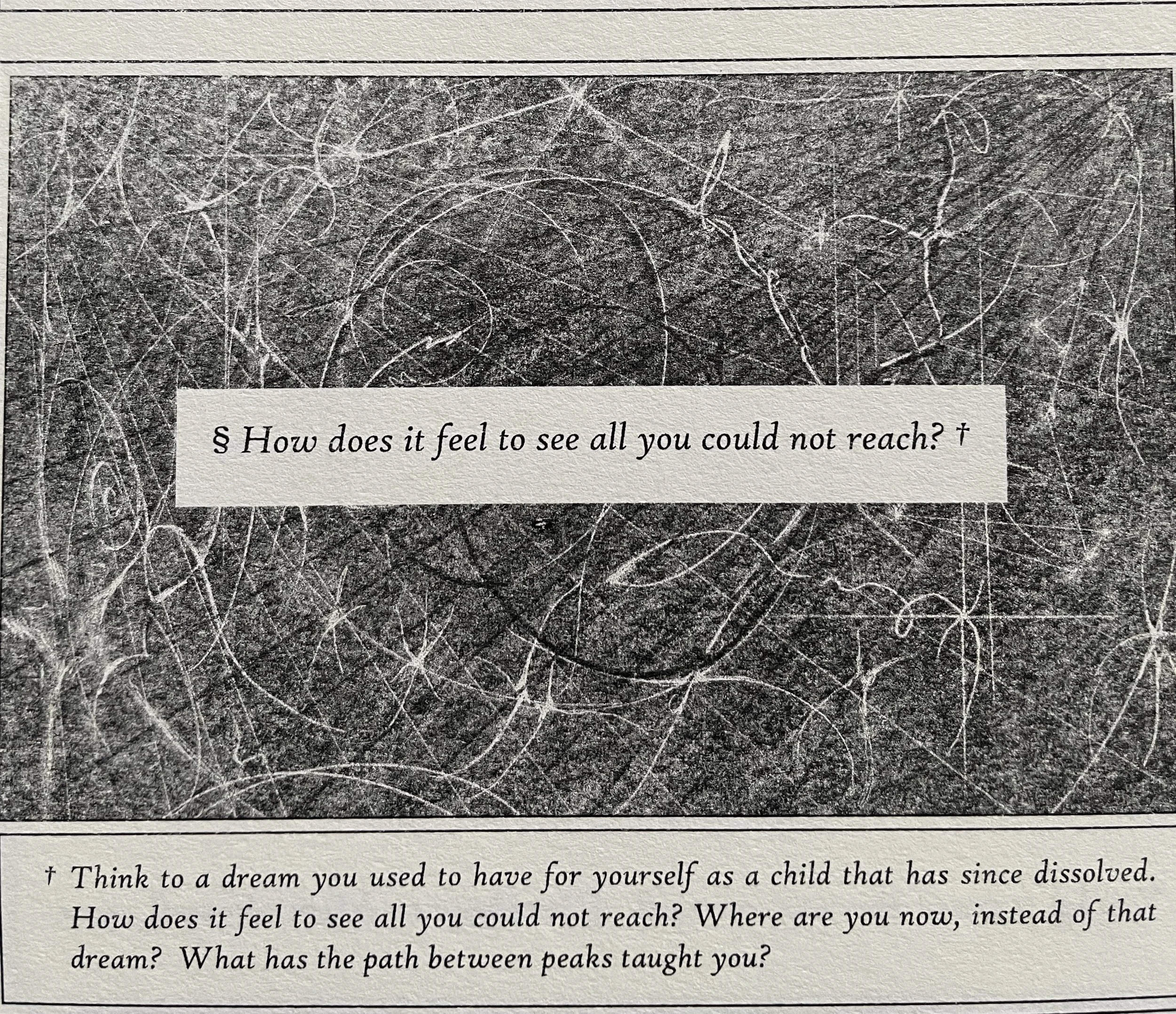
The story itself is deliberate in how it unfolds, and throughout, there are prompts, or moments where you must answer questions, or make decisions, to keep the story moving. “What is easiest for you to let slip away,” Pruzinsky asks of us, early in the game’s narrative. “Were you always aching? What is missing?”
There is a kind of “Choose Your Own Adventure” adjacent element to A Sailor’s Warning the further along into the story you get—and it is a fascinating, and unabashedly honest exercise.
And I think in mirroring the album it is intended to accompany, there is a boldness and a fearlessness that is found in A Sailor’s Warning. It does require a specific kind of confidence, or belief, or bravery, to open yourself up, and to share yourself creatively.
And I think it does continue to require that confidence or belief to, in wishing to share yourself creatively, to continue pushing—to make the ask, of yourself, to try; and to make the ask, of your audience, to come with you, and believe that they will understand.
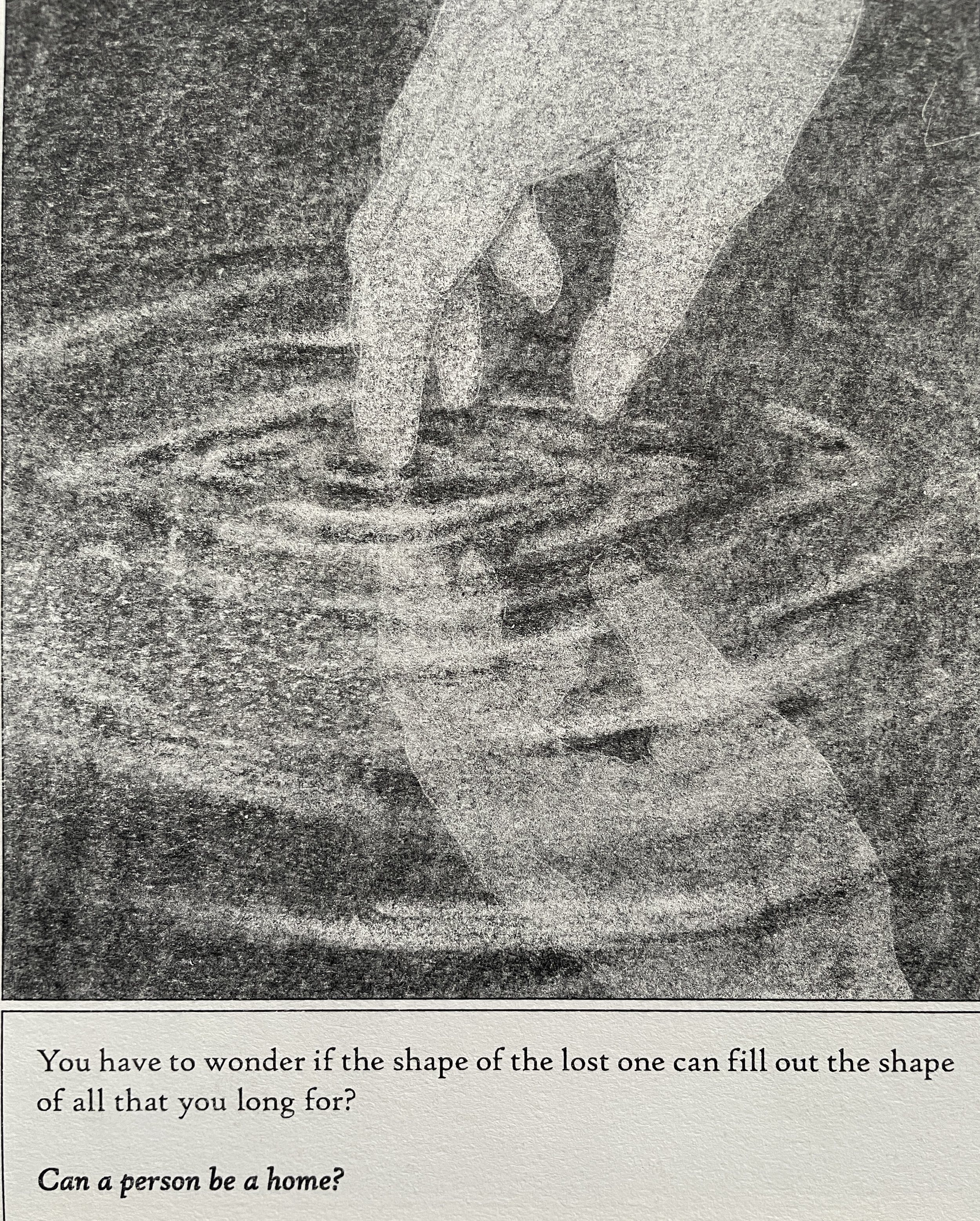
What A Sailor’s Warning asks of you, or wishes you to give consideration to, can be surprising in places—“The wound of loss is an unseen mark, one we cannot see, but that is always felt,” it states within its final pages. “What is in the half that is lost?”
“Can a person be home?,” it asks just a few pages later.
And it is commendable, and admirable, the way that Pruzinsky, as a songwriter, could extract the themes from Red Sky, and weave them into this story—all of it culminating with intensity in the final few lines of A Sailor’s Warning.
“You had grown up being told to avoid the storm, to look away from that which threatens to take. But something about this journey has introduced you to the beauty of chaos, inspiring you to witness its force. To let it guide you…or take away.”
“In the static, often loss is the first to clear a path forward.”
I think, in the end, in looking at both the album, and the companion book, as pieces to something larger, what is most admirable is simply how sharp and how ambitious of a concept it is—and how in the hands of a very capable, thoughtful artist like Hannah Pruzinsky, it never buckles under its own weight, or gets lost within itself.
We continue to try. We are always trying. Part of that is, even in the mornings, when it is almost always the worst, we continue to put in “The Work.” And that never ends. It is exhausting—and it is exhausting if you see little, if any, improvement, or benefit, to the efforts you continue to put in, day after day.
Red Sky at Morning is an enormous, bold artistic statement. And there is a warmth and an invitation throughout, but it is also an album that does ask a lot of us as listeners. It does require effort. It is about putting in “The Work.” Pruzinsky, throughout this collection of songs, is putting in that effort, and that “Work.” It can be daunting to exhume moments, or recollections from the past, while fumbling through the uncertainty of the present, and clawing towards whatever fraying threads of hope, or optimism, you believe will pull you forward.
There is a grace, though, in the fumbling, and in the clawing. And for as tense, or uneasy as Red Sky can be at times, that is an echo of our existence. The tension and the unease. How in the quiet of the morning, it can, and often does, is always the worst. But what do we do with that. How do we manage, if at all. There is a gentleness, and and an assurance, though, which is the most resonant thing the album leaves you with in its final moments. Because even though the last line of “Sailor’s Warning” seems like an accusation, or a kind of frustrated scolding, I understand that it isn’t.
Don’t you know a warning sign when you see it?
There is fear, yes. You are afraid for yourself. Someone else is afraid for you. The hope comes in the space where those things overlap.
Closer to the center.
Red Sky at Morning is available now via Mtn Laurel Recording Company; A Sailor’s Warning is available from Hannah’s Bandcamp page.
